


If someone is looking for a therapist in their area or town, good therapy SEO makes it easier for them to discover your practice and services.
In this guide, we’ll explain how therapists, counsellors, and psychologists can improve their website, strengthen local visibility, and reach more prospective clients through search as well as AI platforms like ChatGPT, Gemini, Claude, etc.
What is SEO for Therapists?
SEO for therapists is the process of improving your website and online presence so that your practice appears when potential clients search for the specific mental health services you provide.
For example, imagine you are a therapist in Austin who works with adults experiencing trauma.
SEO can help your service page appear when someone searches for “EMDR therapist for childhood trauma in Austin,” rather than only targeting a broad and highly competitive term like “therapist.”
This makes it more likely that your website will be found by someone whose needs genuinely match your expertise.
Why is SEO Important for Therapists and Counselors?
SEO is important for therapists and counselors because it helps their practices appear when people are already searching for mental health support.
Someone searching for a grief counselor in Manchester or an online therapist for social anxiety already has a specific need.
Ranking for these searches can connect your practice with clients whose location, concerns, and preferences align with the services you provide.
A strong therapy SEO strategy can also help you:
- Increase your visibility in Google Search and Maps
- Reach more relevant prospective clients
- Highlight your specialties, qualifications, and therapeutic approach
- Build trust before someone makes contact
- Rely less heavily on paid ads and third-party directories
- Generate website traffic over time
A visible, informative, and trustworthy website can help prospective clients understand whether your practice is a suitable fit for them.
What Makes SEO for Therapists Different?
Mental health is a sensitive subject, and prospective clients need to feel confident that the information they find is accurate, trustworthy, and provided by a qualified professional.
Therapy websites must therefore balance search visibility with professional credibility, client privacy, and the personal nature of choosing a therapist.
Mental Health is a High-Trust Topic
Google considers information that could affect a person’s health or wellbeing to be a Your Money or Your Life (YMYL) topic. Mental health content falls into this category because misleading or inaccurate advice could cause genuine harm.
A therapist’s website should clearly demonstrate experience, expertise, authority, and trust. This can include:
- Displaying the therapist’s qualifications, licences, and professional registrations
- Publishing detailed therapist biographies
- Naming the qualified author or reviewer of mental health content
- Supporting health-related claims with reliable sources
- Explaining services and therapeutic approaches accurately
- Keeping important information up to date
- Providing clear contact, privacy, and practice details
For example, a blog post about managing panic attacks should identify the qualified professional who wrote or reviewed it and reference trustworthy sources.
Privacy and Ethical Marketing Requirements
Therapists also need to consider confidentiality, privacy, and professional ethics when promoting their services online.
Marketing content should be truthful, respectful, and free from guarantees such as “cure your anxiety” or “overcome trauma in five sessions.”
Reviews and testimonials require particular care.
Depending on the therapist’s location and professional body, requesting or publishing client testimonials may be restricted or discouraged.
Therapists should never pressure clients to reveal that they received treatment or respond to a public review in a way that confirms a therapeutic relationship.
Choosing a Therapist is Highly Personal
Finding a therapist is different from choosing an ordinary local service provider.
New clients are not only comparing prices; they are trying to determine whether they will feel understood, respected, and comfortable speaking openly with a particular person.
A therapist’s website should therefore help visitors evaluate personal and practical fit. It should clearly explain:
- Who the therapist works with
- Which concerns and conditions they support
- Their therapeutic approach
- Their qualifications and experience
- Whether sessions are online, in person, or both
- Where they are located or licensed to practise
- Their fees, insurance options, and availability
This is why effective therapist SEO should focus on relevance rather than trying to attract the largest possible audience.
Now let’s take a closer look at some of the therapist SEO tactics you can use to improve your practice’s organic rankings.
1. Audit Your Current Therapist Website
Before creating new pages or targeting new keywords, you need to understand how well your current website is optimized for search engines.
An SEO audit looks at the technical, on-page, and usability factors that could affect your visibility. It can reveal problems that are easy to overlook, such as:
- Missing or poorly written title tags and meta descriptions
- Pages without a clear H1 heading
- Slow loading speeds
- A poor mobile experience
- Images without descriptive alt text
- Pages that search engines cannot crawl or index
Therapists can get started by running their website through SEOptimer’s Free SEO Audit Tool.
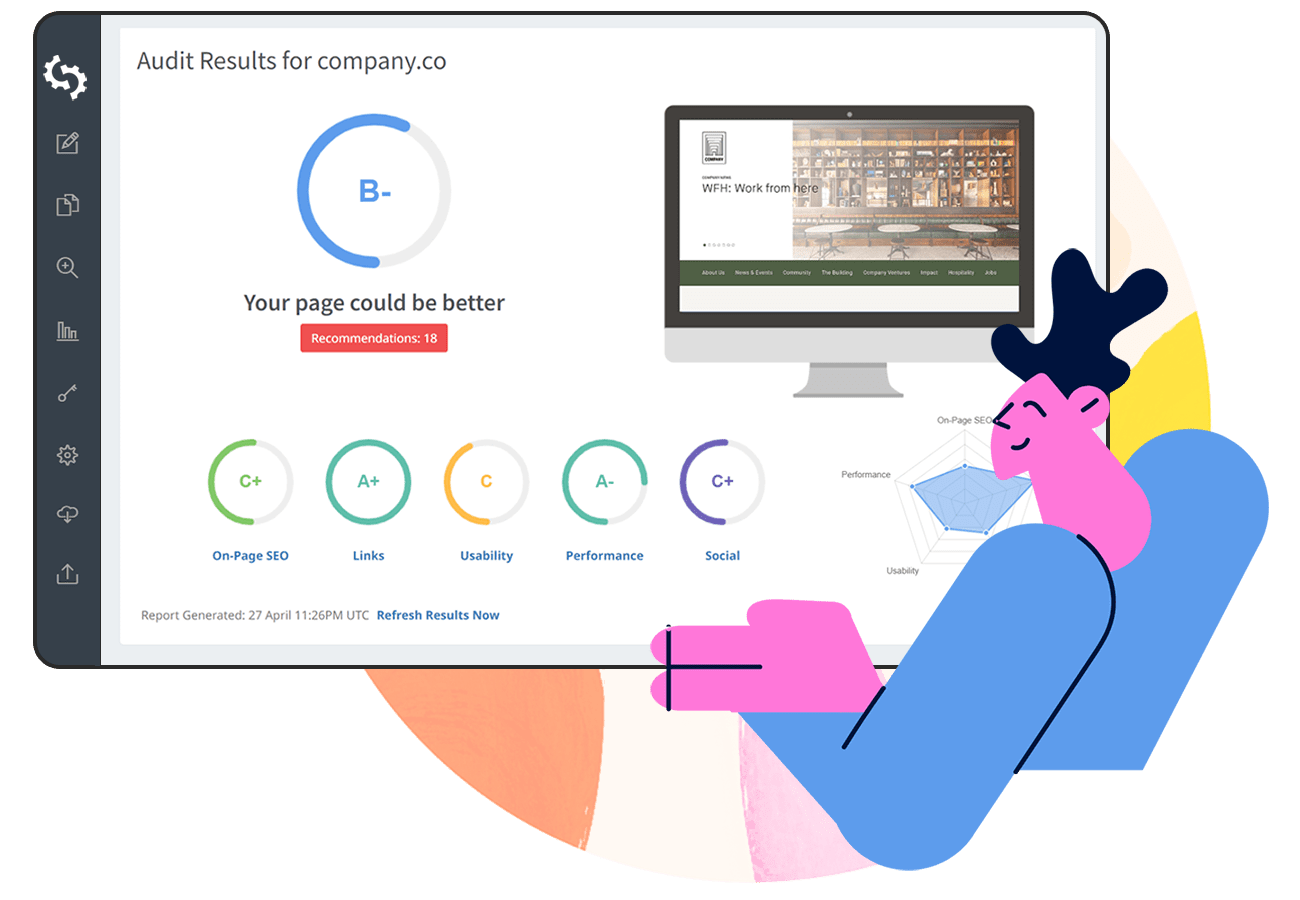
Simply enter your website address to receive an overall SEO grade and a detailed report covering areas such as on-page SEO, links, performance, mobile usability, and social profiles.
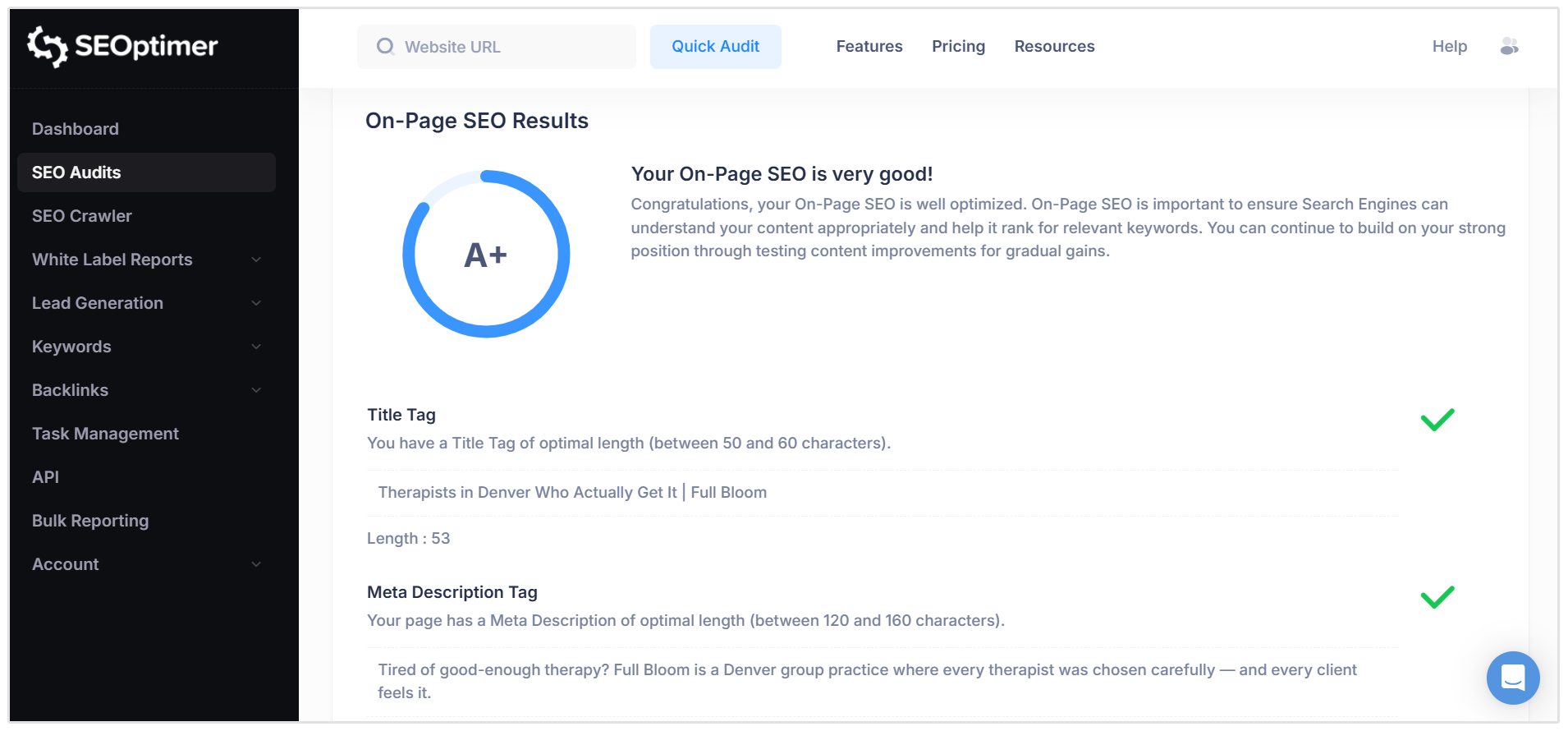
The report also identifies what your website is doing well and which issues deserve attention.
For therapists who want to manage their SEO on an ongoing basis, our DIY SEO Tool provides a more comprehensive solution. It crawls your entire website, identifies problems across its pages, and creates a prioritized list of clear SEO tasks.
Each task includes practical guidance specific to your website, so you do not need to be an SEO expert or developer to start making improvements.
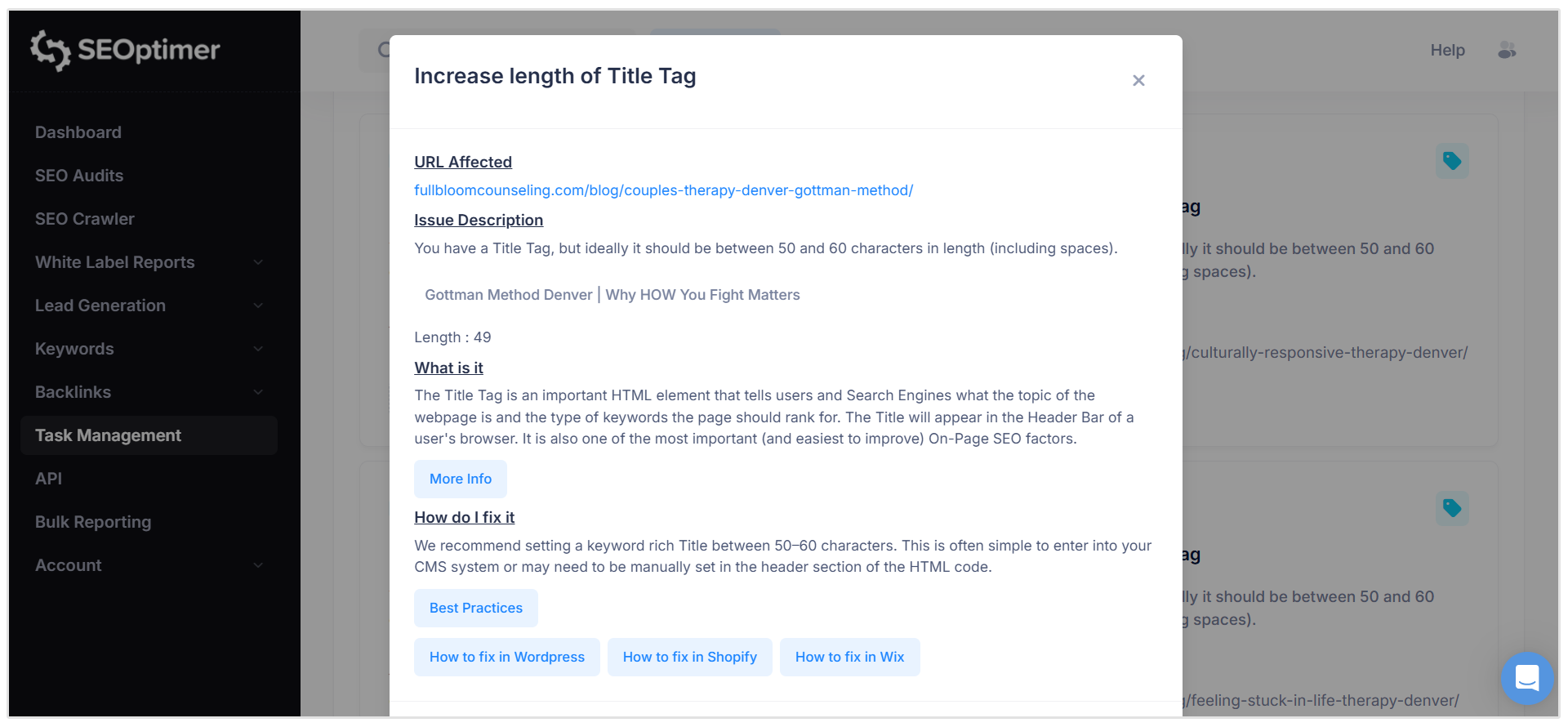
The DIY SEO toolkit can also help you research keywords, monitor your search rankings, analyze competitors, and track backlinks.
All these features make it a useful option for independent therapists and practices that want to improve their online visibility without immediately outsourcing everything to an SEO agency.
2. Find the Right SEO Keywords for Your Practice
SEO keywords are the words and phrases people use when searching for therapists, counselors, and mental health services. The right keywords should reflect what you offer, whom you support, and where you practise.
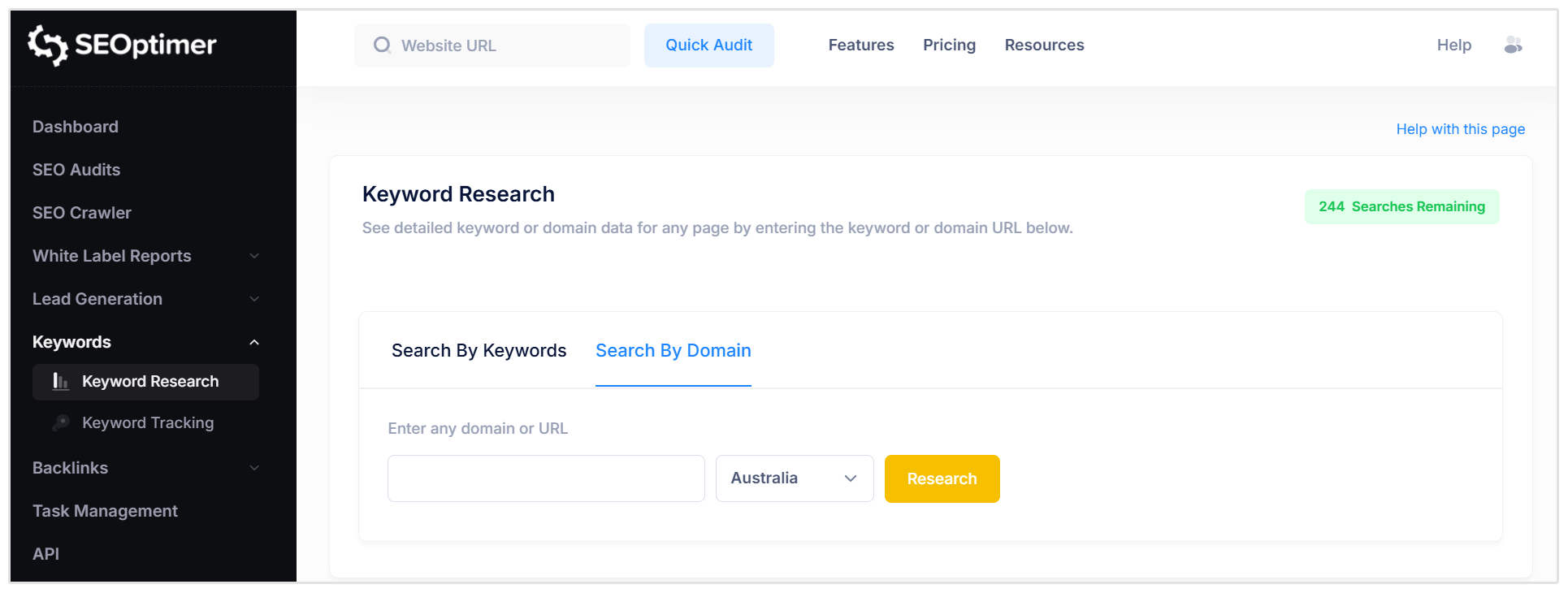
Our Keyword Research Tool can help you find relevant search terms and compare their monthly search volume, competition, and estimated cost per click.
You can also use the Search by Domain option to discover which keywords competing therapy practices already rank for.
Start with the Services You Provide
Begin with the main services offered by your practice. These keywords will usually be assigned to your homepage and individual service pages.
Examples include:
- Individual therapy
- Couples counseling
- Family therapy
- Anxiety counseling
- Trauma therapy
- Grief counseling
- Online therapy
Each major service should ideally have its own useful page. (more on this later)
A therapist offering couples counseling and trauma therapy, for example, would have a better chance of ranking with separate, detailed pages than with one general page listing both services in a few sentences.
Target Local Therapist Keywords
Most people searching for in-person therapy want to find someone nearby. Local SEO for therapists therefore relies on keywords that combine a service or professional title with a city, suburb, or region.
Examples of local therapy keywords include:
- Therapist in Austin
- Counselor in Manchester
- Couples counseling in Brooklyn
- Child therapist Brisbane
- Trauma therapist in Cape Town
You can use these terms naturally on your homepage, service pages, location pages, title tags, and Google Business Profile.
Target Specialty and Client-Need Keywords
People often search according to the specific concern they are experiencing rather than the type of therapy they need.
These longer and more specific searches may have lower search volumes, but they can connect your practice with people whose needs closely match your expertise.
Examples of these long-tail therapy keywords include:
- Therapist for workplace anxiety
- Grief counselor for young adults
- Trauma therapist for childhood abuse
- Couples counselor for communication problems
- Therapist for postpartum anxiety
- Counseling for university students
Include Modality-Based Keywords
Some clients search for a particular therapeutic method, especially when it has been recommended by another healthcare professional or they have used it before.
Relevant searches might include:
- CBT therapist in Chicago
- EMDR therapy near me
- ACT therapist for anxiety
- Psychodynamic therapy in London
- Solution-focused counselor
- Online DBT therapy
If a modality is central to your practice, create a dedicated page explaining what it is, who it may be suitable for, and how you use it.
Avoid targeting every popular therapy approach simply to attract traffic; the content should represent services you are properly trained and qualified to provide.
Once you have collected your keywords, assign one primary topic to each page. This creates a clearer website structure and prevents several pages from competing for the same search term.
3. Create a Separate Page for Each Core Service
A therapy website should give every core service its own dedicated page.
This helps search engines understand what you offer and gives prospective clients more useful information than a single page containing a short list of services.
For example, a therapist offering several services could use the following structure:
- /services/
- /services/anxiety-therapy/
- /services/trauma-therapy/
- /services/couples-counseling/
- /services/grief-counseling/
Link these individual pages from a central Services page, as well as from relevant blog posts and therapist profiles. This creates a clear structure that visitors and search engines can follow.
A great example of this can be seen on Full Bloom Counseling Group's website. You can clearly see all the services they offer and each has it's own dedicated landing page.

Important: Avoid creating separate pages for small keyword variations that describe the same service. For instance, “anxiety therapy” and “anxiety counseling” can usually be covered on one strong page instead of two nearly identical ones competing in search results.
4. Optimize Each Page for Its Target Keyword
Next, we have to use the keywords we found in step 2.
Once you have assigned a target keyword to a page, use it in the places that help search engines and visitors understand the page’s topic.
Include the primary keyword naturally in:
- The page title
- The H1 heading
- The URL
- The opening paragraph
- One or more relevant subheadings
- The meta description
- Image alt text, where it accurately describes the image
- Internal links pointing to the page
For example, a service page targeting “anxiety therapist in Austin” could use the following elements:
- Page title: Anxiety Therapist in Austin | Practice Name
- H1: Anxiety Therapy in Austin
- URL: /anxiety-therapy-austin/
- Meta description: Learn about anxiety therapy in Austin, our therapeutic approach, and how to request your first appointment.
The page’s main content should then answer the questions someone searching for this service is likely to have.
Explain who the service is for, the concerns you work with, your approach to therapy, what sessions may involve, and how to get started.
You can also use closely related terms (also known as secondary keywords). In the case of our anxiety therapist in Autin, this would include terms like “anxiety counseling,” “support for anxiety,” and “therapy for anxiety” where they fit naturally.
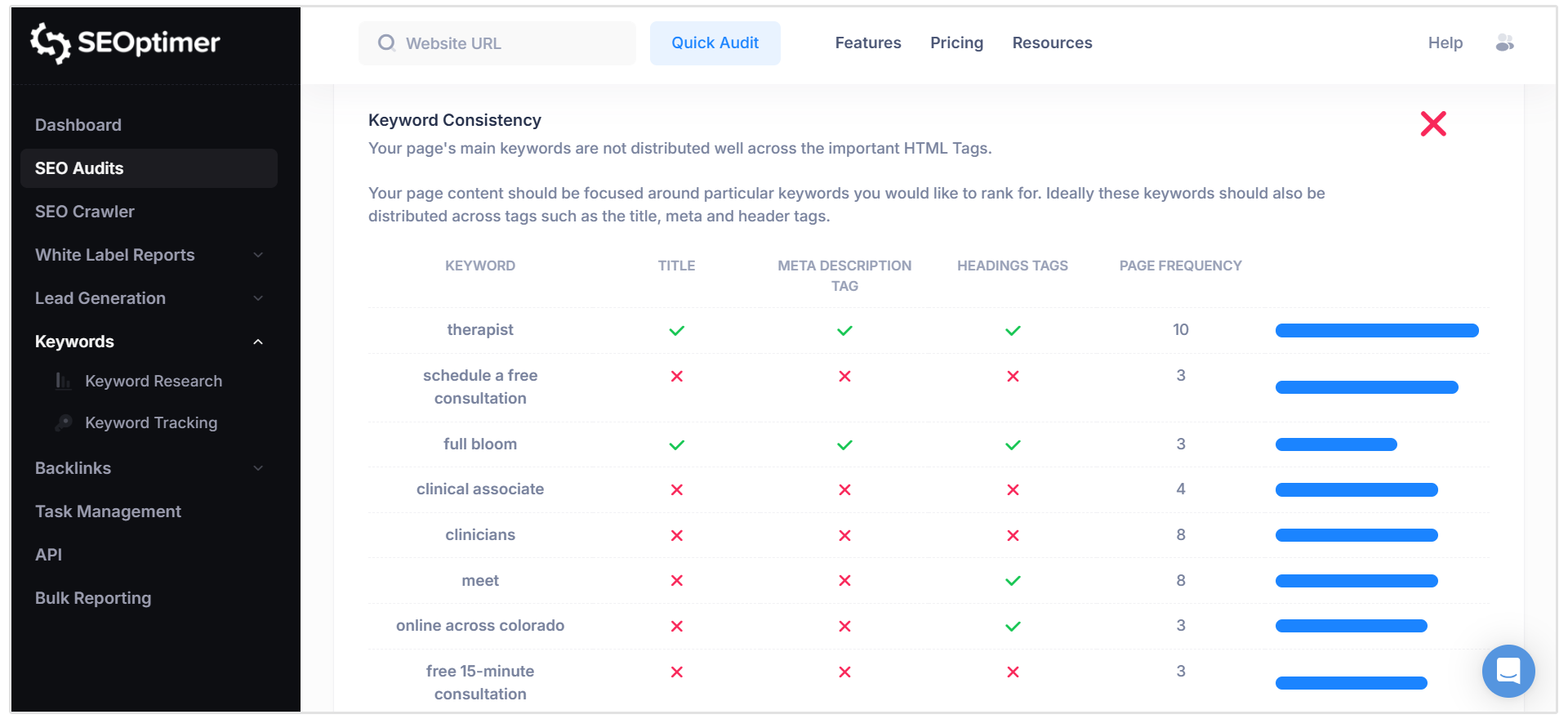
You can verify that you are using keywords in all the right places with SEOptimer. Each site audit includes a Keyword Consistency check which looks at the distribution of your most important keywords across all the places we just discussed above.
5. Improve Your Website’s Technical SEO
Technical SEO helps search engines access, understand, and index your website. It also affects the experience people have when visiting your site, especially on mobile devices.
Start by checking that your website:
- Loads quickly
- Works properly on smartphones and tablets
- Uses HTTPS
- Has a valid XML sitemap
- Does not block important pages from being crawled by search engines or AI bots
- Contains no broken links or unnecessary redirects
- Uses clear and readable URLs
- Has properly optimized images
- Meets important Core Web Vitals standards
Even if you have the best information on your trauma therapy page, it will struggle to perform if Google or AI crawlers cannot index it.
SEOptimer includes technical SEO checks in every website audit, making it easier to identify issues related to performance, mobile usability, security, indexing, and other technical elements.
Users on any SEOptimer paid plan can also access the SEO Crawler, which scans an entire website instead of checking only one page.
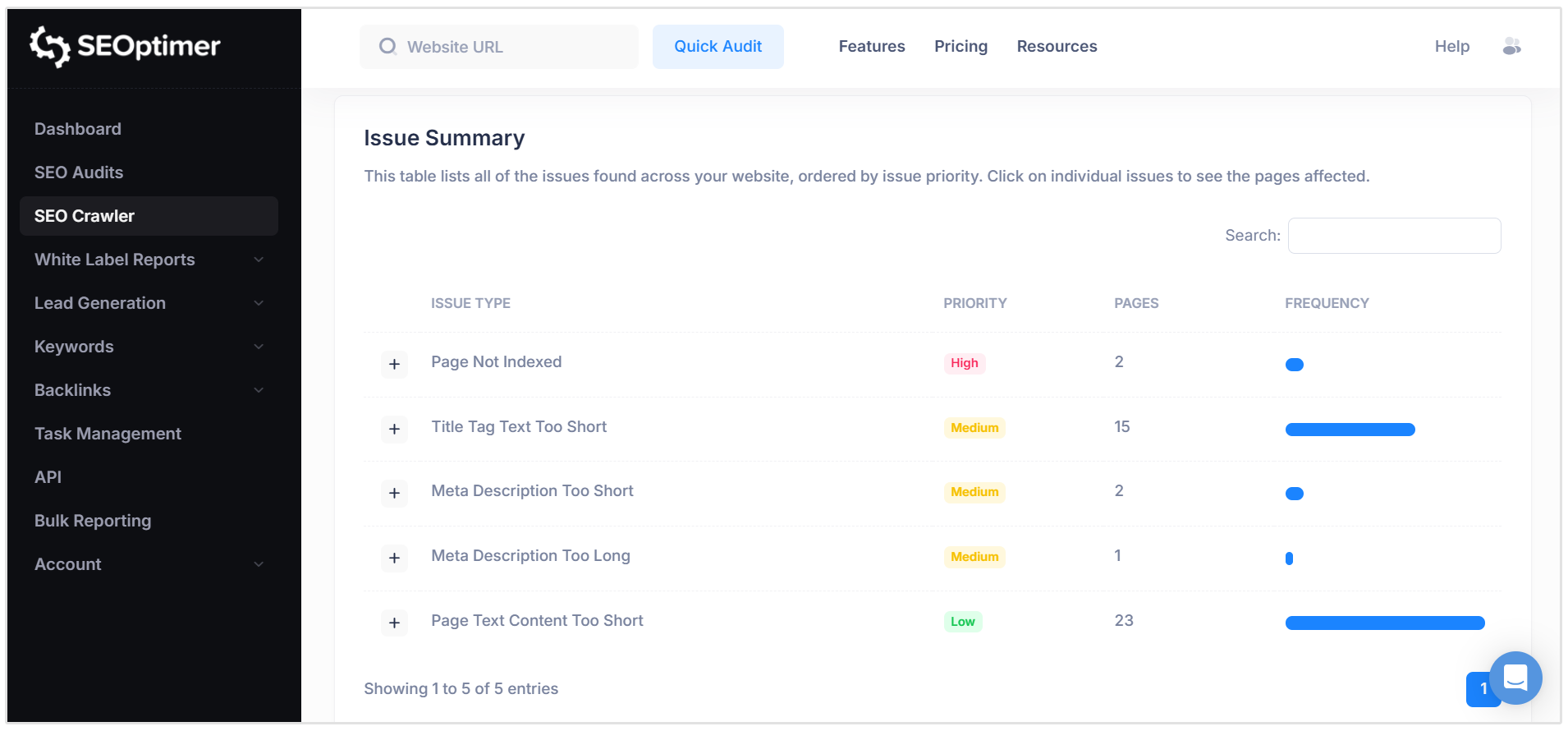
It can help therapists find site-wide problems such as broken links, missing metadata, duplicate content, and pages that may be difficult for search engines to crawl.
The SEO Crawler feature is very handy as your practice adds more service pages, therapist profiles, locations, and blog content over time.
6. Add Relevant Schema Markup
Schema markup gives search engines and AI crawlers extra context about your practice and the information on your website.
For example, schema can help Google understand that a name on your About page belongs to a qualified therapist or that the address shown on your Contact page is the location of your practice.
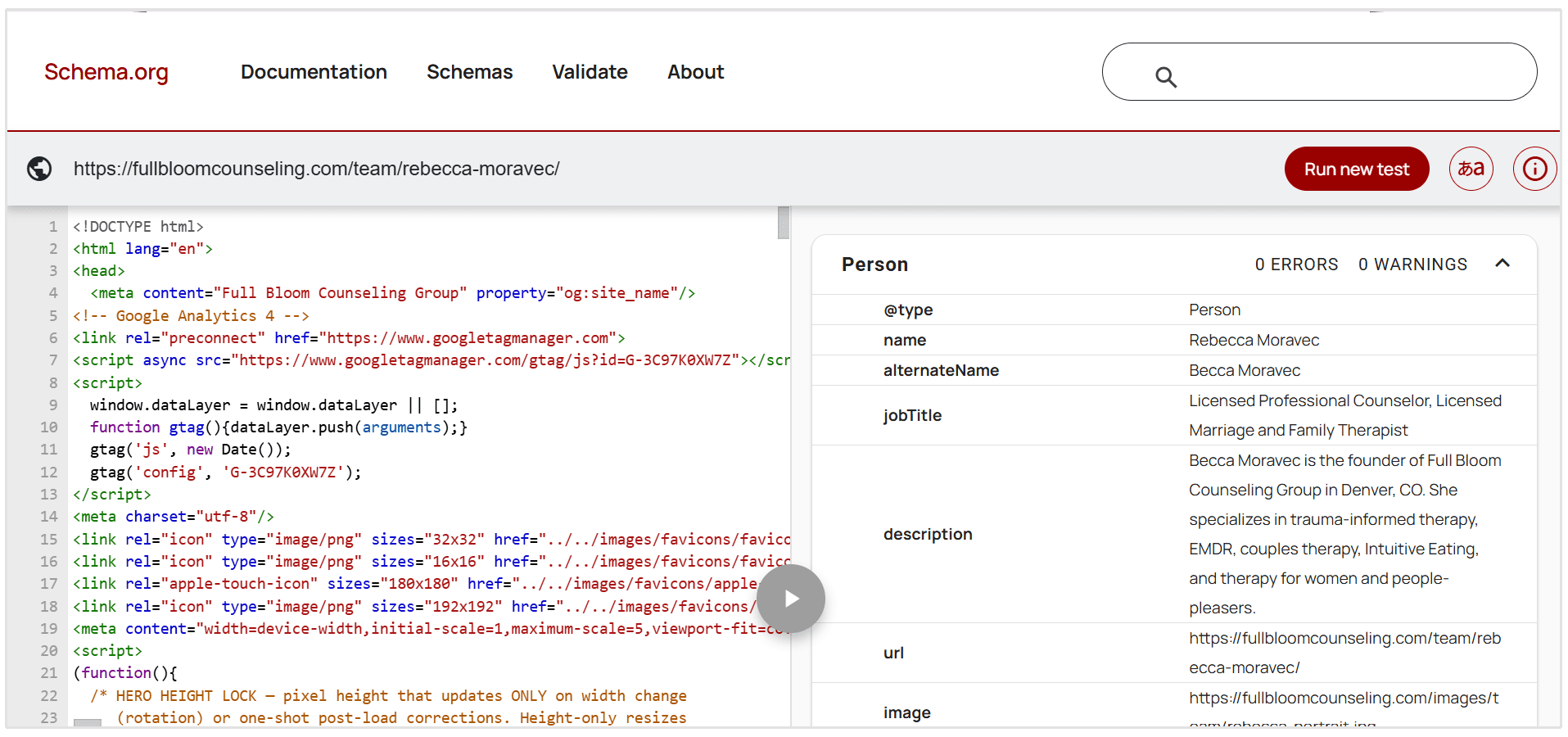
Let's take the example of Full Bloom Counseling again. They have "bio pages" for each of their therapists. (see the below example)

If we take the page's URL and run it through a Schema Validator tool, we can see that it uses the Person schema. This gives Google and AI tools more concrete structured data about the therapist, her education, areas of focus, etc.
The most relevant schema types for a therapist’s website may include:
- LocalBusiness for information about the practice
- Person for individual therapist profiles and credentials
- Service for the different therapy services offered
- Article for educational blog content
- BreadcrumbList to explain the structure of the website
Many website platforms and SEO plugins can generate basic schema without requiring you to write the code yourself.
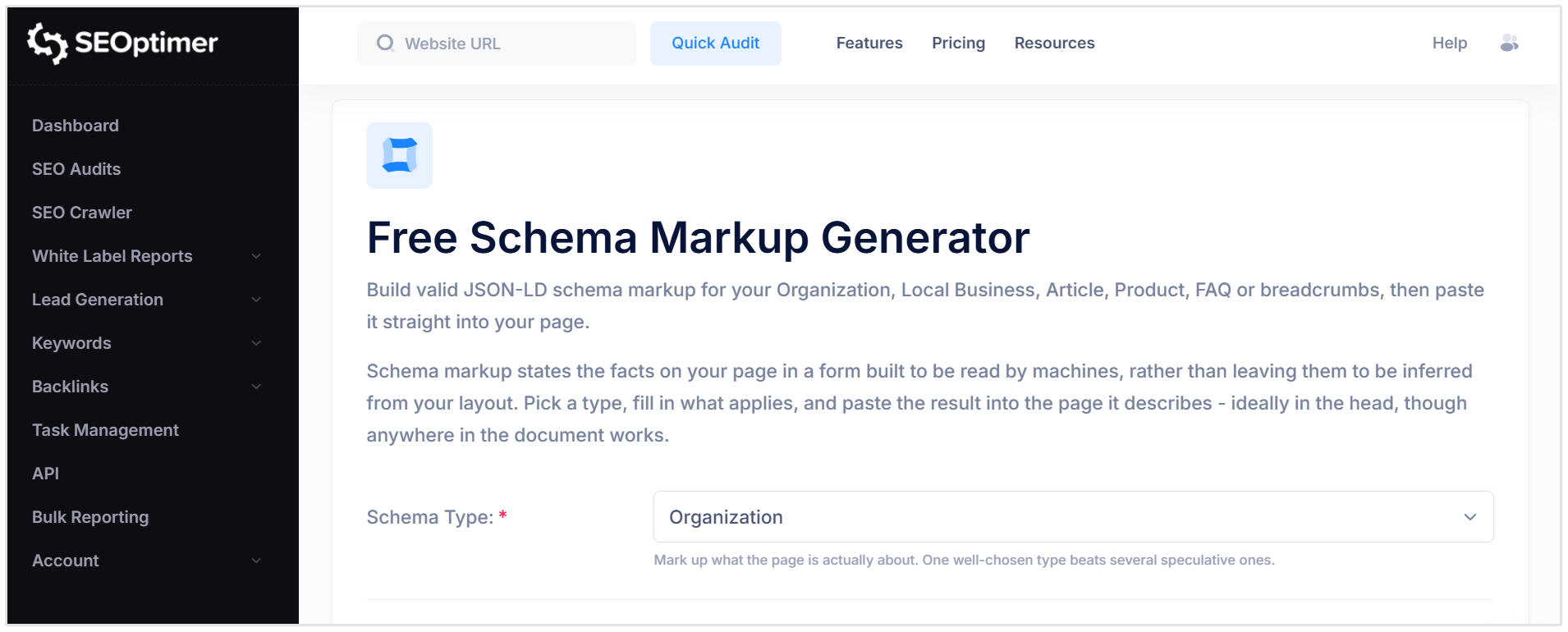
SEOptimer has a completely free Schema Markup Generator that will generate Organization, Local Business, Person, Article, Product, FAQ Page, and Breadcrumbs schema that you can add to your website.
7. Claim and Complete Your Google Business Profile
A Google Business Profile (GBP) is the free listing that controls how your practice appears across Google Search and Google Maps.
It can display your address, phone number, opening hours, website, services, photos, reviews, and appointment link before someone even visits your website.
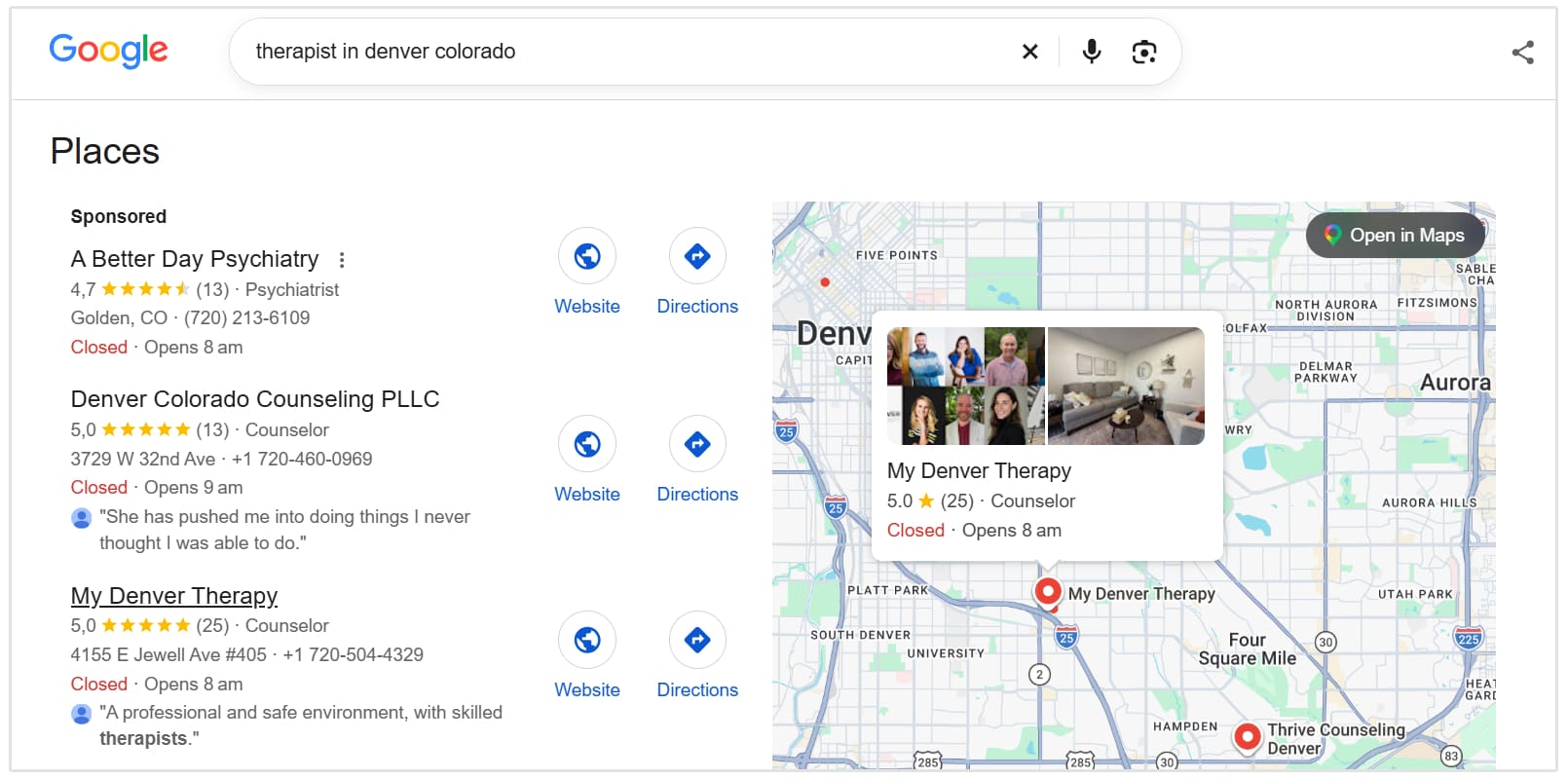
For therapists serving clients from a physical location, a GBP is an essential part of local SEO.
It gives your practice the opportunity to appear in the map results for searches such as “therapist near me” or “couples counselor in Manchester.”
The profile also influences how prospective clients perceive your practice.
Research cited by Google found that customers are 2.7 times more likely to consider a business reputable when they find a complete Business Profile. Google also says complete and accurate information makes businesses more likely to appear in relevant local searches.
Google determines these results mainly through relevance, distance, and prominence.
An optimized Google Business Profile should include:
- Your correct practice name, address, and phone number
- Accurate opening and appointment hours
- Your website and direct booking link
- The most appropriate primary and secondary categories
- A clear description of your practice
- Individual therapy services with brief descriptions
- Recent, professional photos of the therapist and practice
- Relevant accessibility and appointment information
- Regularly updated business information
- Professional responses to reviews where ethically appropriate
Make sure the information matches what appears on your website and other online directories.
It is also worth noting that an online-only therapist may not qualify for a Google Business Profile unless they meet Google’s eligibility requirements for in-person contact with clients. Don’t create a false address simply to appear in another location.
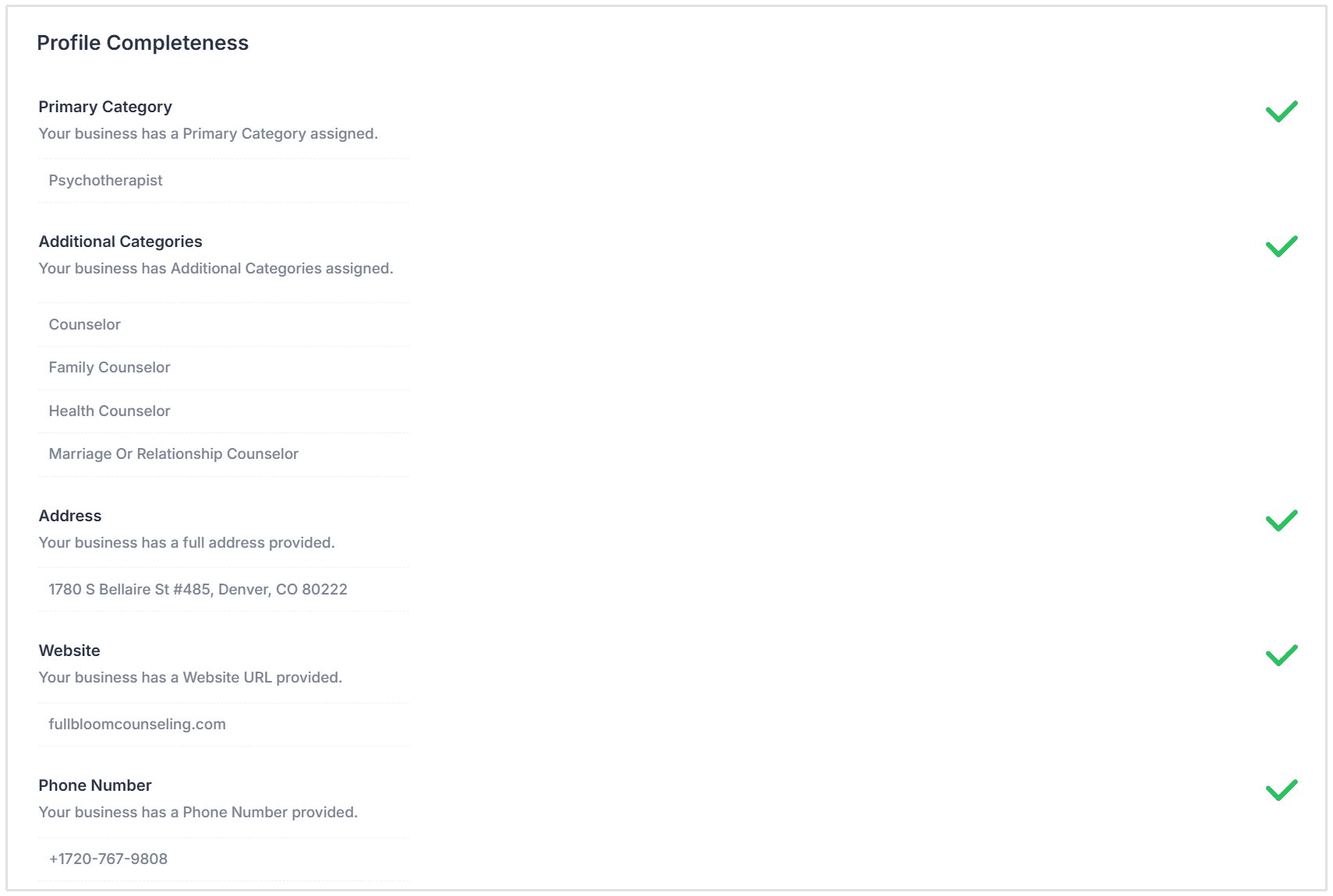
Once your profile is live, use SEOptimer’s Google Business Profile Audit Tool to check how well it is optimized.
The GBP audit reviews the profile against important local SEO factors and highlights missing or incomplete information, giving you a clear starting point for improving your practice’s visibility in local search.
8. Keep Your NAP Information Consistent
NAP stands for your practice’s Name, Address, and Phone number.
These details should remain consistent wherever your practice appears online, including your:
- Website
- Google Business Profile
- Therapist directories
- Professional association profiles
- Social media pages
- Local business directories
Consistent NAP information helps Google verify that these listings belong to the same practice.

If one directory shows an old address while your website displays a new one, search engines and prospective clients may not know which information is correct.
This can weaken trust and potentially affect your local search visibility.
For example, avoid listing your practice as “Austin Anxiety Therapy” on Google, “Austin Anxiety Therapy Centre” on your website, and “AAT Clinic” in a professional directory unless these are genuine, established business names.
Use the same official practice name, current address, and primary phone number across your listings.
Whenever your practice moves, changes its phone number, or rebrands, update all major listings as soon as possible.
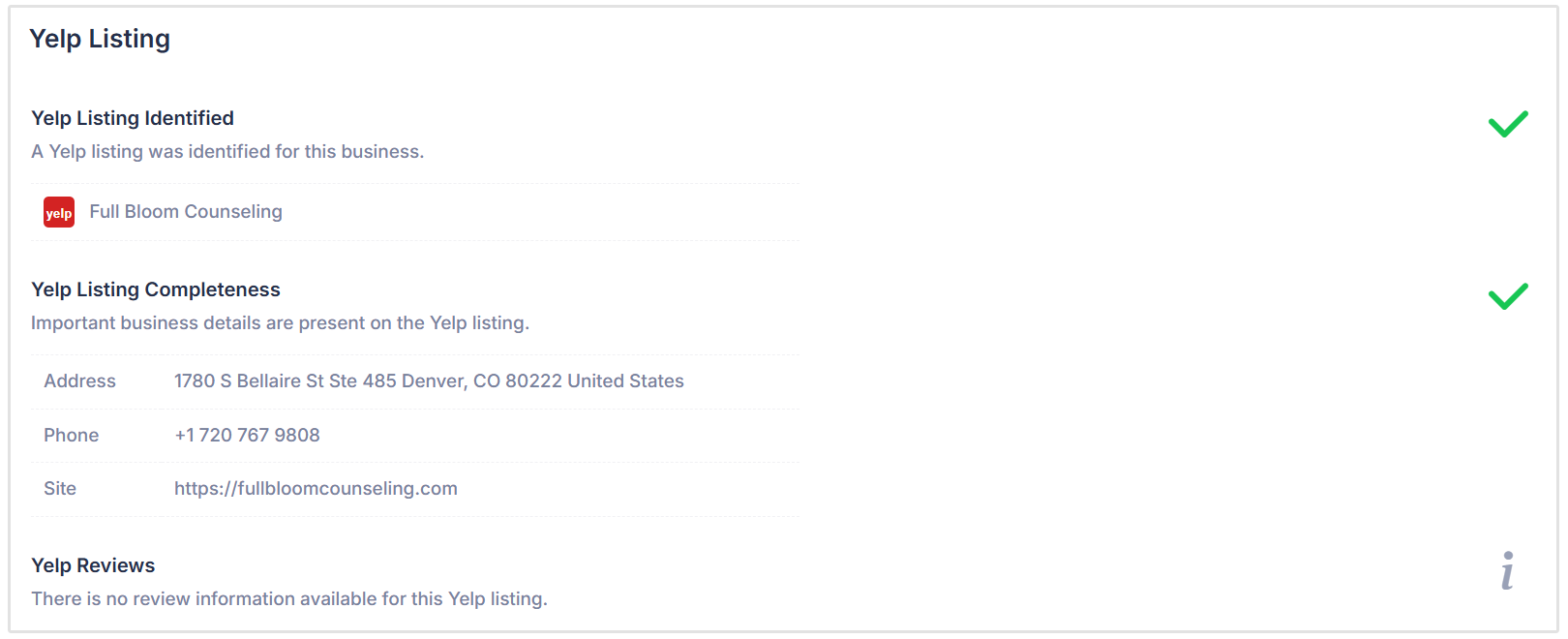
You can use our Local SEO Audit Tool to check your practice’s citations across the web. The audit identifies whether your business details are consistent and highlights listings that may be incomplete or fail to meet important local SEO guidelines.
9. List Your Practice in Relevant Directories
Therapist directories can help prospective clients discover your practice while also creating consistent business citations across the web.
Some listings may provide a backlink to your website, but their biggest value is often direct visibility among people already searching for mental health support.
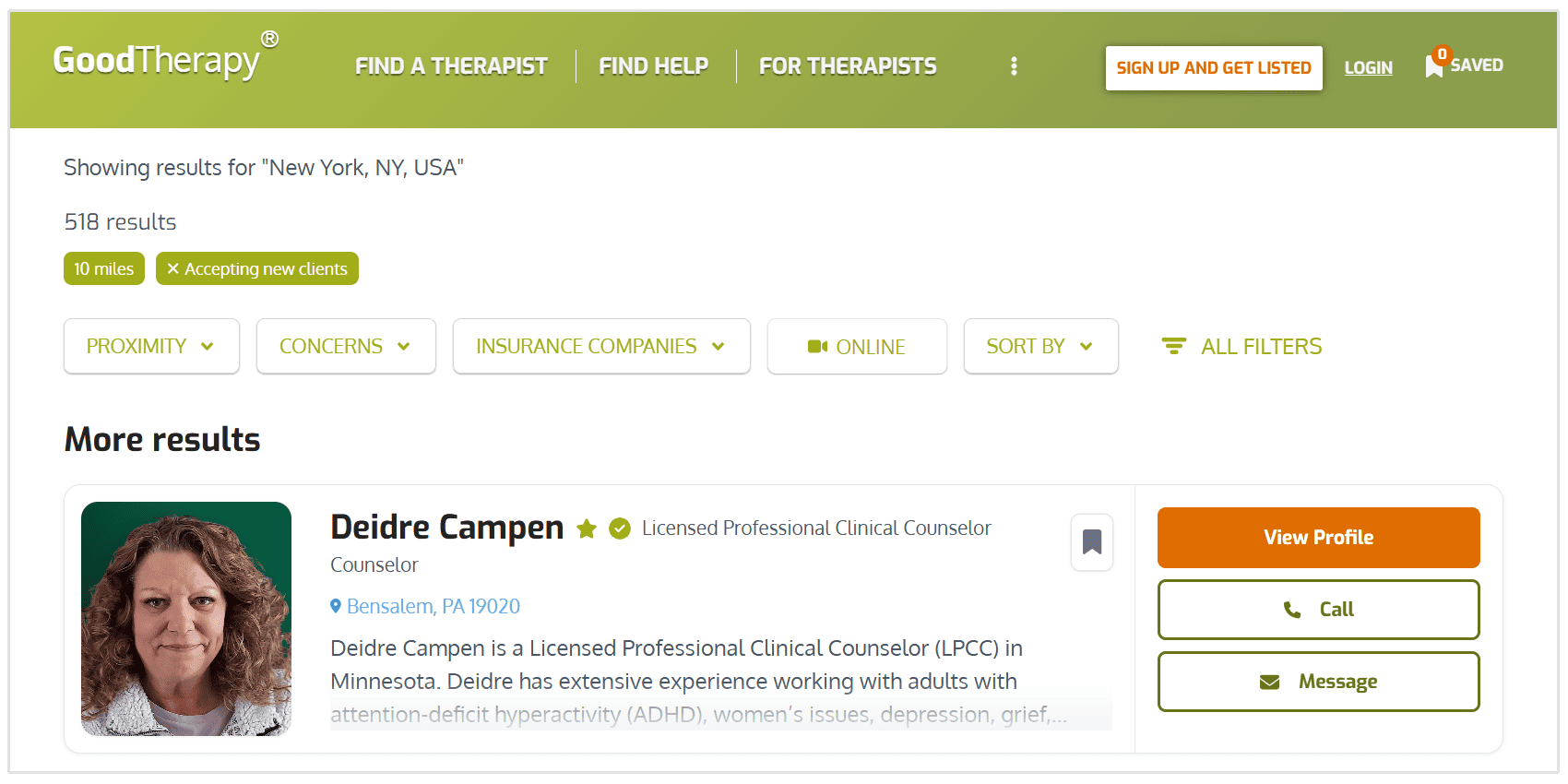
Relevant directories include:
- Psychology Today: lists therapists, counselors, and psychologists across multiple countries
- GoodTherapy: a directory of licensed therapists and counselors
- TherapyDen: an inclusive directory for mental health professionals
- APA Psychologist Locator: available to licensed American Psychological Association members
- BACP Therapist Directory: for eligible counselors and psychotherapists in the UK
- Local licensing boards, professional associations, insurance networks, and reputable healthcare directories
Choose directories that are trusted, relevant to your profession, and commonly used in the country or region you serve.
A listing on a recognized professional association’s website is generally more valuable than submitting your details to dozens of unrelated business directories.
Complete each profile with accurate contact information, qualifications, specialties, locations, and a link to the most relevant page on your website. Most importantly, keep your practice name, address, and phone number consistent across every listing.
10. Publish Helpful Mental Health Content
Publishing useful content allows you to answer the questions prospective clients are already searching for.
It can also help Google understand your areas of expertise and create more opportunities for your website to appear beyond its main service pages.
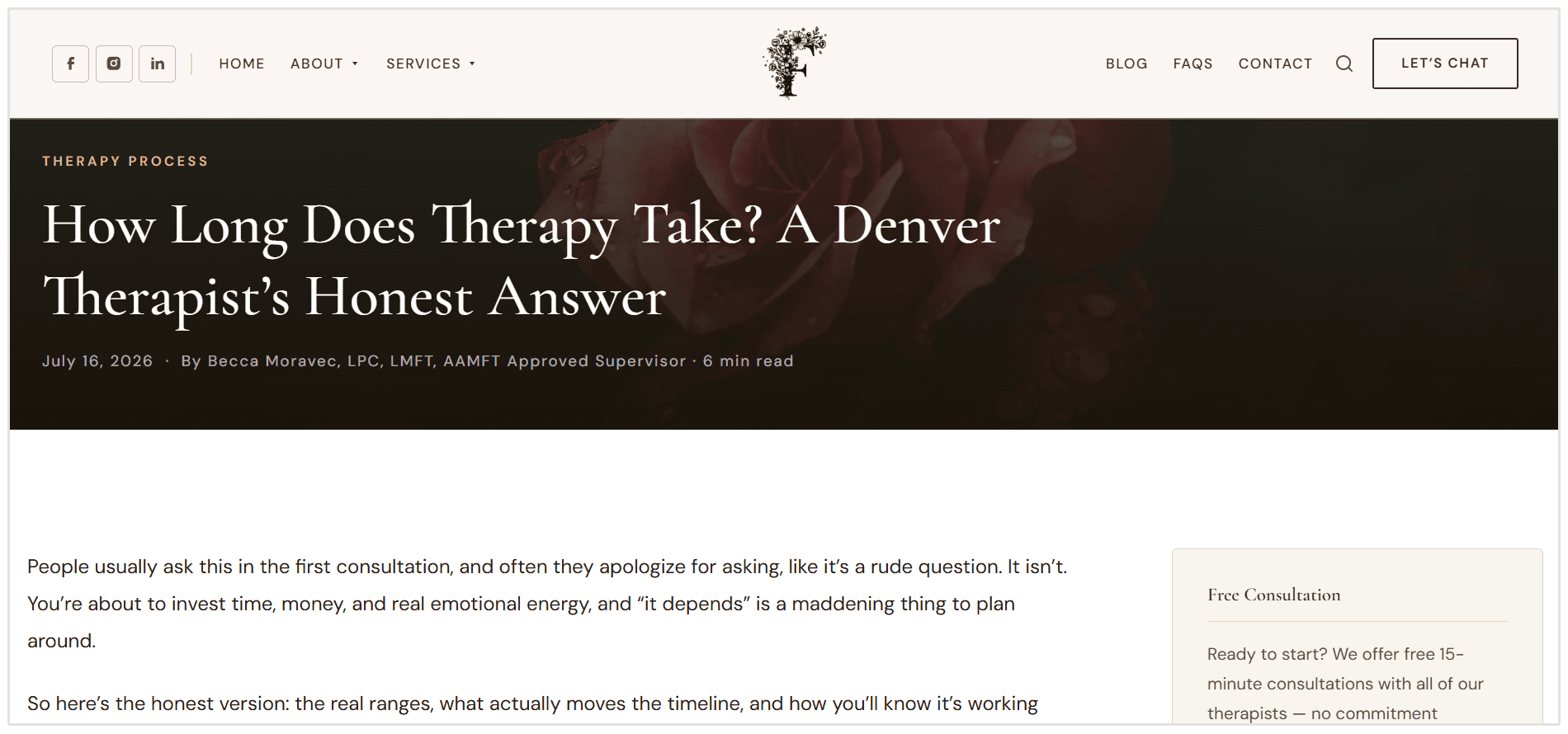
As we mentioned at the start, mental health content falls under Google’s Your Money or Your Life (YMYL) category because inaccurate information could affect a person’s health or wellbeing.
Therapists will already understand the importance of communicating responsibly, but those same professional standards should extend to every blog post published online.
Avoid diagnosing readers, making treatment guarantees, exaggerating outcomes, or presenting general information as personalized clinical advice.
11. Demonstrate Experience, Expertise, Authority, and Trust
Because mental health is a high-trust topic, your website should make it easy for clients and search engines to verify who you are and why your information is credible.
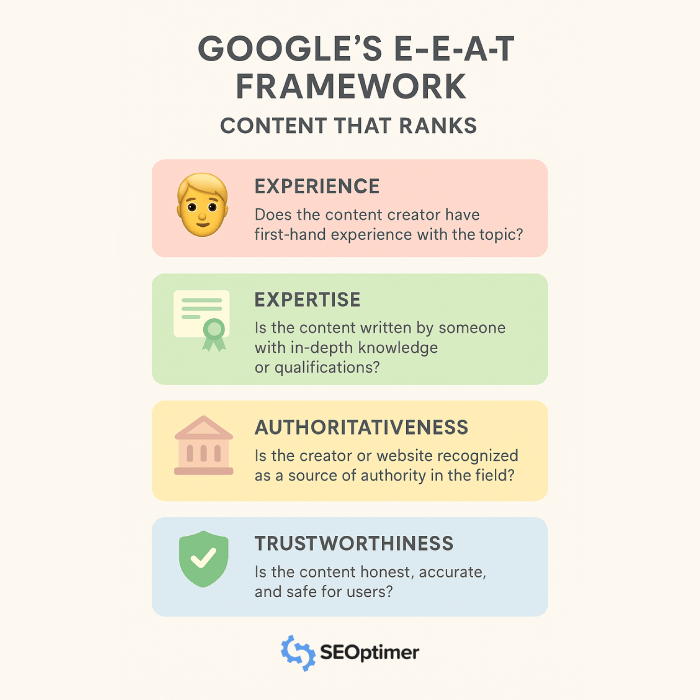
You can strengthen your website’s E-E-A-T signals by including:
- Detailed therapist biographies
- Qualifications, licences, and professional registrations
- Relevant clinical experience and areas of specialization
- Professional association memberships
- Named authors and reviewers on mental health content
- References to reliable sources
- Accurate contact and practice information
- Clear privacy, editorial, and website policies
- Secure forms and HTTPS
- Honest descriptions of services without guaranteed outcomes
For example, instead of placing “Written by Practice Name” above a blog post, identify the therapist who wrote or reviewed it and link to a profile showing their credentials and relevant experience.
A great example of this can be found on Full Bloom Counseling's blogs. As you can see in the below screenshot, they have detailed author bios at the end of each blog post with a link to view the full author bio.
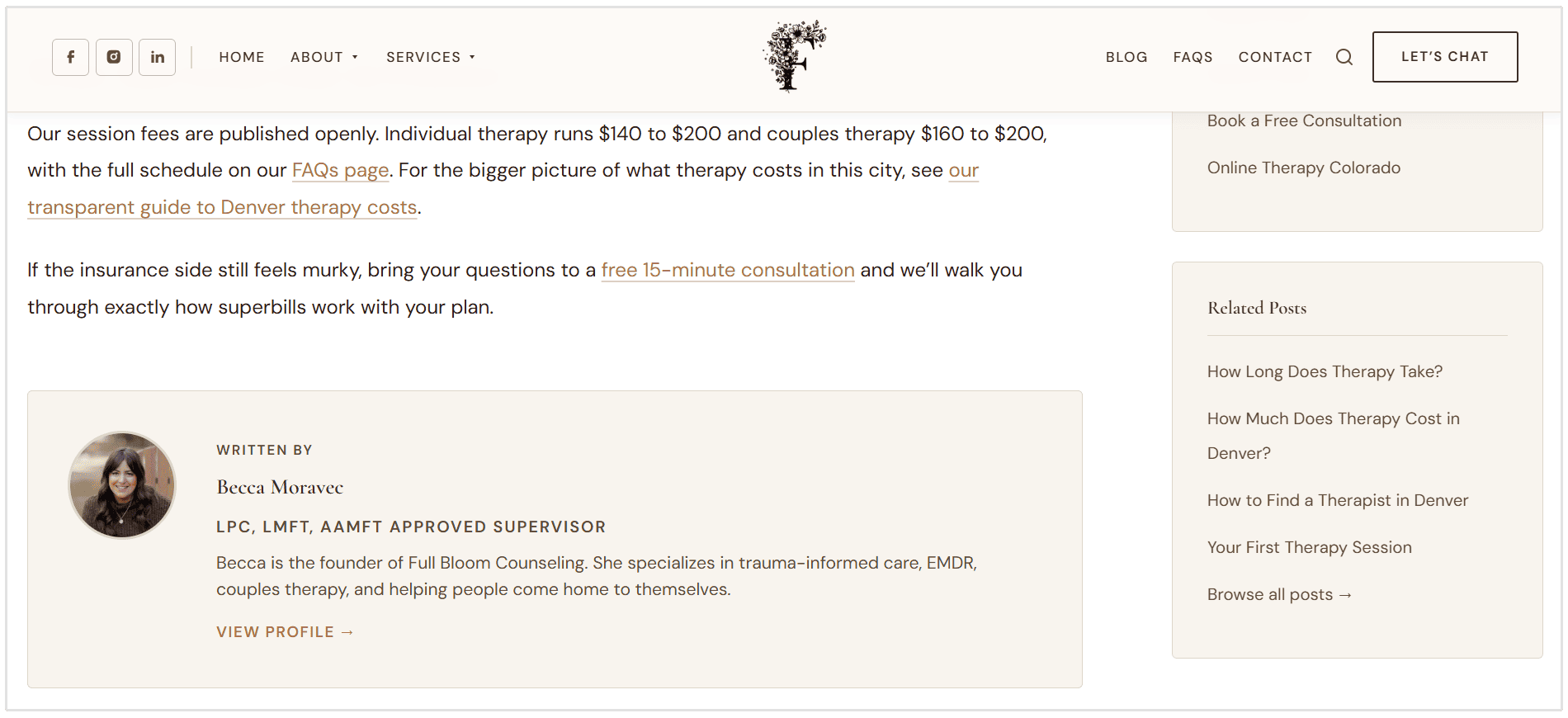
These details are not there to just impress Google. They help clients determine whether your practice is legitimate, qualified, and suitable for their needs before making contact.
12. Build Relevant Backlinks and Professional Mentions
A backlink is a link from another website to your own. For example, if a professional counseling association lists your practice and links to your website, that link counts as a backlink.
Backlinks are important because they help search engines discover your pages and can indicate that other websites consider your practice or content credible. They can also send referral traffic directly to your website.
However, quality matters far more than quantity when it comes to backlinks and building a strong backlink profile. One link from a respected professional association or reputable mental health publication is more valuable than dozens of links from unrelated directories.
You can also build professional mentions by contributing useful insights to articles or participating in community initiatives, even when the mention does not include a link.
These references can still strengthen your practice’s visibility and reputation online, as well as in generative AI tools.

13. Bonus Step: Optimizing for AI Search Engines (ChatGPT, Gemini, Claude & Perplexity)
The good news is that if you follow the steps outlined above you are already doing most of the heavy lifting required for AI search engine visibility (also known as Generative Engine Optimization or GEO).
Generative AI models do not search the web the same way traditional search engines do.
Instead of simply matching keywords, they crawl trusted web sources, synthesize information, and recommend local providers based on multi-criteria prompt matching.
To give your therapy practice an extra advantage in AI recommendations beyond standard SEO, consider these additional steps:
Answer Questions in Direct, Natural Language
AI models favor content that answers specific questions cleanly.
Include explicit FAQ sections on your service pages using clear, complete sentences (e.g., “What is the difference between CBT and EMDR for trauma?” or “How do virtual therapy sessions work in Texas?”).
This makes it easy for AI models to extract and present your content as direct answers.
Specify Nuanced Practice Details
AI searches are often long and conversational (e.g., “Find a trauma therapist in Austin who specializes in medical burnout and offers evening virtual sessions”).
Clearly list your specific niche specializations, session availability, languages spoken, insurance details, and modalities on your site so AI tools can accurately match your practice to complex client prompts.
Feed the AI Data Ecosystems
Large language models regularly pull local business data directly from major core entities.
For instance, Google Gemini relies heavily on Google Business Profile data, while OpenAI and Apple Intelligence draw from web directories and mapping ecosystems.
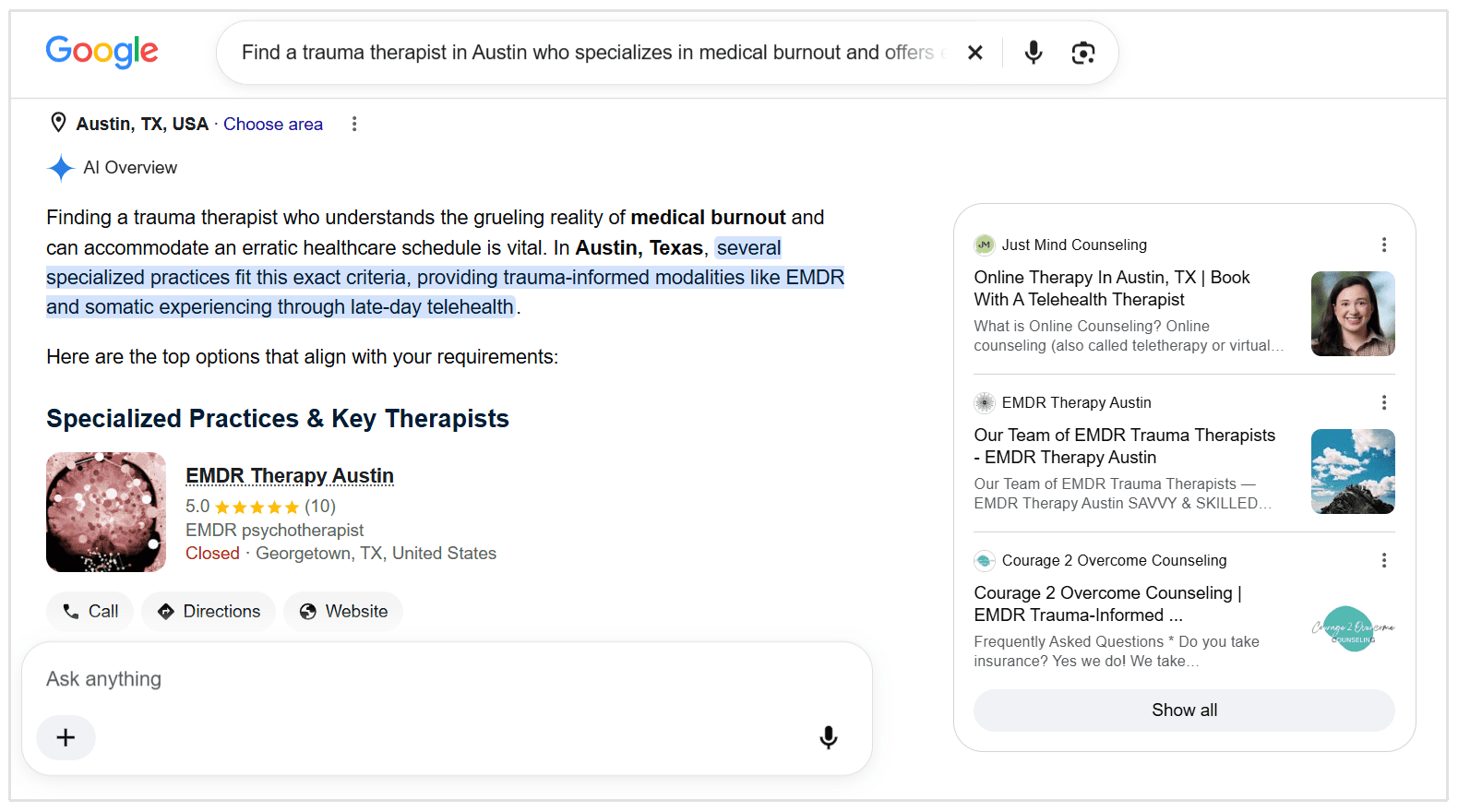
Keeping your practice profiles complete across Google, Bing Places, and major therapist registries ensures AI platforms have verified factual data about your practice.
Related Reading:
- How to Build Authority and Trust for AI Search
- How to Structure Content to Get Cited in AI Answers
- How to Find Which Prompts Your Website Appears For
Make It Easy for Potential Clients to Take the Next Step
Bringing visitors to your website is only useful if they can easily understand what to do next.
Each important page should include clear conversion elements that guide prospective clients towards making contact.
These may include:
- A visible Book an Appointment or Request a Consultation button
- A simple and secure contact form
- A clickable phone number on mobile devices
- A link to your online booking system
- Clear information about fees, insurance, and availability
- Details about what happens after someone submits an inquiry
- Frequently asked questions that address common concerns
Place the main call to action near the top of the page and repeat it naturally after the most important information.
How to Measure Therapist SEO Performance
SEO performance should be measured by more than total website traffic. The most useful indicators show whether your practice is becoming more visible for relevant searches and whether that visibility is leading to appropriate inquiries.
Track metrics such as:
- Rankings for your priority service and location keywords
- Organic clicks and impressions
- Traffic to individual service pages
- Google Business Profile calls, website visits, and direction requests
- Contact form submissions
- Consultation or appointment requests
- New backlinks
SEOptimer’s Keyword Tracking Tool allows you to monitor your practice’s rankings for selected keywords over time.
For example, you could track terms such as “anxiety therapist in Denver,” “couples counseling Denver,” and “EMDR therapist near me” to see whether your SEO efforts are improving your search positions.
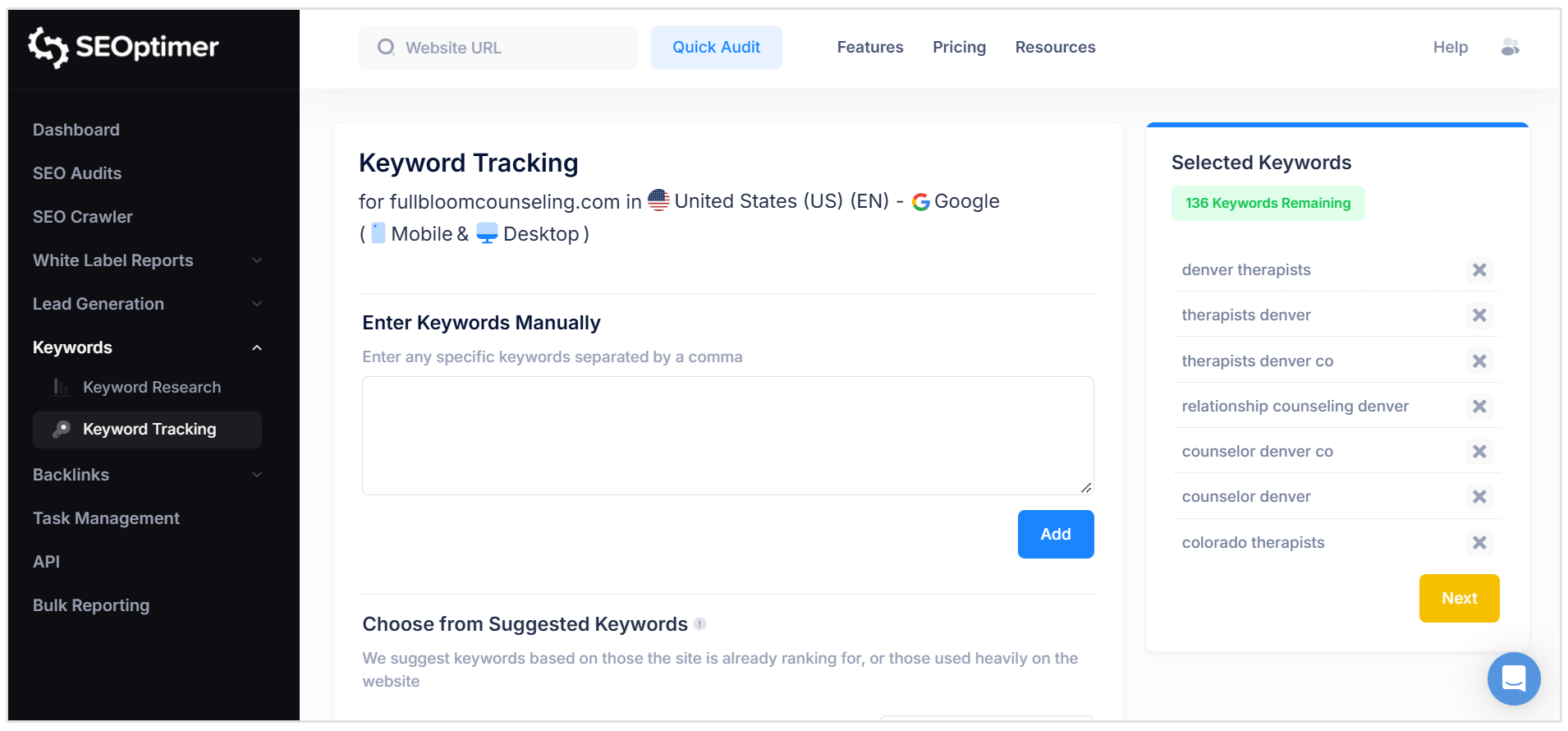
Review these results monthly rather than reacting to daily ranking changes.
SEO performance naturally fluctuates, so the aim is to identify longer-term trends and determine which services, locations, and content topics are producing the most relevant visibility and inquiries.
Conclusion
SEO for therapists takes time to deliver meaningful results, but it remains one of the best long-term marketing channels for building your practice’s online visibility.
By consistently improving your website, local presence, content, and authority, you can make it easier for prospective clients to find your services when they are actively searching for support.
The results may not appear overnight, but the work you put into SEO can continue bringing relevant traffic and inquiries long after the initial optimizations are made.