


AI prompt tracking helps you understand which questions and conversations bring up your brand in ChatGPT, Gemini, and Perplexity. It’s a little like traditional keyword tracking, except there’s no fixed list of prompts or neat set of rankings to work with.
That can make getting started feel confusing.
How do you know which prompts people are using? Can you see which ones already mention your website?
And what does ranking even mean when AI tools can generate a different answer each time?
In this guide, we’ll explain how to find relevant AI prompts, check where your website appears, and track your visibility over time. We’ll also look at the different types of prompts you should track and how to choose which ones to monitor.
What is AI Prompt Tracking?
AI prompt tracking is the process of monitoring how AI platforms respond to specific questions related to your business, products, or industry. It records whether your brand appears in the answer, how it is described, which pages are cited, and which competitors are recommended alongside or instead of you.
By checking the same set of prompts regularly, you can see how your visibility changes across platforms such as ChatGPT, Gemini, Perplexity, and Google AI Mode.
Can You See All the AI Prompts your Website Appears in?
No, there isn’t currently a way to see every AI prompt your website appears for. AI platforms don’t provide a report showing all the questions users asked before your brand or content appeared in an answer.
AI prompt tracking tools work around this by testing a selected set of relevant prompts and recording whether your brand is mentioned, recommended, or cited.
Some tools can also suggest additional prompts where your website may already have visibility, but these findings still represent a sample rather than a complete list.
It’s also worth remembering that AI rankings aren’t fixed.
Answers can change depending on the platform, location, conversation context, and when the prompt is entered.
For this reason, AI prompt tracking gives you a useful view of your visibility, but not a complete record of every prompt your website is mentioned in.
Why Track AI Prompt Visibility?
Tracking AI prompt visibility helps you understand how platforms such as ChatGPT, Gemini, and Perplexity see and present your brand.
You can find out whether your business is being mentioned, recommended, or cited when people ask questions related to your industry.
It can also help you:
- See which prompts already bring up your brand or website
- Find prompts where competitors appear but you don’t
- Identify the pages AI platforms cite most often
- Discover gaps in your existing content
- Check whether AI tools describe your brand accurately
- Monitor changes in your AI visibility over time
- Find new topics and questions worth targeting
These insights give you a clearer idea of where your brand is performing well and where there is room to improve.
You can focus on the improving your visibility for the topics and prompts that are most relevant to your customers and business.
Related Reading:
How to Find which AI Prompts your Website Appears for
Use SEOptimer’s GEO Audit
SEOptimer’s GEO Audit makes it really easy to see how visible your website is across leading AI platforms.
Our dedicated Prompt Visibility section shows whether your business appears in responses from ChatGPT, Gemini, Claude, and Perplexity.
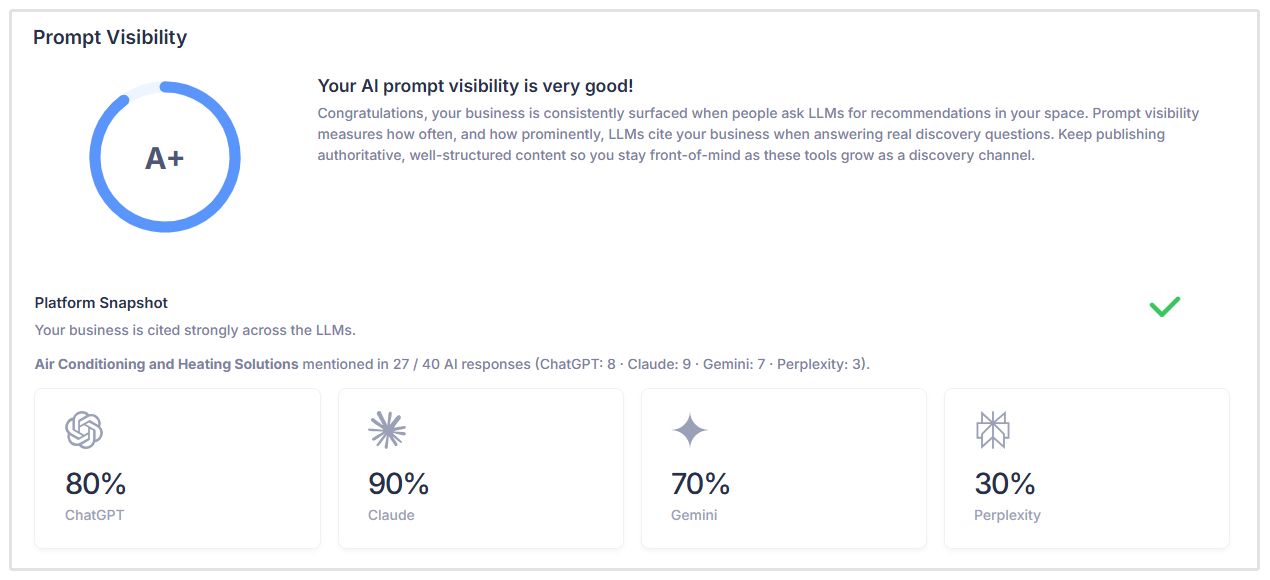
The audit uses an LLM to evaluate your website and generate a set of relevant synthetic prompts.
These are questions that a potential customer might realistically ask when searching for a business, product, or service like yours.
It then tests each prompt across the four AI platforms and brings the results together in a report.
You’ll be able to see:
- Which prompts mention your business
- Which AI platforms include your brand in their responses
- Where your business appears within each response
- Your overall visibility across all the prompts tested
- How consistently your brand appears across different AI tools
It works a little like a traditional keyword ranking report, but it’s designed for the way people search with conversational AI.
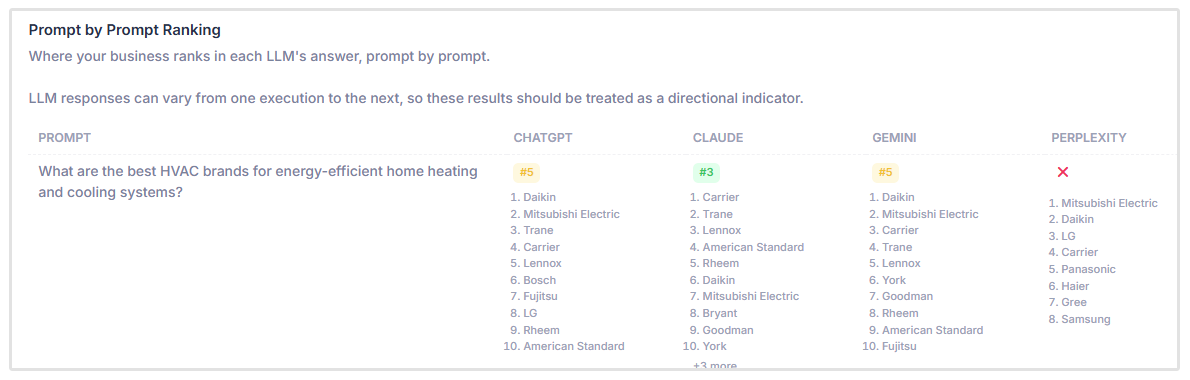
Since AI platforms don’t reveal every prompt entered by real users, these synthetic prompts provide a useful sample of the questions your target audience might ask.
Each GEO Audit also includes other helpful checks, including LLM Accessibility and LLM Content Analysis.
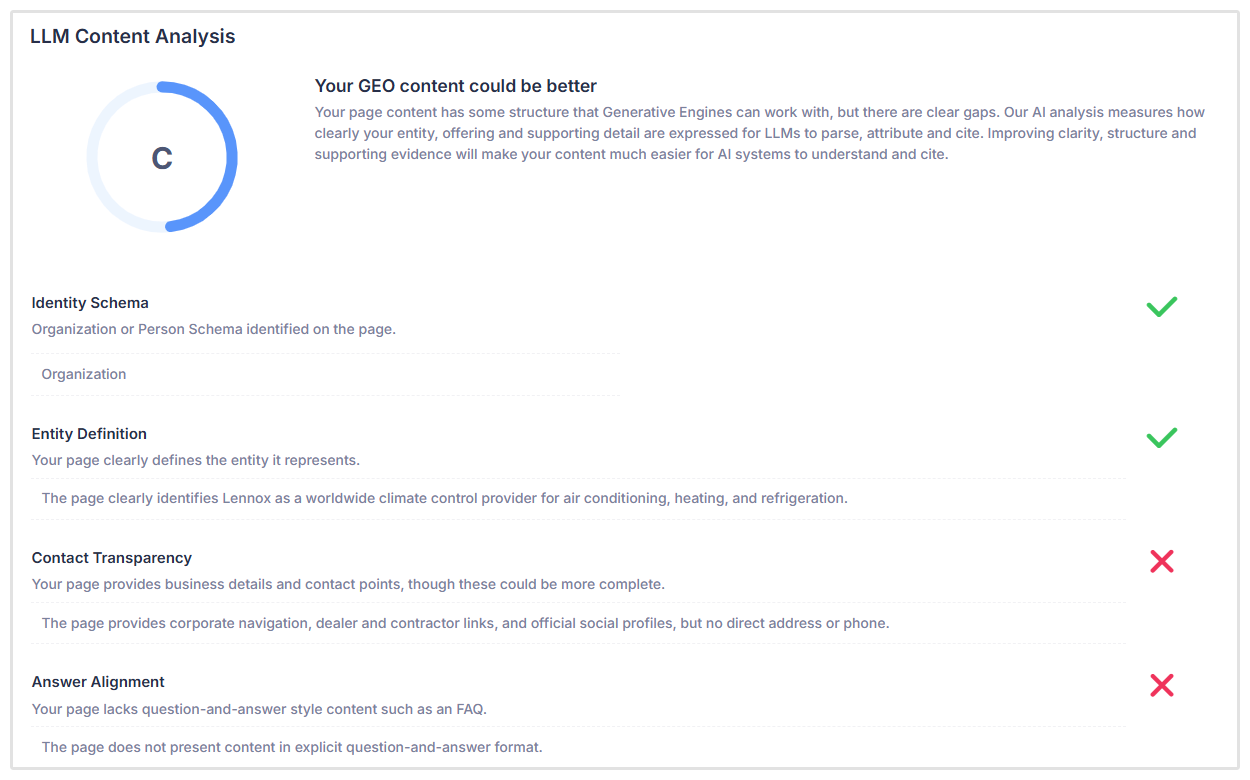
These help you understand whether AI crawlers can access your website and how well your content is structured for AI-generated responses.
However, the Prompt Visibility section gives you the clearest picture of which questions your business currently appears for and where you still have room to improve.
Check High-Value Prompts Manually
You can also test important prompts by entering them directly into ChatGPT, Gemini, Claude, and Perplexity.
Start with questions a potential customer might ask when searching for your product, service, or expertise.
For example, you could test prompts such as:
- What are the best [product category] tools?
- Which [service] is best for [target audience]?
- How can I solve [specific problem]?
- What are the best alternatives to [competitor]?
- Recommend a [product or service] for [specific need]
Review each response to see whether your business is mentioned, where it appears, how it is described, and whether your website is cited.
While manual checks can be helpful for testing a few high-value prompts, they can quickly become difficult to manage.
You would need to repeat every prompt across multiple AI platforms, record the results, and check them again regularly. Responses can also change between searches, making it hard to measure progress consistently.
For ongoing monitoring, an automated prompt-tracking tool or our GEO Audit is far more practical.
Manual testing is best used for occasional spot checks or a small number of prompts that are especially important to your business.
Start with your Existing SEO Keywords
Your existing SEO keywords are a useful starting point because they already show which topics, products, and problems are relevant to your audience.
If a keyword is valuable enough to target in Google, there’s a good chance people will ask AI platforms about the same subject, but just in a more conversational way.
"Keywords are raw material from which you can derive a relevant prompt.
For example, my agency Arbor Growth works with a developer and property manager that provides workforce housing in Orlando. We will take a keyword like "workforce housing Orlando" and expand it into how a person would actually ask an LLM "What are the best affordable apartments in Orlando?"
- Theron Tingstad, CEO and Co-Founder at Arbor Growth
For this method, you shouldn’t just add “What is” to the beginning of every keyword.
Instead, think about the reason someone would search for that term and turn it into a complete question with more context.
For instance, if you’re a dentist one of your primary SEO keywords might be “dental implants cost,” so a potential prompt you might want to track is “How much do dental implants cost, and what affects the price?“
The prompts you select must keep the original topic and search intent but add details such as the user’s location, budget, business size, or specific needs. This is closer to how people naturally speak to AI assistants.
You can find keyword ideas by using a Keyword Research tool as well as Google Keyword Planner that's typically used for paid search campaigns.
Here’s a handy tip: Many of the websites that perform well in Google search results also tend to appear in AI-generated responses.
You can use the Search by Domain feature in SEOptimer’s Keyword Research Tool to find the keywords your website already ranks for and use them as a starting point for developing relevant AI prompts.
You can also analyze a competitor’s domain to see which keywords they rank for. This can uncover topics and search queries you may have overlooked, which you can then turn into natural, conversational prompts to test and track.
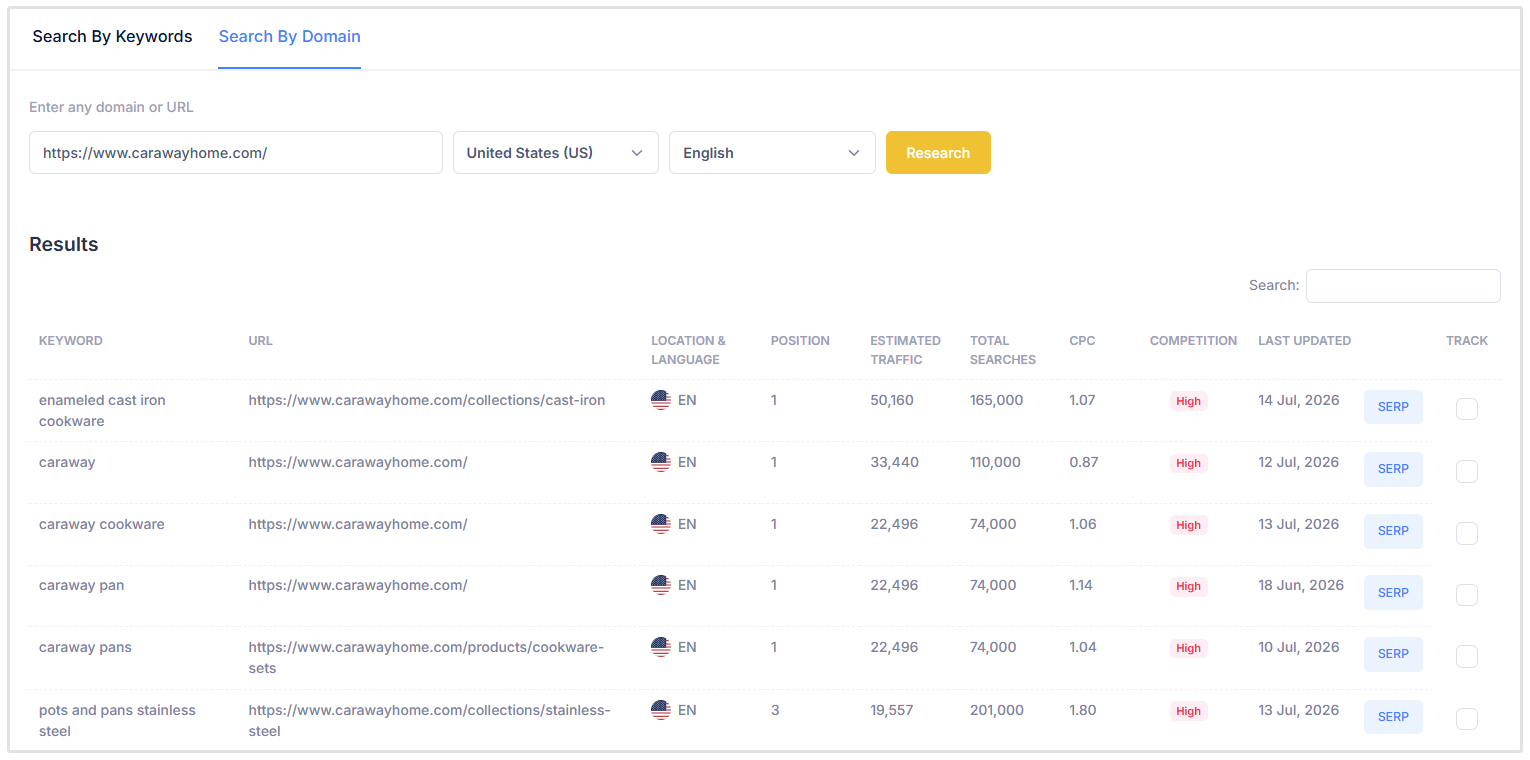
Focus on keywords connected to your most important products, services, and customer problems, then create a few meaningful prompt variations for each one.
This gives you a relevant starting list without having to dream up every prompt from scratch.
Once you’ve created a list of prompts from your existing SEO keywords, add them to an AI visibility tracker.
The tracker can test them across multiple AI platforms and monitor whether your brand is mentioned, recommended, or cited over time.
Again, you could check each prompt manually, but repeating the process across several platforms quickly becomes time-consuming.
Ask AI for Prompt Ideas
You can also use an AI assistant to brainstorm prompts related to your business.
Give it some background about your products, target audience, and the problems you solve, then ask it to generate questions potential customers might use at different stages of the buying journey.
Here's an example prompt that you can use:
I run a [type of business] that offers [products or services] to [target audience]. Generate 20 natural prompts that potential customers might enter into an AI assistant when researching my business and services. Include informational questions, problem-solving prompts, product recommendations, comparisons, and purchase-focused questions. Organize the prompts by stage of the customer journey.
The more context you provide, the more relevant the suggestions will be. You can also ask the AI to include specific locations, industries, budgets, use cases, or customer types.
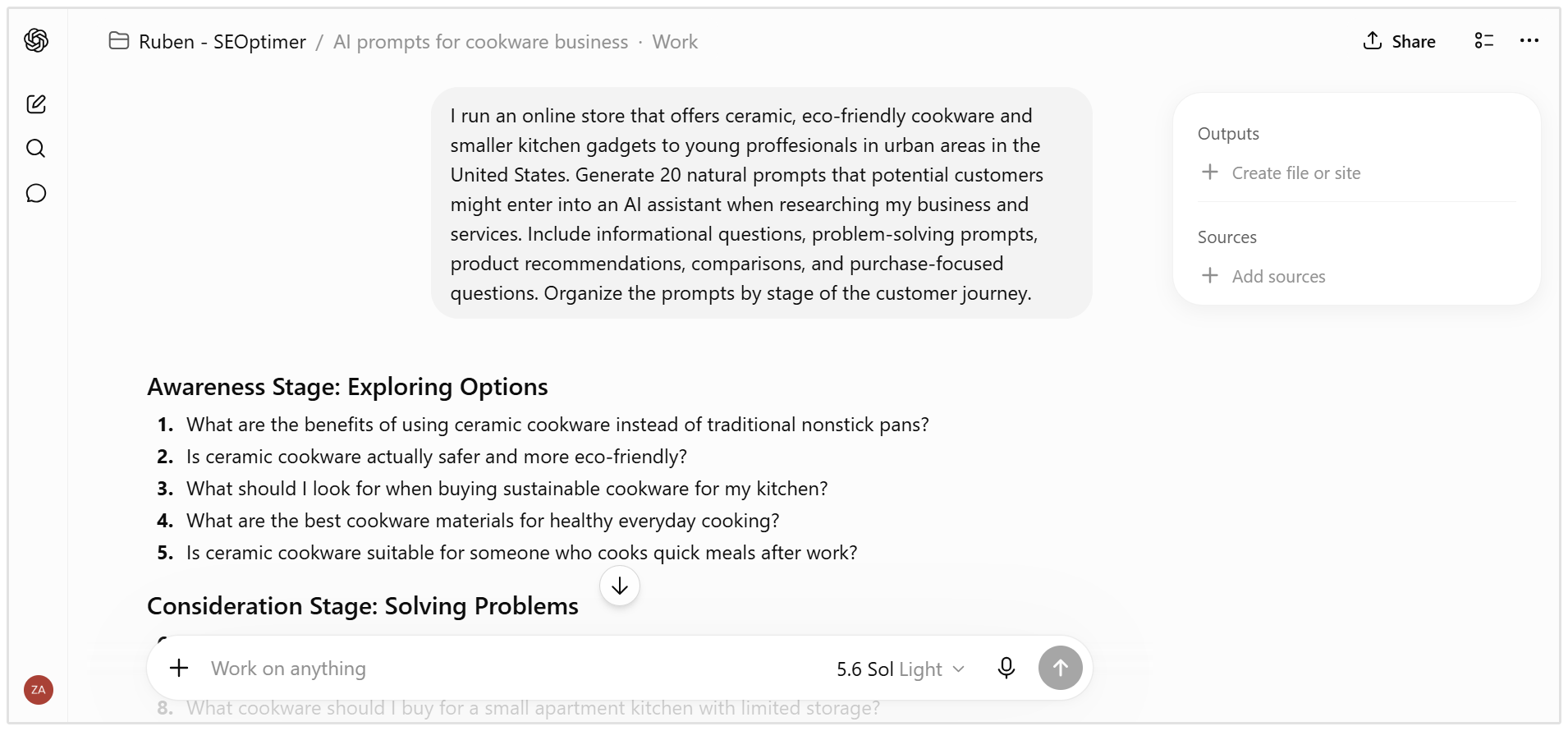
Keep in mind that AI-generated prompts are suggestions, not proof that real people are using them.
Review the list carefully and compare it with your SEO keywords, customer questions, support conversations, and sales data.
Once you have narrowed it down to the most relevant prompts, add them to an AI visibility tracker to see whether your brand appears and monitor the results over time.
Use Google Search Features to Find Prompt Ideas
This means using features in Google’s search results to find real questions and related topics that people are already searching for. These can include:
- People Also Ask questions
- Google Autocomplete suggestions
- Related searches
- Follow-up questions suggested in Google AI Mode
For example, if you search for “dental implant procedure,” Google may suggest questions such as “What is the recovery time for dental implants?” or related searches such as “tooth implant side effects.”
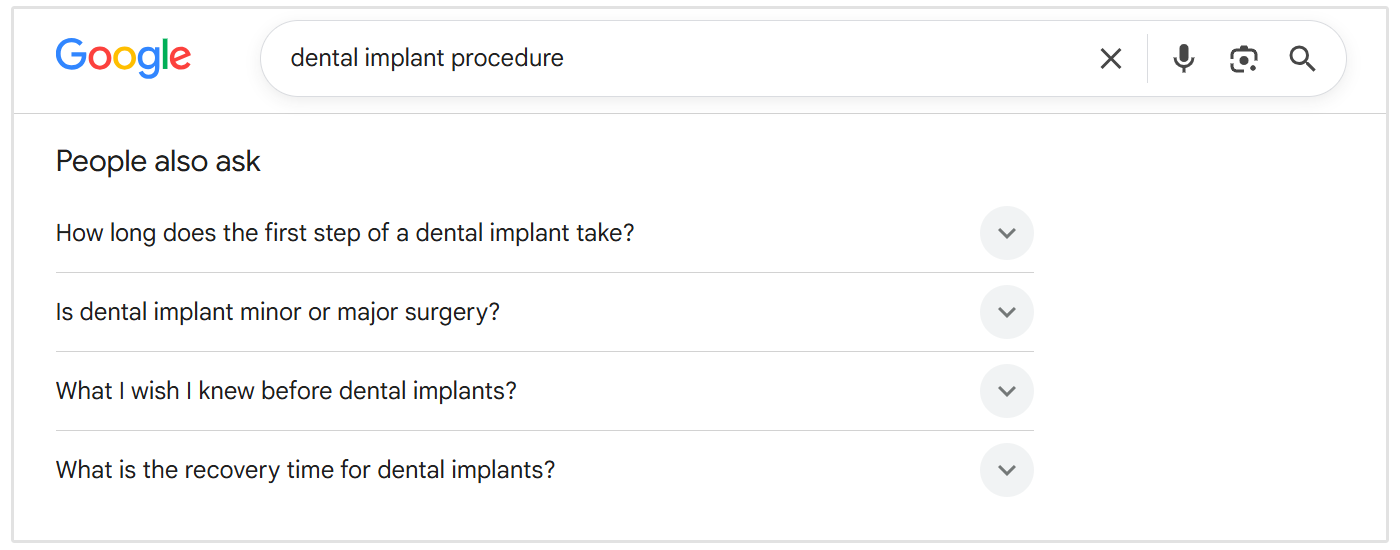
You can turn these questions into conversational prompts to track across AI platforms.
The main benefit of this method is that your ideas are based on existing search behavior rather than guesswork.
However, just remember that Google search features reflect traditional search activity, so they don’t prove that people are entering those exact prompts into ChatGPT or other AI tools.
Once you have collected the most relevant questions, refine them into natural prompts and add them to an AI visibility tracker.
Mine Reddit for Prompt Ideas
Reddit can be a great place to find the questions people are already asking about products, services, and brands.
Search relevant subreddits for your product category, customer problem, or competitors, then look for recurring questions, recommendations, complaints, and comparisons.
Pay close attention to the natural language people use.
A discussion titled “What’s a good ceramic cookware set that isn’t too expensive?” could become a prompt such as: “What is the best affordable ceramic cookware set for everyday use?”
"There is an untapped trove of good information for AI prompts on Reddit. I would advise companies to scan sub Reddits for their business category and look for material that would fit into a prompt.
For example, “I asked ChatGPT to compare company X and company X for DLP, and here is what it said” or “What are the best GEO agencies for SaaS on the market?” Gather prompts and map them into phases of the buying journey."
- Anne Coyle, Founder at CEN Communications
Types of Prompts you can Track
Informational Prompts
Informational prompts are questions people ask when they want to understand a topic, problem, or concept.
Tracking them shows whether AI platforms recognize your website as a useful source of information during the early research stage.
These prompts may not lead to an immediate purchase, but they can help introduce your brand to potential customers and earn citations to your educational content.
They can also reveal topics where competitors are being used as sources while your website is being overlooked.
For example, a financial services company might want to track, “What are the benefits of using a financial advisor?”
Instructional Prompts
Instructional prompts are questions people ask when they need step-by-step help completing a task or solving a problem.
Tracking them can show whether AI platforms use your website’s guides and tutorials as sources.
One of the most applicable examples for this is a home improvement company or hardware store that might want to track something like, “How do I repair a small crack in a concrete wall?”
Comparison Prompts
Comparison prompts are used when someone is weighing up different products, services, or brands before making a decision.
Tracking them shows whether AI platforms include your business when comparing features, pricing, benefits, or alternatives.
So someone that’s new to website design and creation might ask, “Which is better for beginners, Wix or Squarespace?”
"The prompts worth tracking are the ones a potential customer types when they are close to making a decision. These include comparisons, and problem-focused questions. Broad informational queries don’t usually increase revenue.
In practice, we maintain an active tracking set of around 40–60 prompts per client instead of hundreds. A tight set linked to intent is something you can actually act on.
About 70% of our prompts relate to the comparison and decision stages since that’s where an AI recommendation directly affects who receives the call."
- Sasha Berson, Co-Founder and Chief Growth Executive at Grow Law
Transactional Prompts
Transactional prompts show that someone is close to taking action, such as buying a product, booking a service, or requesting a quote.
Tracking them helps you see whether AI platforms recommend your business when potential customers are ready to convert.
For example, someone wanting to go abroad might ask ChatGPT for a list of hotels in NYC, “Where can I book an affordable hotel near Times Square?”
"I build a prompt set around the questions that can change revenue or trust: “Which option is best for my situation?”, “What are the alternatives?”, “Is this product right for this constraint?”, and “How do I solve this problem?”
Then I map those questions to a customer type and stage of the journey. Sales calls, support tickets, on-site search, paid-search terms and organic queries are useful source material because they contain the language customers already use."
- Heath Squier, Founder and Chief AI Officer at EVKII
How to Choose which AI Prompts to Track
It’s nearly impossible to track every prompt that could mention or cite your brand.
People can phrase the same question in several ways, and AI platforms don’t provide a complete list of the prompts their users enter.
Even with an automated AI visibility tool, trying to monitor everything would quickly become expensive, time-consuming, and difficult to manage.
Instead, focus on prompts that are most relevant to your business and customers. When deciding what to track, consider:
- How closely the prompt relates to your products or services
- Whether your target audience is likely to ask it
- Its relevance to an important customer problem or use case
- Where it fits within the customer journey
- Whether appearing for it could lead to awareness, traffic, or conversions
- Whether your competitors are already mentioned for it
Aim for a balanced selection of informational, instructional, comparison, and transactional prompts.
Tiffany Davidson, a professional Squarespace web design and SEO says that marketers must avoid making this mistake when tracking prompts:
"Here's the mistake I see over and over: brands only watch for prompts where their own name shows up. Wrong place to be looking.
The prompts that actually matter are the ones where a competitor gets mentioned and you don't. That's the real gap, and it's usually the thing nobody's tracking."
- Tiffany Davidson, Professional Squarespace Web Design and SEO
You should also include several natural variations around each important topic, since small wording changes can produce different AI responses.
You should try to create a focused set that gives you a useful picture of your brand’s visibility in the AI conversations that matter most to your business.
Check Your AI Visibility with SEOptimer’s GEO Audit
Want to see how ready your website is for AI search?
Try SEOptimer’s new GEO Audit to check your visibility across leading AI platforms and find out whether your site is optimized for LLMs.
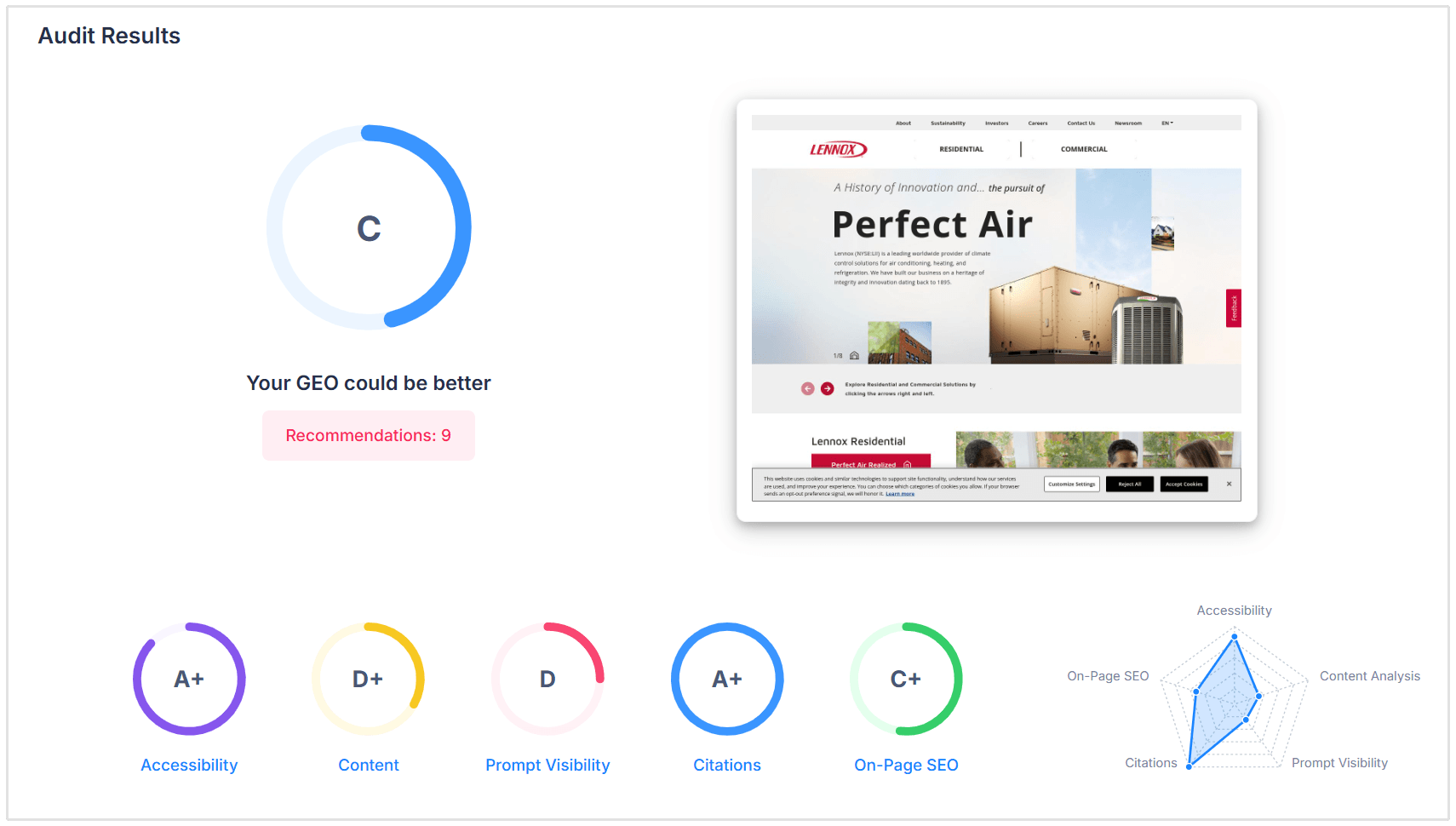
The report covers:
- LLM Accessibility
- LLM Content Analysis
- AI Search Rankings
- Prompt Visibility Important Citations
- On-Page SEO
Run your GEO Audit to see where your website is performing well and what you can improve to boost its chances of appearing in AI-generated responses.
Make AI Prompt Tracking Part of Your Search Strategy
AI prompt tracking isn’t about monitoring every question someone could possibly ask.
It’s about choosing the conversations that matter most to your business and learning where your brand fits into them.
Start with a focused set of relevant prompts, track them consistently, and use the results to guide where you focus your content and marketing efforts next.