

How to Structure Content for AI Citations
- Put the main point at the top of each section.
- Make headings describe the exact question or topic.
- Keep each section focused on one idea.
- Add original data or insights.
- Update content regularly.
For brands, small businesses, and publishers, being cited in AI answers creates another opportunity to build visibility and reach more potential customers.
But did you know that even a good website or page with strong SEO metrics can be overlooked if it lacks the qualities that make its content easy for AI tools to find, understand, and use.
There are a few things you can do to help AI systems interpret the information and determine when it is relevant to a user’s question.
Learning how to structure content for AI citations can make your information easier for AI systems to retrieve and reference. Additionally, many of the same improvements also make your content easier for human readers read.
In this guide, we’ll show you how to organize your content to improve your chances of being cited in AI-generated answers.
Note: Content structure alone cannot guarantee an AI citation, but it can make sure your best information is not hiding where neither people nor machines can easily find it.
What Does it Mean to Structure Content for AI Citations?
Structuring content for AI citations means organizing information so AI tools can easily find, understand, extract, and reference it. This involves:
- Using descriptive headings
- Providing clear, direct answers
- Keeping each section focused on one topic
- Clearly identifying people, brands, products, and other entities
- Supporting important claims with credible evidence like statistics
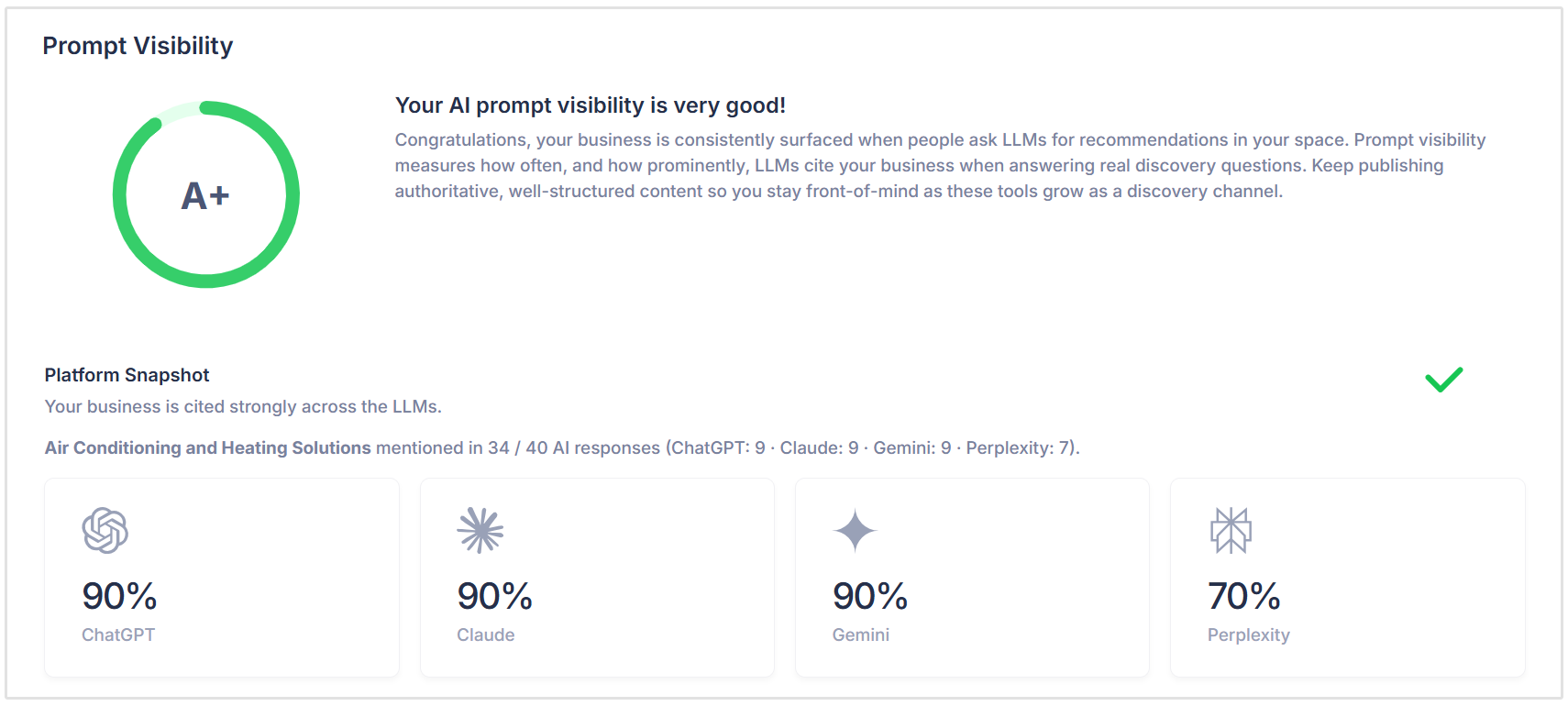
Did you know? You can now check your AI visibility with SEOptimer. Our GEO Audit shows which prompts your website ranks for across ChatGPT, Claude, Gemini, and Perplexity. We also show you how you stack up against your competitors.
How do AI Tools Find Content to Cite?
AI tools generate answers using current web content following a process known as retrieval-augmented generation (RAG).
In simple terms, the process usually works like this:
- The tool interprets the question. It identifies the user’s intent and the specific information needed. Some platforms may also perform several related searches to explore different parts of the question, this is a process Google calls query fan-out.
- It retrieves relevant sources. The system searches its index, the web, or another available collection of content for information related to the question.
- It identifies useful passages. Instead of evaluating only the page as a whole, retrieval systems can locate specific passages that appear relevant. These passages may then be assessed based on factors such as relevance, context, accuracy, freshness, and how well they support the answer.
- It generates and cites the answer. The AI model uses the retrieved information to create a response and may include links to the webpages that support particular claims.
Now that you have a better understanding of how AI tools find content online, let’s get to the main topic of how to structure your content for AI.
How to Structure Content to Get Cited in AI Answers
1. Put the Direct Answer First
Begin each section with a clear answer to the question in its heading. This helps AI tools quickly identify the main point of the passage and determine whether it is relevant to a user’s query.
A useful answer-first structure is:
- Direct answer: Provide the most important information immediately.
- Explanation: Add the context needed to understand the answer.
- Evidence: Support the answer with data, research, or expert insight.
- Example: Show how the information applies in practice.
For example, if the heading asks, “How often should you replace a mattress?” the first sentence should provide the recommended timeframe directly.

Avoid opening with several paragraphs about the importance of sleep or the different types of mattresses before answering the question.
Your answer should simply be concise enough to understand quickly and complete enough to make sense when read on its own.
More detailed explanations, exceptions, and examples can follow afterward.
Putting the answer first also improves the experience for human readers. Visitors can find the information they need immediately, while those who want greater detail can continue reading the rest of the section.
"Lead with the answer. AI is largely lazy due to the resources it takes and the need for quick response for the user experience to be accepted and users to adopt and interact with platforms in a positive way.
The closer your phrasing is to a direct answer that sits close to a heading or content that closely aligns to the answer, the more likely AI will find your answer satisfactory."
- Logan Willliams, Founder and SEO Strategist at Eleventh Peak Digital
2. Use Descriptive or Question-Based Headings
Use page headings that clearly communicate what each section explains or which question it answers.
Specific headings help AI tools understand the topic of the content beneath them and match relevant passages to users’ queries.
For instance, if we look at the following examples:
| Vague heading | Descriptive or question-based heading |
|---|---|
| Getting Started | How to Start a Vegetable Garden at Home |
| Important Information | How Often Should You Replace a Mattress? |
| Costs | How Much Does It Cost to Paint a Room? |
| Helpful Tips | Five Ways to Reduce Your Home Electricity Bill |
Question-based headings are useful when a section provides a direct answer to something your audience commonly searches for.
However, not every heading needs to be written as a question.
A descriptive heading can work just as well when it accurately summarizes the section.
Your headings should also follow a logical hierarchy.
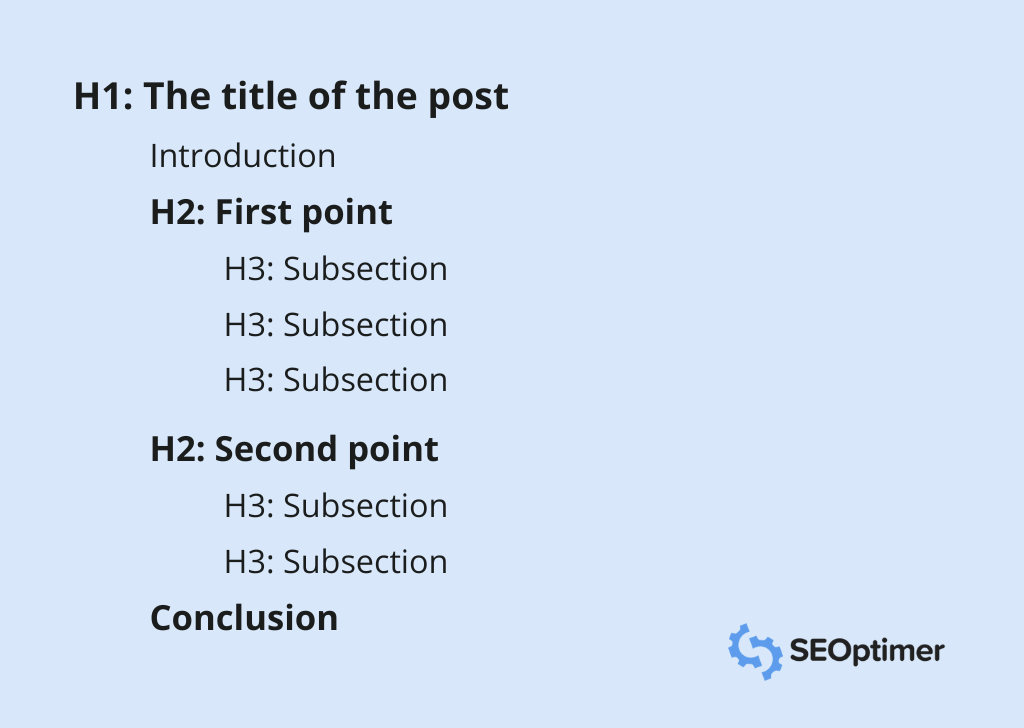
Use H2 headings for the main sections of the page and H3 headings for related points within those sections. Avoid skipping between heading levels or choosing headings simply because of how they look visually.
You can actually do a quick test by reading the headings without the body copy.
They should provide a clear overview of the page and make it easy to understand what information appears in each section.
3. Keep Each Section Focused on One Question
Each section should answer one clear question or cover one closely defined topic.
This makes it easier for AI tools to understand what a passage is about and determine whether it is relevant to a user’s query.
For example, a section titled “How Much Does a Root Canal Cost?” should focus on typical price ranges and the factors that affect the cost.
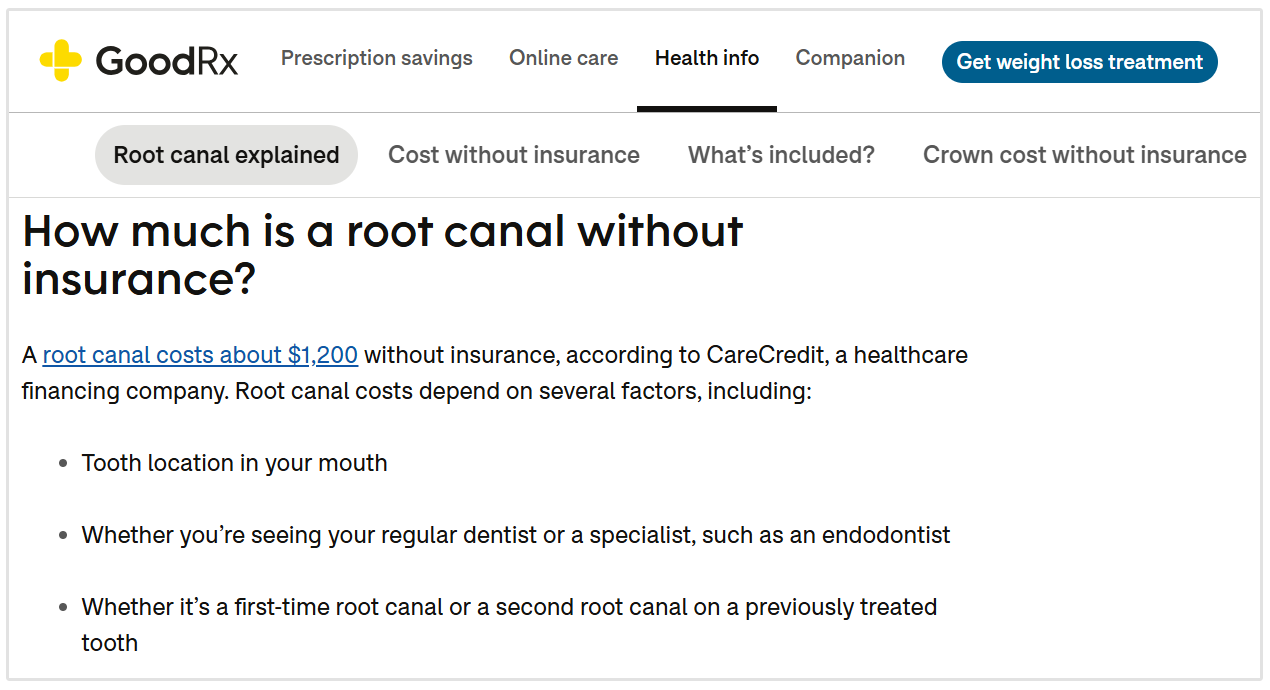
Information about the signs that someone may need a root canal, what happens during the procedure, or how long recovery takes should appear under separate headings.
An ideal section should:
- Address the question stated in its heading
- Provide the direct answer near the beginning
- Include only the explanation, evidence, and examples needed to support that answer
- Move separate or follow-up questions into their own subsections
This does not mean every section needs to be extremely short.
Some questions require more context than others. The main takeaway is that you should avoid combining several distinct topics in one long block of text.
"The AI tools use snippets from your pages, so starting with something like “this makes sense because” or “how does it work” will cause your reference to be lost once the answer is extracted. Each answer must stand on its own without relying on any previous text."
- Tyler Desjardins, Founder at Pivot Creative Media
4. Make Important Passages Clear in Context
Write important passages so their meaning is clear, but do not divide your content into tiny, self-contained blocks purely for AI systems.
Google’s guidance for generative AI search states that there is no requirement to chunk content.
There's no requirement to break your content into tiny pieces for AI to better understand it. Google systems are able to understand the nuance of multiple topics on a page and show the relevant piece to users.
However, sometimes shorter (or longer!) pages can work well depending on your audience and subject matter.
- Google Search Central
Individual explanations should still contain enough context to be easily understood. This benefits readers who scan a page or enter through a specific section, while also making relationships between ideas and entities clearer.
To improve passage clarity:
- Name the subject when a pronoun could be ambiguous
- Keep essential context close to the claim it explains
- Avoid relying unnecessarily on phrases such as “as mentioned above”
- Make relationships between people, products, companies, and concepts explicit
- Use natural paragraph lengths based on what the topic requires
In the case of a local SEO blog, instead of writing: It can also improve visibility by helping businesses appear in relevant searches.
Provide the missing context: Local SEO can improve a business’s visibility by helping it appear in location-based search results.
You should aim to write clear, cohesive content that both readers and AI systems can understand within the context of the complete page.
5. Use Numbered and Bulleted Lists Appropriately
Use lists when they make information easier to scan and understand.
Numbered lists work best for steps, sequences, or ranked items. Whereas, bulleted lists work best for features, benefits, examples, or other items without a required order.
Keep each item specific and use a consistent grammatical structure throughout the list.
However, you should avoid overusing lists (whether numbered or bulleted). Lists should only be used when they present the information more clearly than a regular paragraph.
"Turning an entire page into bullet points does not make it more AI-friendly; in fact, it has the opposite effect. Using bullet points to strategically highlight important information is what actually increases the chances of that information being cited."
- Alex Tkacovs, CEO of 94n Digital
6. Publish Original Information Worth Citing
Publish information that adds something new to the conversation.
Original research and firsthand insights can make your page a primary source, giving AI tools a reason to cite you and other publishers a stronger reason to give you a backlink.
"Shift your effort into brand comparisons, routines, insights, first party data, and things a model couldn't synthesize on its own. That's where a citation will send a real visitor."
- Michael Johnson, CEO at Get Found First
This could include:
- Proprietary survey results
- Anonymized customer or product data
- Original tests and experiments
- Expert interviews
- Industry benchmarks
- Detailed case studies
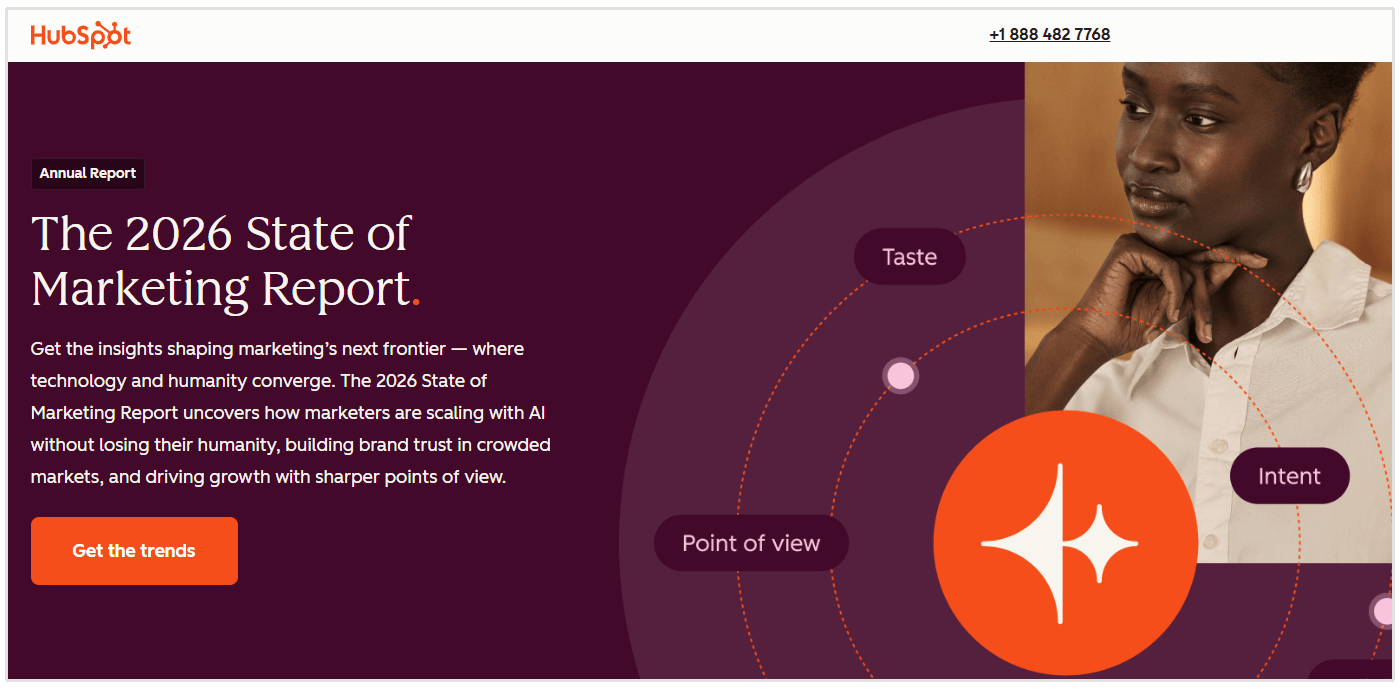
An excellent example of this is HubSpot's State of Marketing Report which is published each year. It features marketing industry statistics and benchmarks, giving AI tools and other publishers a primary source to cite when discussing current marketing trends.
The truth is simply rewriting information found elsewhere may improve readability, but the original source may still receive the citation.
The most valuable content combines clear structure with information readers cannot easily find on several other websites.
7. Keep Facts, Examples, and Sources Updated
Review your content regularly to ensure its claims, examples, and supporting sources are still accurate.
Outdated information can make a page less useful and reduce trust in the content, particularly for queries where current information matters.
Check and update:
- Statistics and research
- Product names, features, and pricing
- Screenshots and examples
- External links and cited sources
- Recommendations and best practices
Updating content involves more than changing the publication date. Revise the information itself, replace outdated sources, and remove claims that are no longer accurate.
For more guidance, read our guide to content freshness.
Does Better Content Structure Guarantee AI Citations?
No, most certainly not. Better content structure can make your information easier for AI tools to understand, but it cannot guarantee that your page will be cited.
Getting AI citations depends on several other factors like:
- How relevant the content is to the user’s prompt
- The accuracy and originality of the information
- The authority and reputation of the source
- Whether other credible sources support the claims
- How current the content is
- Whether AI crawlers can access and render the page
- The retrieval and citation methods used by each AI platform
Check Your Presence and Performance in AI Answers
Improving your content structure is only part of the process. You also need to determine whether your content contains the signals AI platforms need to understand your business, trust your information, and potentially cite it.
SEOptimer’s GEO Audit includes an LLM Content Analysis that evaluates how clearly your website communicates its identity, offering, expertise, and supporting information.
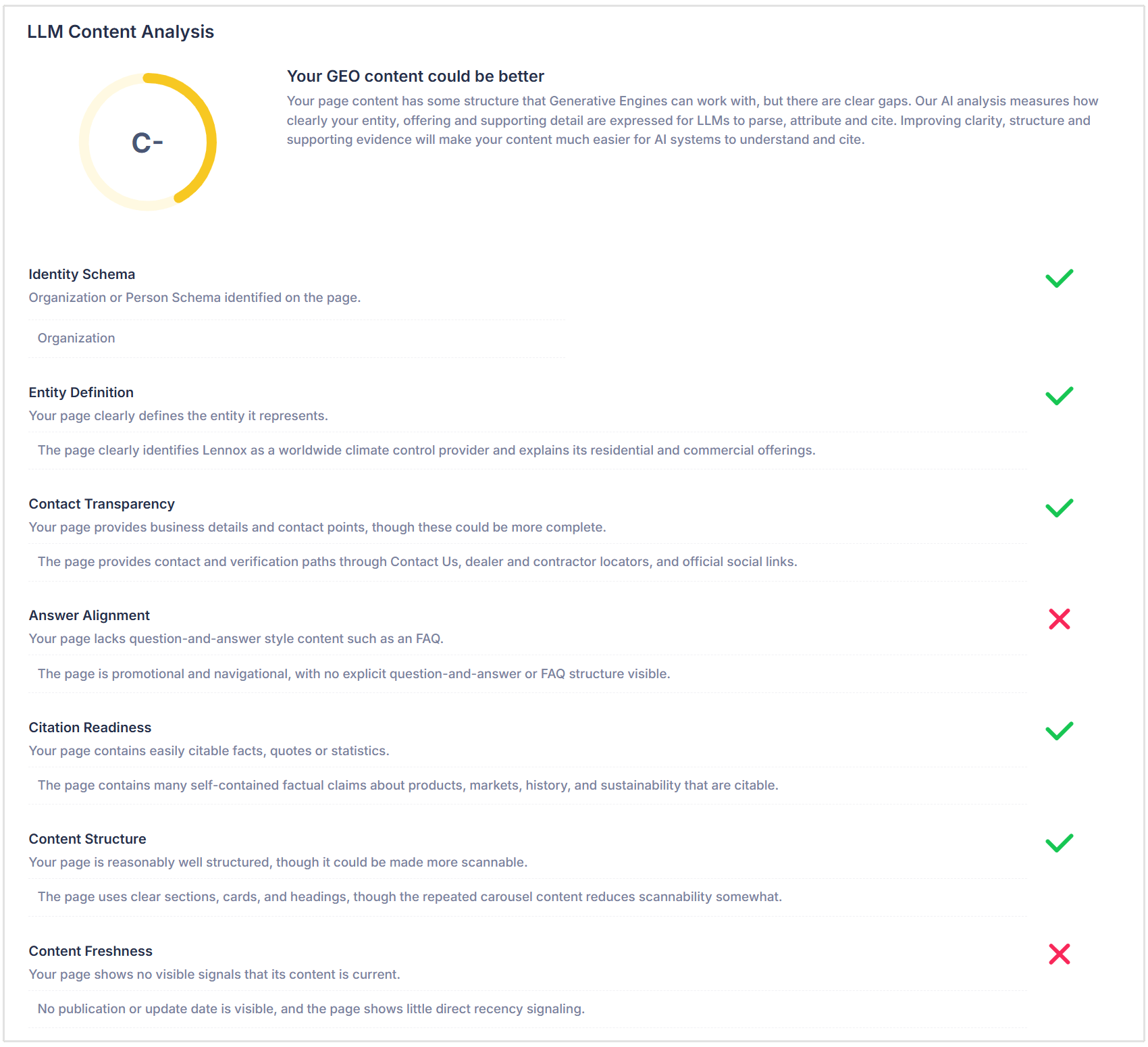
The audit checks areas such as:
- Entity definition: Whether your content clearly explains who you are, what you offer, who you serve, and where you operate
- Answer alignment: Whether the page directly answers questions your target audience may ask
- Citation readiness: Whether your content contains clear facts, claims, or insights that AI platforms could reference
- Content structure: How logically the page uses headings, sections, lists, and other formatting elements
- Content freshness: Whether the information appears current, accurate, and regularly maintained
- Authority and trust: Whether author expertise, credible references, reviews, accreditations, and other supporting evidence are present
- Contact transparency: Whether reliable business and contact information is easy to find
Alongside these content checks, the GEO Audit can:
- Test AI prompt visibility across ChatGPT, Claude, Gemini, and Perplexity
- Identify brand mentions, rankings, and competing businesses
- Find keywords where your website appears as a source in Google AI Overviews
- Check whether AI crawlers can access and process your content
- Evaluate technical signals such as rendered content, llms.txt, robots.txt, XML sitemaps, and identity schema
The report brings these findings together into an overall GEO grade and provides practical recommendations for improving weak areas.
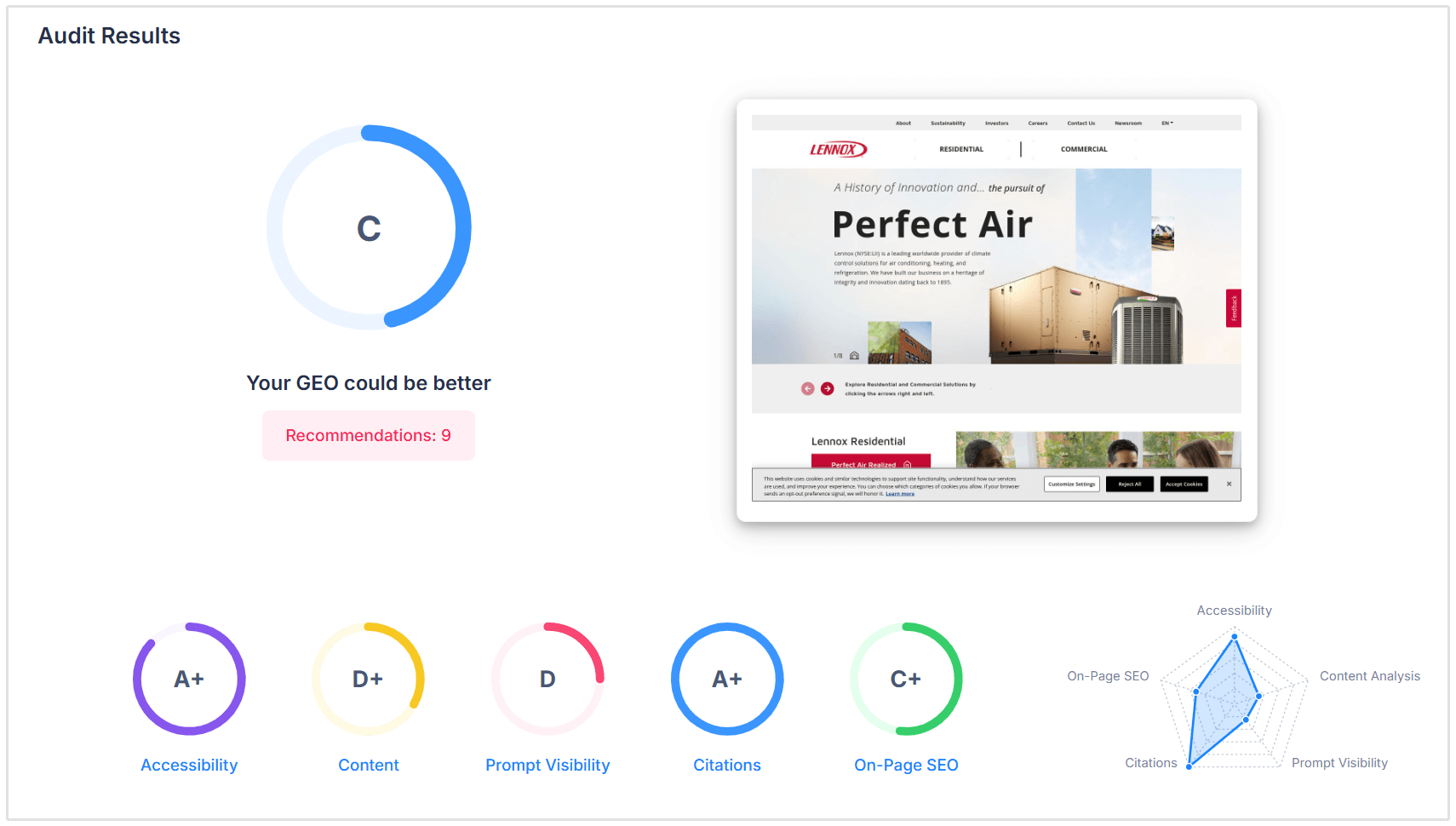
Run a GEO Audit today to see whether your content is ready for AI search and how your website currently performs in generated answers.
Conclusion
Structuring content for AI citations is not about writing unnaturally for machines with the hopes of getting cited. Instead, it is about making content more natural and easier to read and understand.
To achieve this, you can focus on these three priorities:
- Answer important questions directly.
- Support each answer with sufficient context, credible evidence, and original insights.
- Monitor whether these improvements lead to greater visibility, mentions, and citations in AI answers.
Better structure cannot guarantee citations, but when combined with accurate, valuable, current, and accessible content, it can give your website a stronger chance of being used as a source.