

Meta descriptions may be small, but they can have an impact on how people decide whether to click on your page in search results.
Even though Google does not always show the exact meta description you write, a clear and well-written description can still help search engines understand your page and give users a better reason to visit it.
In this guide, we’ll explain what meta descriptions are, why they matter for SEO, how long they should be, and how to write descriptions that attract more clicks.
What is a Meta Description?
A meta description is an HTML tag that gives search engines and users a short summary of what a page is about.
It is placed in the <head> section of a page’s HTML code and is not usually visible on the page itself. In other words, visitors won’t see it while reading your page, but search engines can read it when they crawl your site.
Here's what the meta description looks like for Reliant Plumbing, a plumbing company in Austin:
<meta name="description" content="Affordable plumbing repairs from experts nearby. From repairs to installations, trust Reliant Plumbing for expert solutions. Book now!">
And here's the meta description for the homepage of The Oodie:
<meta name="description" content="Experience ultimate comfort with The Oodie. Loved by 4+ million customers worldwide. 30-day returns. Afterpay & Apple Pay available.">
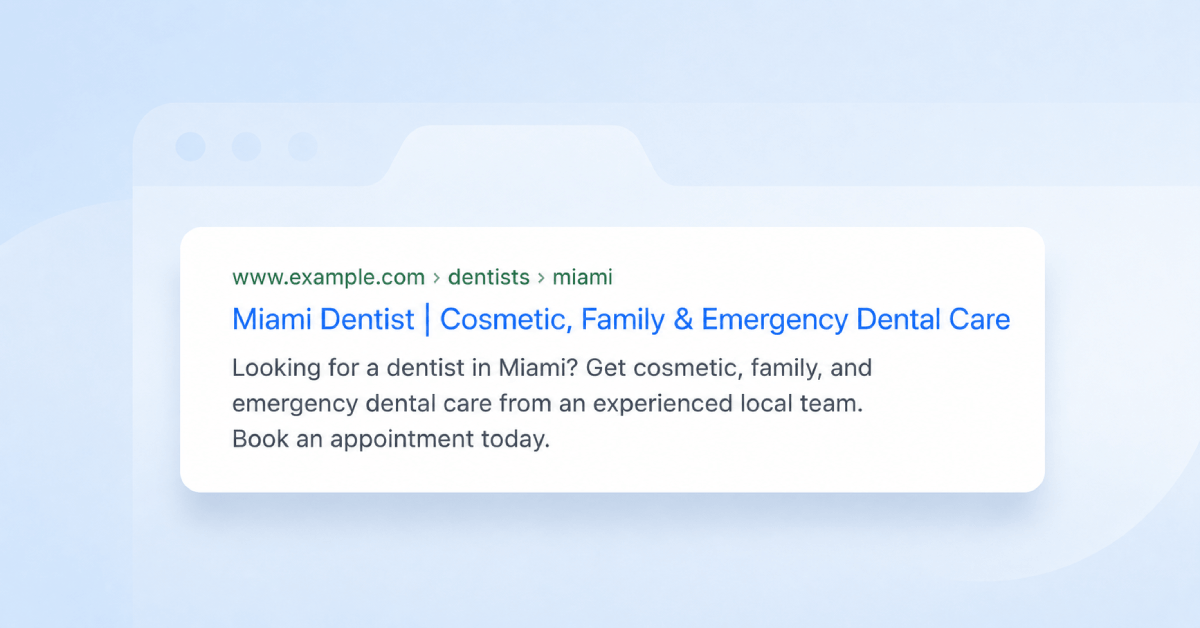
Search engines may use this description as the snippet that appears below your page title in the search results.
How Meta Descriptions Appear in Search Results
When your page appears in search results, the meta description may be shown as the short piece of text underneath the page title and URL.
This text is often called the search snippet.
Here is an example of this from one of the search results when I searched for “how to train for Hyrox”.
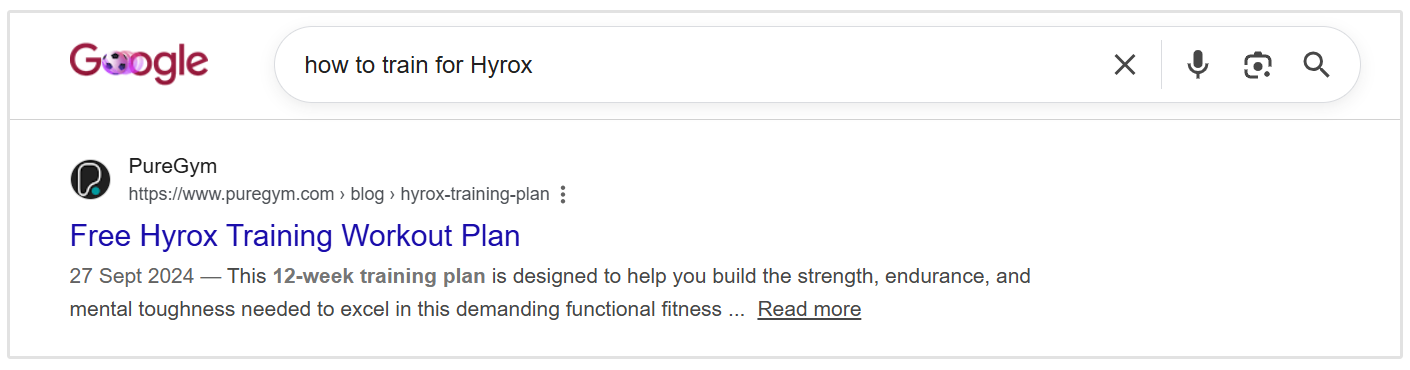
The purpose of the snippet is to give users a quick preview of what they can expect to find on the page before they click through.
However, Google does not always display the meta description exactly as you wrote it.
In some cases, Google may rewrite the snippet using text from the page itself. This usually happens when Google believes another part of the page better matches the user’s search query.
That’s why your meta description should accurately summarize the page, but the content on the page should also clearly support the same topic.
A good meta description gives Google a strong snippet option, while clear on-page content gives Google more context if it decides to generate its own.
Google does not use meta descriptions as a direct ranking factor. However, a well-written meta description can encourage more people to click on your result when it appears in search.
This makes meta descriptions important for organic traffic, click-through rates, and the overall search experience.
Think of your meta description as your page’s mini sales pitch in the search results. It should tell users what the page is about and give them a reason to click it.
How Long Should a Meta Description Be?
A meta description should generally be between 120 and 155 characters.
There is no official character limit, but Google usually cuts off snippets that are too long, especially on mobile devices.
The goal is not to hit an exact character count. The goal is to write a clear, useful summary that explains what the page is about and gives users a reason to click.
As a rule of thumb, keep your most important information near the beginning of the description.
How to Write a Good Meta Description
A good meta description should clearly explain what the page is about and give users a reason to click.
It does not need to be clever or complicated. The best meta descriptions are usually simple, specific, and closely matched to what the searcher is looking for.
Here are some best practices to follow:
1. Match the Search Intent
Before writing a meta description, think about what the user wants from the page.
If someone is searching for a definition, your description should make it clear that the page gives a quick explanation.
If they are comparing products, your description should mention comparisons, features, pricing, or decision-making help.
The closer your meta description matches the user’s intent, the more likely it is to feel relevant in the search results.
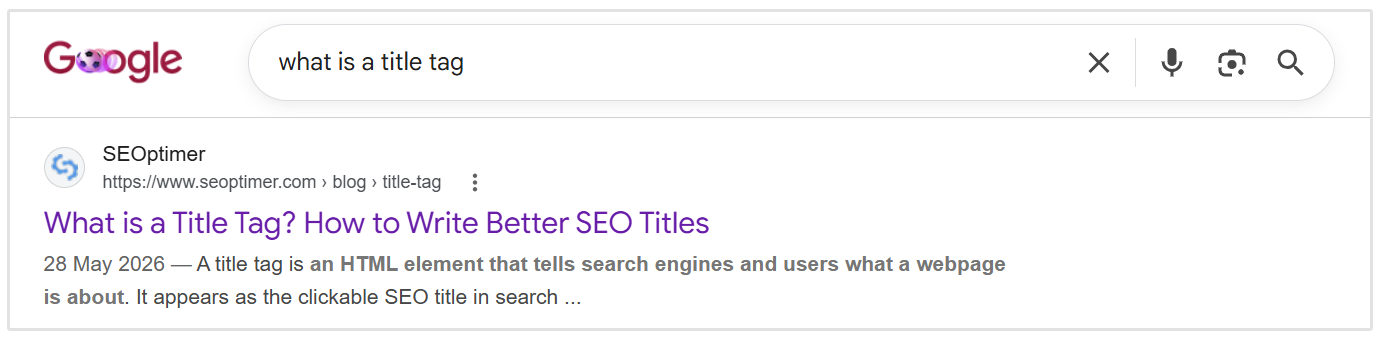
For example, someone searching for “what is a title tag” is likely looking for a simple definition before diving into more detailed SEO guidance.
That is why our blog post on title tags uses the following meta description:
A title tag is an HTML element that tells search engines and users what a webpage is about. It appears as the clickable SEO title in search.
This works because it answers the search intent directly. The user gets a clear definition straight from the search results, while still having a reason to click through for more detail.
2. Include the Target Keyword Naturally
Add the page’s main keyword to the meta description where it makes sense, preferably near the beginning.
This helps users quickly see that your page matches their search. Google may also bold matching words in the search snippet, which can make your result stand out.
For example, HubSpot’s result for the search “social media management course” starts its snippet with:
HubSpot Academy's free Social Media Marketing Certification Course!
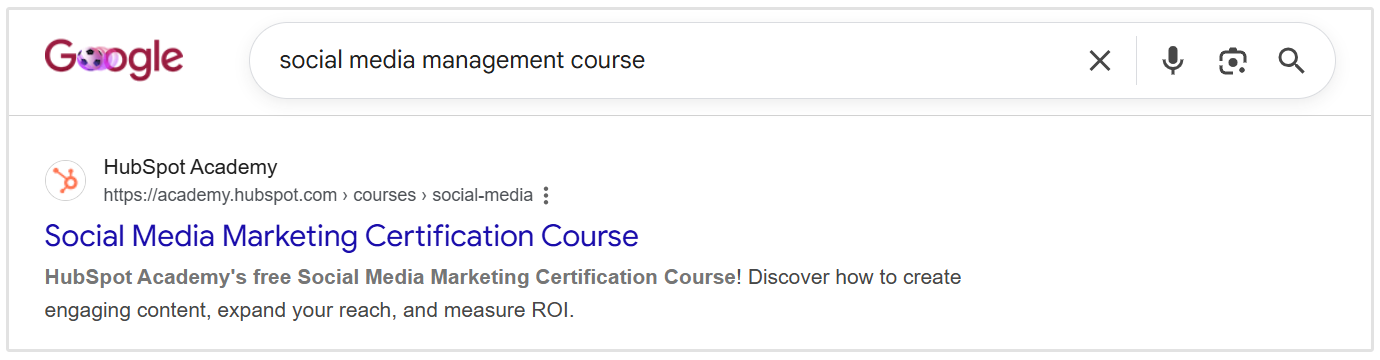
This works because the snippet immediately confirms that the page offers a social media course. The keyword is not forced, but it appears close enough to the start of the description to show clear relevance.
Avoid repeating the keyword multiple times in the same description. One natural mention, or a close variation, is usually enough.
3. Make Each Meta Description Unique
Every important page on your website should have its own meta description.
Avoid using the same description across multiple pages, because this makes it harder for users and search engines to understand what makes each page different.
A product page, service page, blog post, and homepage should all have descriptions that reflect the specific content and purpose of that page.
4. Be Specific
Vague descriptions are easy to ignore.
Instead of writing a generic summary like “Learn more about our services,” explain what the user will actually find on the page.
For example, mention the specific service, product, topic, location, benefit, or problem the page addresses.
5. Use Clear, Action-Oriented Language
Your meta description should help users understand the next step.
Depending on the page, this could mean using phrases like “learn how,” “compare,” “discover,” “get,” “shop,” “book,” or “try.”
The goal is not to sound pushy. It is to make the value of the page clear before the user clicks.
6. Reflect the Page Accurately
Your meta description should match the content on the page.
Do not promise something in the description that the page does not actually deliver. This can lead to disappointed visitors, lower engagement, and a poor search experience.
A good meta description acts like a preview, not clickbait.
7. Add Useful Details Where Relevant
Not every meta description has to be written as a full sentence.
For product pages, you can include details such as price, product type, features, brand, or availability.
For example, the F1 Store’s McLaren merchandise page includes product-specific details directly in the search snippet.
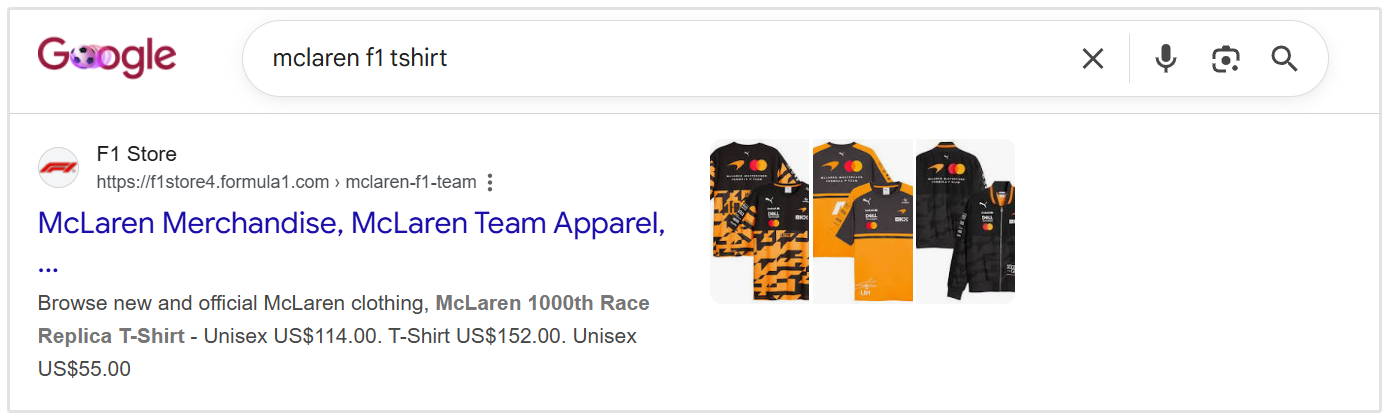
This works because users can immediately see that the page sells official McLaren clothing and includes T-shirt options with pricing information.
For ecommerce pages, these details can help users decide whether the result matches what they are looking for before they click.
For blog posts, you can mention the main topic, examples, checklist, or guide format.
For local business pages, you can include the service area, opening hours, emergency availability, or key services.
Like here we can see the meta description for Roto-Rooter's Emergency Plumbing Services page:
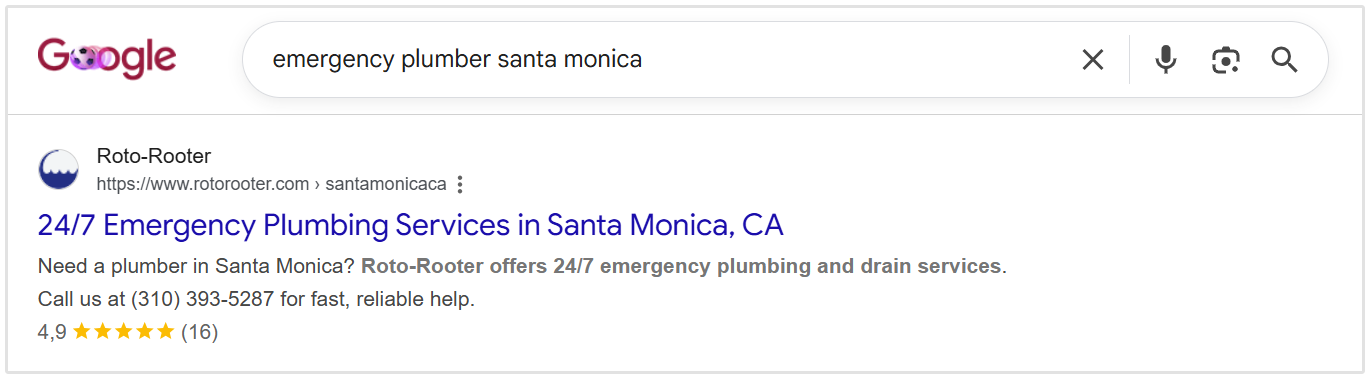
As you can see they have their contact number in the meta description as well as the primary keyword, "emergecy plumbing and drain services."
The more useful and specific your description is, the easier it is for users to decide whether your page is the right result.
How to Write Meta Descriptions for Different Page Types
Not every page needs the same type of meta description.
A blog post, product page, homepage, and local service page all serve different search intents. So, your meta descriptions should be written to match the purpose of each page.
Here’s how to approach different page types.
Homepage Meta Descriptions
Your homepage meta description should explain who you are, what you offer, and who you help.
It should give users a quick reason to visit your website and understand your brand at a glance.
Example:
Looking for the best SEO Audit Tool to analyze and grade your website? SEOptimer is the web's best SEO Checker. Improve your website, rank better in Search Engines and win more customers with beautiful SEO Reports. Audit your SEO today!
Blog Post Meta Descriptions
A blog post meta description should summarize what the reader will learn from the article.
Focus on the main topic, the problem being solved, or the outcome the reader can expect.
Example:
Cost Per Click (CPC) refers to the actual price you pay for each click in your pay-per-click (PPC) marketing campaigns. In this lesson, you'll learn why CPC is so important.
Product Page Meta Descriptions
For product pages, include the product type, key features, benefits, and any important buying details.
Depending on the product, this could include price, size, material, availability, shipping, or brand information.
Example:
Buy Oakley Meta Vanguard AI Glasses with Black Frame and Prizm Black Lenses developed for sport performance and everyday style. Free and safe shipping.
Service Page Meta Descriptions
A service page meta description should clearly state the service being offered and the main benefit to the customer.
If the service is location-based, include the target location as well.
Example:
Get professional plumbing services in Austin, including leak repairs, drain cleaning, installations, and emergency plumbing support.
Category Page Meta Descriptions
Category pages should describe the range of products, services, or resources available on the page.
The goal is to help users understand what they can browse, compare, or choose from.
Example:
Browse women’s winter jackets, including padded coats, parkas, rain jackets, and lightweight outerwear in a range of sizes and colors.
Local Landing Page Meta Descriptions
For local landing pages, include the service, location, and a trust signal where possible.
This helps users quickly see that your business serves their area.
Example:
Looking for an SEO agency in Chicago? Our local team helps businesses improve rankings, traffic, and leads with tailored SEO campaigns.
Comparison Page Meta Descriptions
A comparison page meta description should mention the products, services, or options being compared.
It should also explain how the page helps users make a better decision.
Example:
Check out this in-depth comparison table to see the differences between Hootsuite and Buffer. Compare prices, features, integrations, and more in seconds.
SaaS Feature Page Meta Descriptions
For SaaS feature pages, focus on the feature, who it is for, and the result it helps users achieve.
Keep it specific and benefit-driven.
Example:
White Label our SEO Audit Tool with custom branded, White Label PDF Reports for your customers. Customize report branding, checks and text to suit your needs!
How to Check Meta Descriptions on Your Website
Before you start rewriting your meta descriptions, it helps to know what is already on your site.
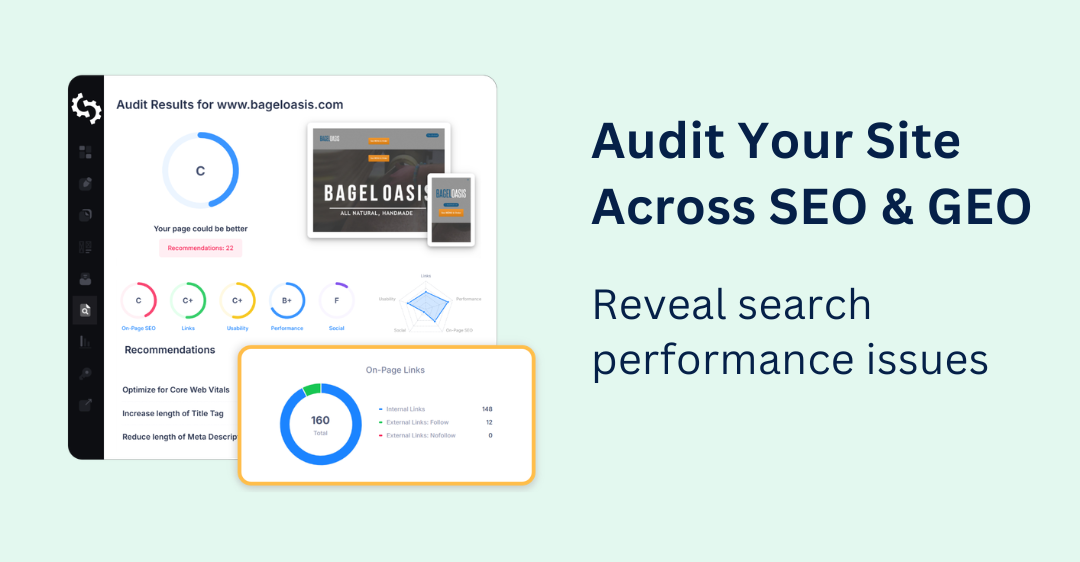
If you want to quickly check the meta description of a single page, you can run a quick SEO audit with SEOptimer. This is useful for checking your own pages or seeing how a competitor has written their meta description.
The audit will show whether the page has a meta description present, and whether it is written in a search-friendly way.
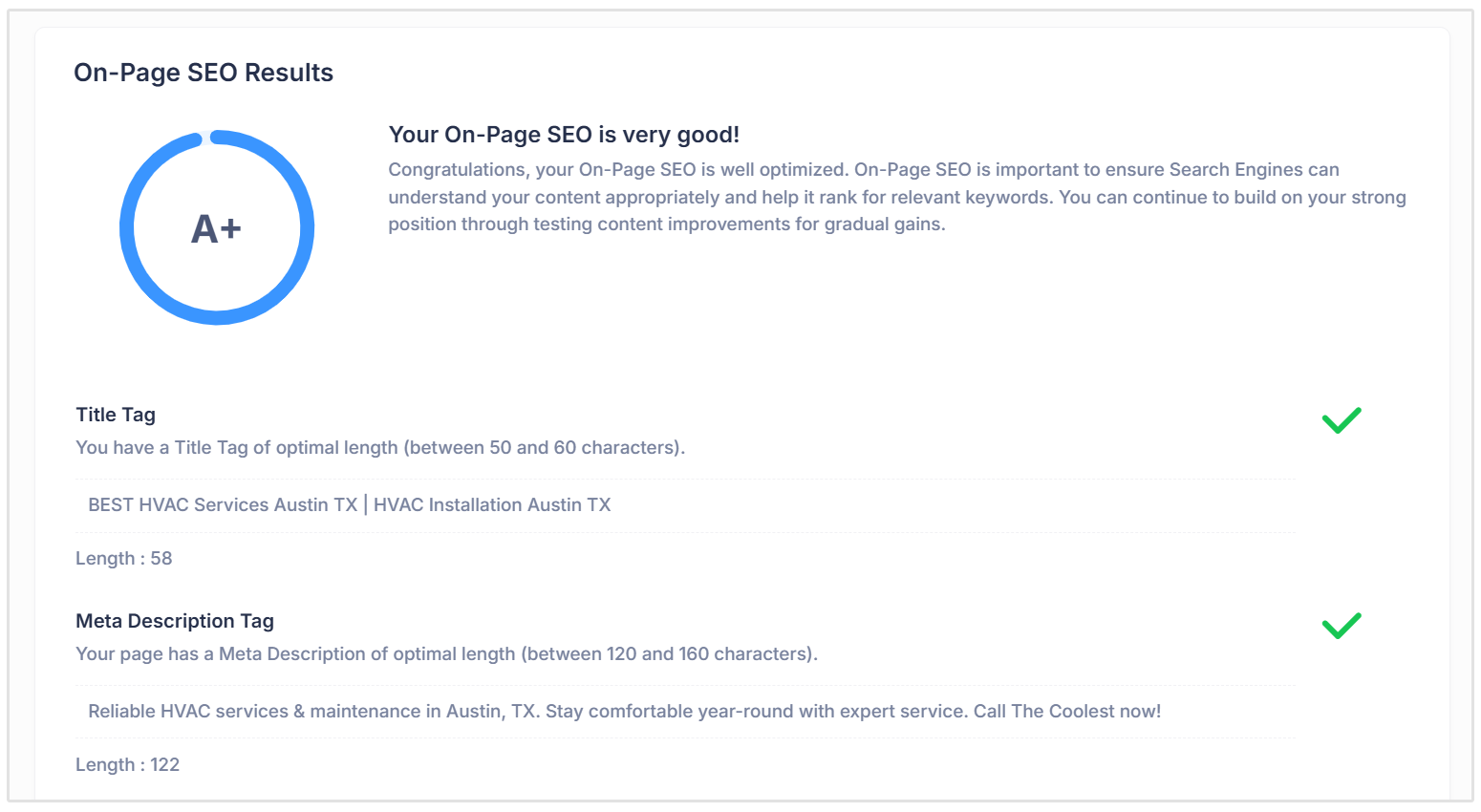
This is especially helpful when reviewing important pages such as your homepage, service pages, product pages, landing pages, or blog posts.
For larger websites, you will need to check meta descriptions across multiple pages at once.
This is where SEOptimer’s SEO Crawler is useful. Instead of checking each URL manually, you can crawl your website and review meta description issues across all pages.
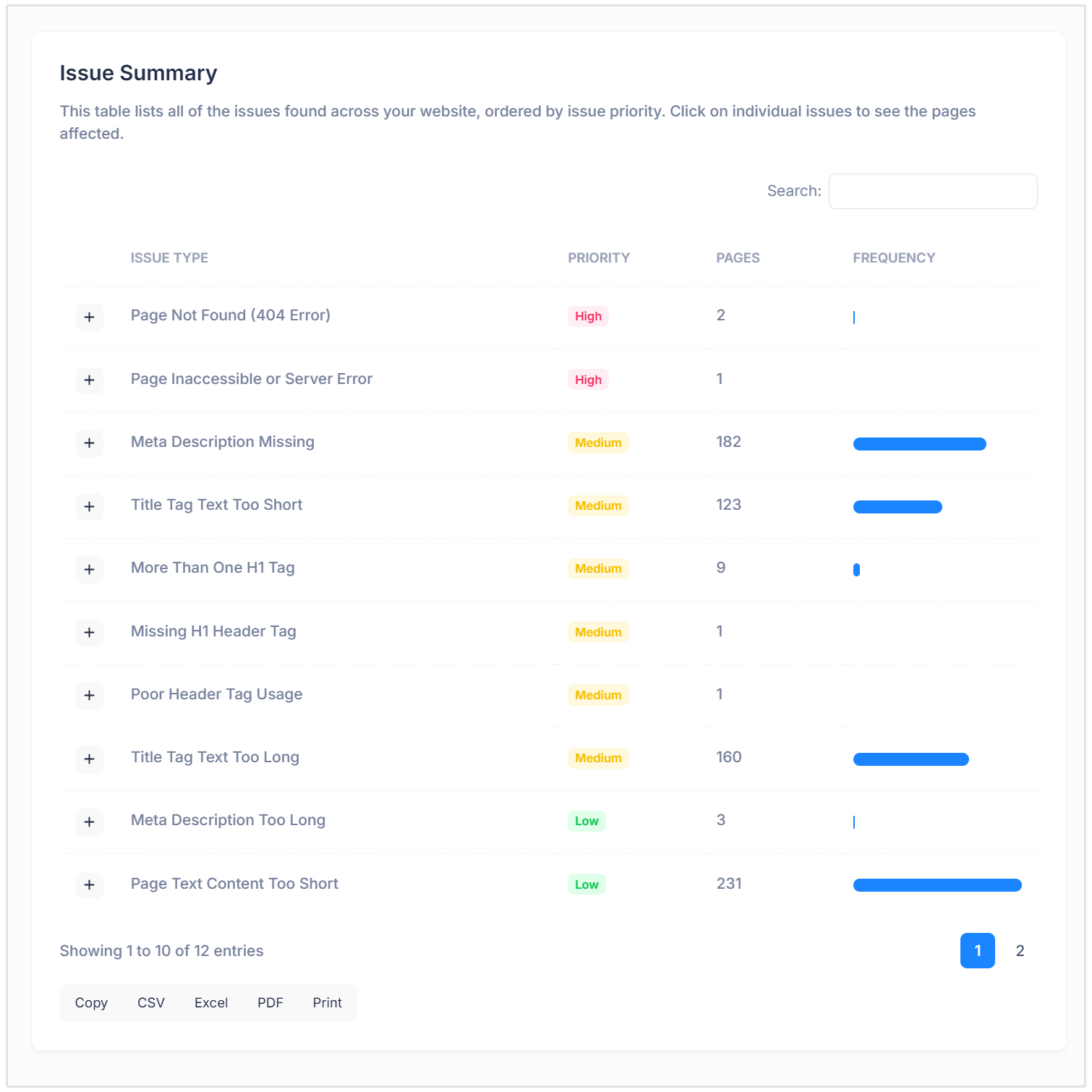
The SEO Crawler can help you identify pages with:
- Missing meta descriptions
- Meta descriptions that are too long
- Meta descriptions that are too short
Once you have this information, you can prioritize the most important pages first.
Start with pages that already get traffic, pages that rank on the first page of Google, or pages that are important for conversions. Improving the meta descriptions on these pages can help make your search results more relevant and more appealing to potential visitors.
Can You Use AI to Write Meta Descriptions?
Yes, you can use AI to write meta descriptions.
AI tools can be useful when you need to create meta descriptions quickly, especially if you are updating a large website or working through many pages at once.
However, AI-generated meta descriptions should still be reviewed before you publish them.
The description needs to accurately match the page content, include the right keyword naturally, and give users a clear reason to click. AI can sometimes produce descriptions that sound polished but are too vague, too long, or not specific enough to the actual page.
For best results, give the AI tool enough context before asking it to write the description.
Include details such as:
- The page title
- The target keyword
- A short summary of the page
- The intended audience
- The preferred length
- The main benefit or takeaway
You can use a prompt like this:
Write a meta description for a page about [topic]. The target keyword is [keyword]. Keep it under 155 characters, make it clear and specific, and encourage users to click without sounding too promotional.
Once the description is generated, review it manually. Make sure it is accurate, unique, and useful to the person searching.
AI can help you write faster, but the final meta description should still feel like it was written for a real user, not assembled in a content factory with fluorescent lights and no coffee.
Conclusion
Meta descriptions may not directly improve your Google rankings, but they still play an important role in SEO.
A clear and relevant meta description can help users understand what your page is about and encourage more people to click on your result in search.
The best meta descriptions are specific, accurate, unique to each page, and written with the searcher’s intent in mind.
Whether you are optimizing one page or reviewing an entire website, it is worth checking that your meta descriptions are present, the right length, and useful to potential visitors.
You can use SEOptimer to quickly check the meta description of a single page, or run a full site crawl to find missing, duplicate, too short, or too long meta descriptions across your website.