


Choosing the right SEO API depends on what you want to build.
Some teams need keyword ranking data. Others need backlink metrics, SERP results, technical SEO checks, or automated website audits.
And for agencies, the best SEO API is often the one that can turn data into clear, client-ready reports.
An SEO API lets you pull search data directly into your own tools, dashboards, reports, or workflows.
In this guide, we compare the best SEO API tools for different use cases.
We’ll also look at what each API is best suited for, so you can choose the right option for whatever you’re building.
What is an SEO API?
An SEO API (Application Programming Interface) allows developers to pull search engine optimization data directly from a provider's database into their own applications.
Instead of logging into a platform to check keyword rankings or run a site audit manually, an API lets your software request that data programmatically.
For instance, teams can use an SEO ranking API to track thousands of queries automatically, monitor competitors across different geographic locations, and feed data into business intelligence workflows.
Whether you are building a custom client dashboard, a white-label SEO auditing tool, or an internal data warehouse, a website SEO API delivers the raw data you need in a structured format like JSON or XML.
The Best SEO APIs
Here is a detailed breakdown of the top SEO APIs available today.
1. SEOptimer SEO API
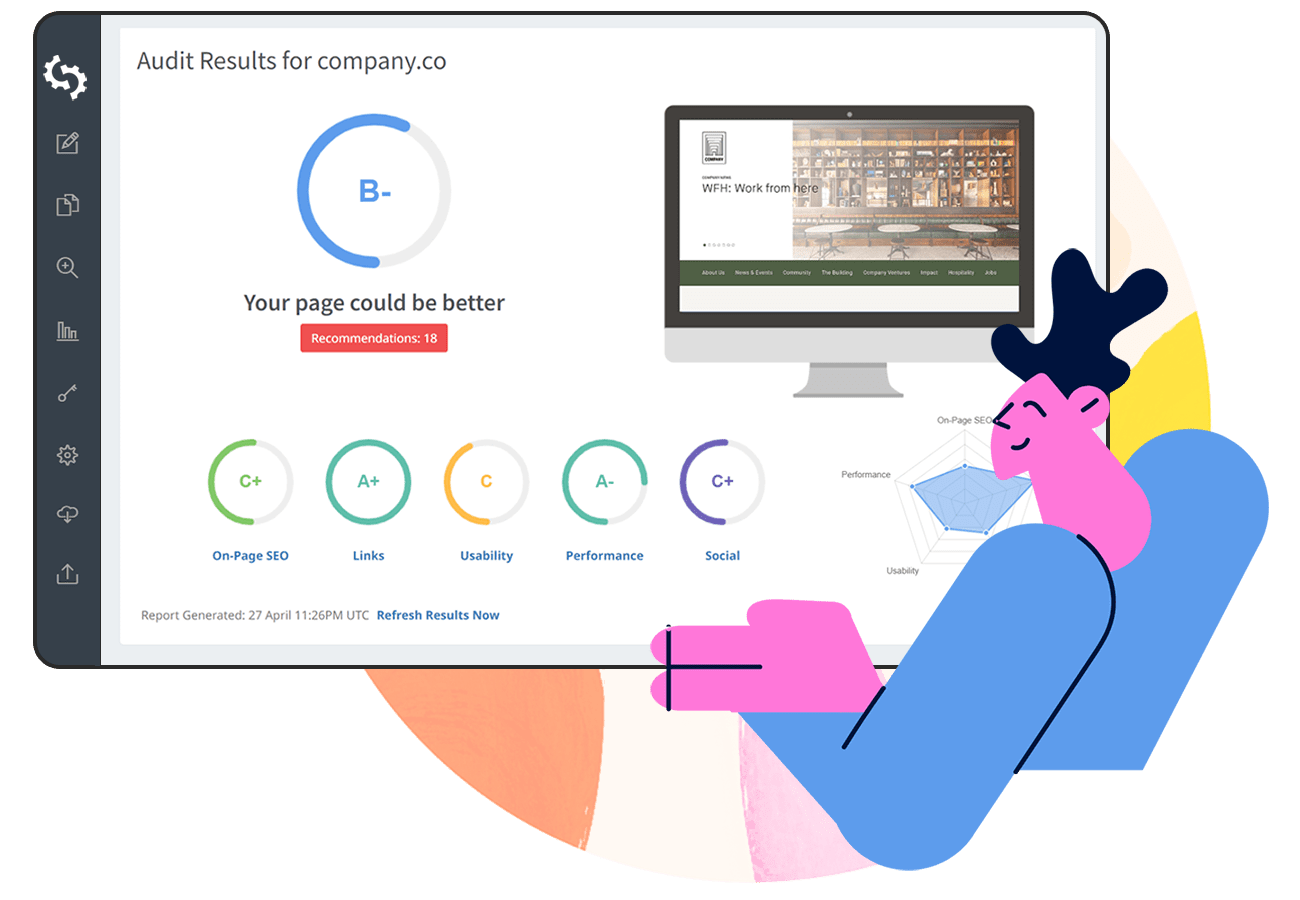
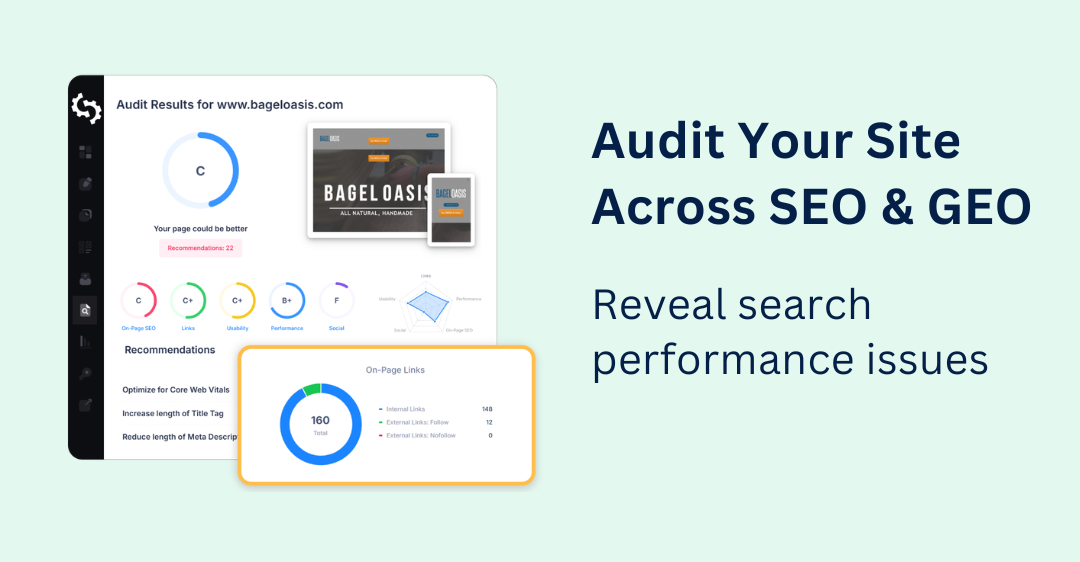
SEOptimer’s SEO Audit API is built for teams that want to automate website audits, generate SEO reports, and pull audit data into their own tools or workflows.
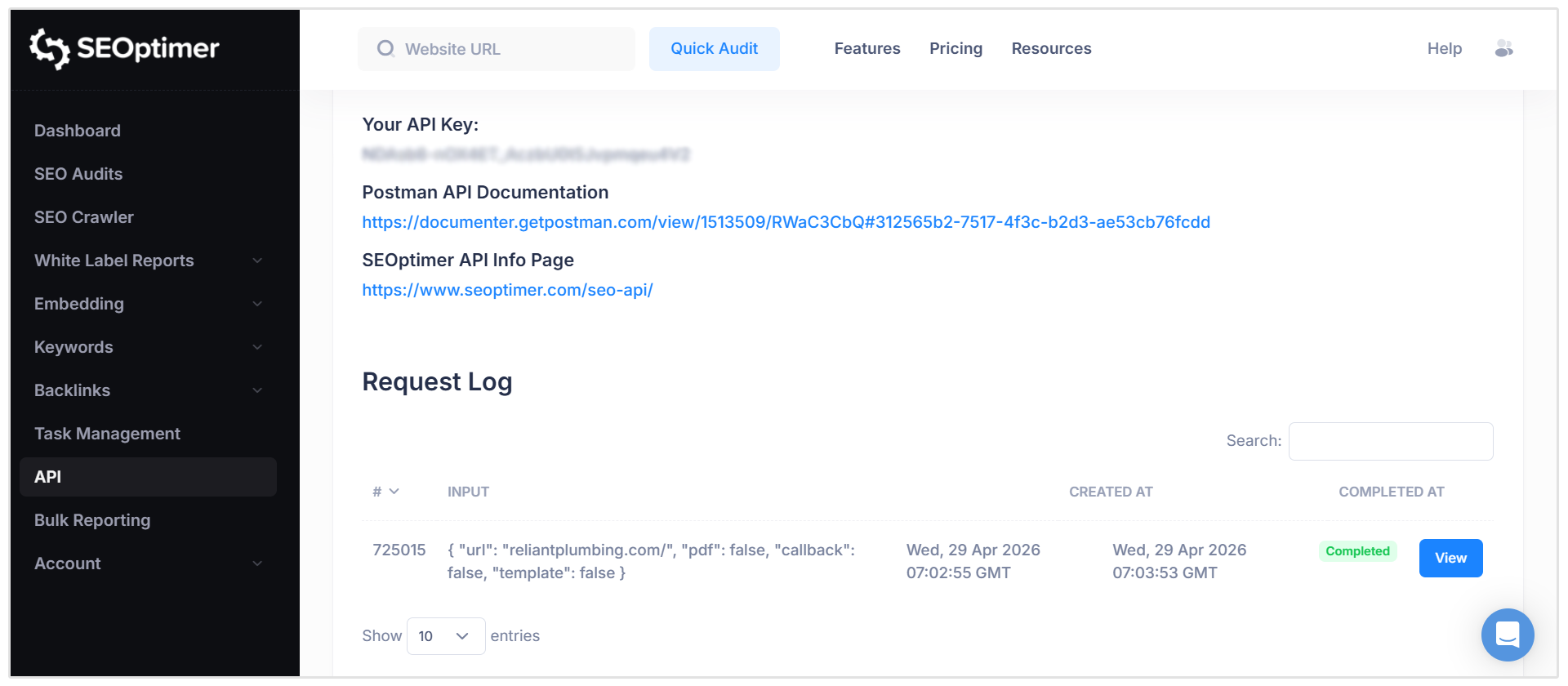
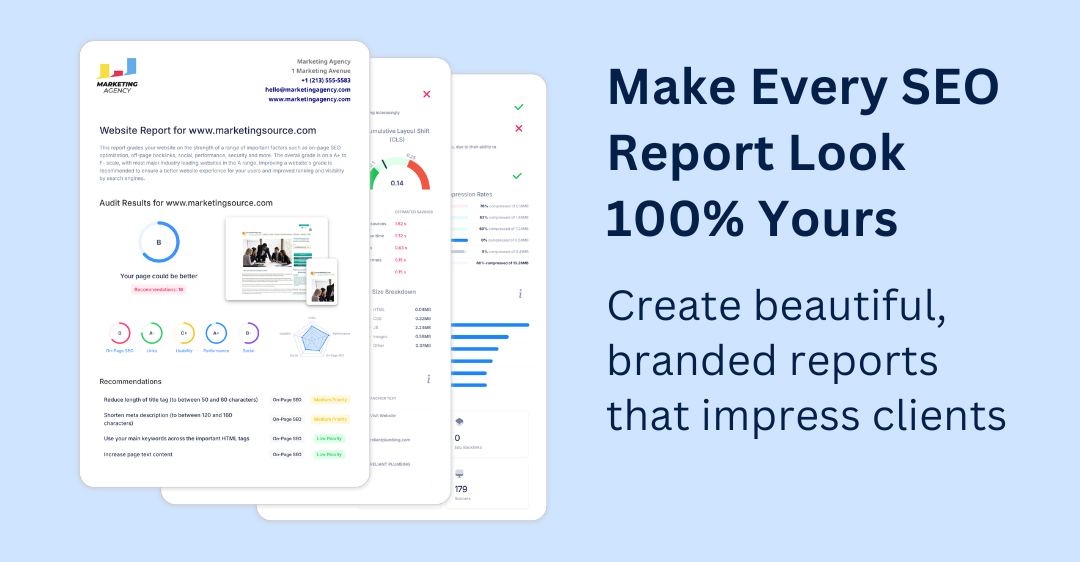
Instead of manually running one website audit at a time, you can use the API to submit URLs, retrieve SEO data, get audit scores, and generate white-label PDF reports.
This makes it especially useful for agencies that want to audit prospect websites at scale, create branded reports, or connect SEO audit data to their sales and reporting processes.
SEOptimer is not just a raw SEO data API.
It is designed around practical website audit and reporting workflows, making it a great choice for agencies, developers, and SaaS teams that need structured SEO analysis.
Key Features
SEOptimer’s SEO API includes:
- Website audit data via JSON
- SEO scores and recommendations
- White-label PDF report generation
- Custom report branding and colors
- Bulk reporting for lead generation
- Callback and queue-and-wait workflows
- Technical SEO checks
- On-page SEO checks
- Performance and usability checks
- Backlink summary data
- Organic keyword ranking data
- AI search-related checks, including llms.txt, Identity Schema, LLM readability, and top AI Overview citations
The API can be used to audit hundreds or even thousands of websites, making it a good fit for agencies that want to scale lead generation, prospecting, or client onboarding workflows.
Pricing
SEOptimer’s SEO API is available through the Bulk Reporting + API plans:
- BR-API-1: $100/month for 500 reports per month
- BR-API-2: $250/month for 2,500 reports per month
- BR-API-3: $500/month for 10,000 reports per month
Annual billing is available at a discounted rate, starting from $75/month when billed annually.
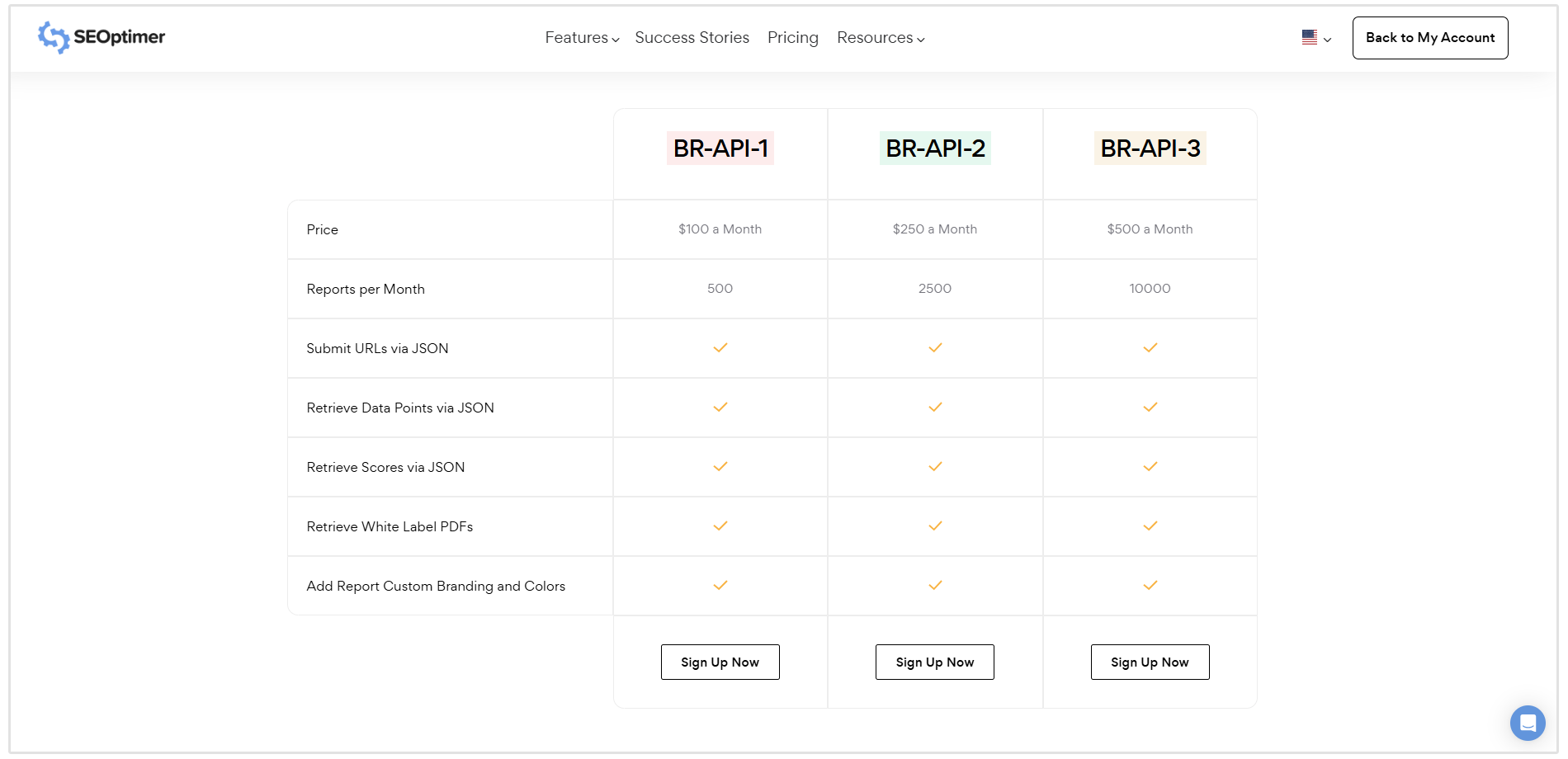
All plans include SEO API access, bulk reporting, white-label report generation, and access to SEOptimer MCP using the same API key.
Pros
- Strong fit for agencies and white-label reporting
- Useful for lead generation and sales workflows
- Includes branded PDF report generation
- Supports bulk website audits
- Provides structured SEO audit data through JSON
- Covers technical SEO, on-page SEO, performance, usability, backlinks, and selected AI search checks
- Includes access to SEOptimer MCP for AI-assisted SEO workflows
- Easier to use for audit and reporting workflows than building an SEO audit system from scratch
Cons
- More focused on website audits and reporting than rank tracking
- Not designed to replace specialist backlink APIs
- Not a raw SERP scraping API for large-scale search result extraction
SEOptimer is one of the best SEO API tools for agencies and teams that need scalable website audits, branded reports, and practical SEO data they can plug into sales, reporting, or client workflows.
If your main goal is to build a rank tracker or scrape live search results, you may want a dedicated SEO ranking API or SERP API.
But if you need to audit websites at scale and turn the results into client-ready reports, SEOptimer is one of the strongest options available.
2. DataForSEO
DataForSEO is one of the more comprehensive SEO API providers on the market.
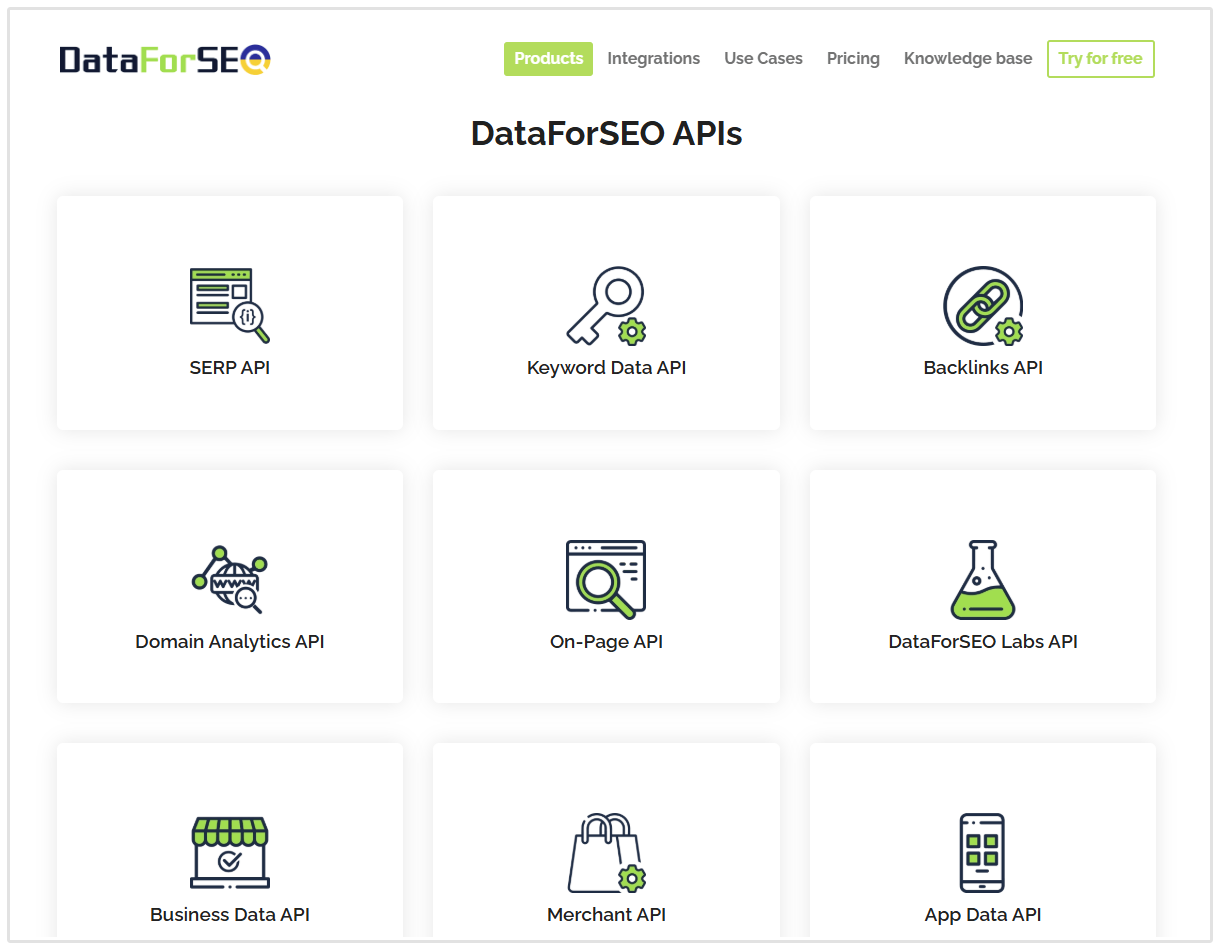
Instead of offering one single SEO API, DataForSEO provides a full API stack covering SERP data, keyword data, backlinks, on-page SEO, domain analytics, business listings, merchant data, and more.
This makes it a strong choice for teams building custom SEO software, rank tracking tools, keyword research platforms, competitor analysis dashboards, or internal SEO data systems.
DataForSEO is especially useful if you need access to multiple SEO data sources through one provider.
For example, you could use its SERP API for search result data, its Keywords Data API for keyword research, its Backlinks API for link data, and its OnPage API for website health checks.
That said, DataForSEO is more of a developer-first SEO data provider than a client-reporting tool.
It gives you access to a lot of raw and structured SEO data, but you will usually need to build your own dashboards, reports, and workflows around it.
Key Features
DataForSEO offers a wide range of SEO and digital marketing APIs, including:
- SERP API for Google, Bing, Yahoo, Baidu, Naver, Seznam, and other search engines
- Keywords Data API for keyword volume, CPC, competition, and related keyword data
- DataForSEO Labs API for keyword research, competitor analysis, ranked keywords, and visibility data
- Backlinks API for referring domains, backlinks, anchors, and link metrics
- OnPage API for technical SEO and website health checks
- Lighthouse API for performance and quality checks
- Content Analysis API for content and sentiment insights
- Domain Analytics API for domain-level visibility data
- Business Data API for local business and Google Maps-related data
- Merchant API for ecommerce and product data
- App Data API for app store data
- AI Optimization and AI-related search data features
This makes DataForSEO one of the broader options in this list, especially for teams that want to combine rank tracking, keyword research, backlink analysis, and SERP data in one data stack.
"For agency and publisher workflows, my default recommendation is DataForSEO. It is flexible, cost-effective and API-first, which makes it easier to build internal dashboards, keyword tools, SERP trackers or client reporting systems without paying for a full enterprise SEO suite.
I especially like it when the goal is to pull keyword, SERP and ranking data into your own workflow."
- David Lange, Founder at The Query Post
DataForSEO’s official pricing page also groups its APIs into categories such as search and generative engine optimization, keyword data, backlink data, on-page SEO and website health, and website visibility.
Pricing
DataForSEO uses a pay-as-you-go pricing model, which means you pay for the specific API services you use rather than subscribing to one fixed monthly plan.
According to DataForSEO, pricing is based on individual service consumption, with a minimum payment amount of $50.
Pricing varies by API type, endpoint, search engine, location, request priority, and data volume.
This can make DataForSEO cost-effective for teams with fluctuating usage, but it also means you need to estimate your expected request volume carefully before choosing it.
Pros
- Very broad SEO API coverage
- Strong option for developers and SaaS platforms
- Flexible pay-as-you-go pricing
- Useful for building custom SEO tools and dashboards
- Covers SERP data, keyword data, backlinks, technical SEO, and domain analytics
- Good fit for teams that need multiple SEO data sources from one provider
- Can be more flexible than fixed subscription-based APIs for variable usage
Cons
- Can feel complex for non-technical users
- Pricing can be harder to predict if usage varies across different endpoints
- Not mainly built for white-label client reporting
- Requires more development work to turn raw data into polished reports
- May be more than what a small agency needs if they only want website audits and client-ready PDFs
DataForSEO is one of the best SEO API options for developers and SaaS teams that need flexible access to a wide range of SEO data.
It is a good option if you want to build your own rank tracker, keyword research tool, SERP monitoring system, backlink dashboard, or custom SEO platform.
3. Semrush
Semrush offers a broad API ecosystem rather than one simple SEO API.
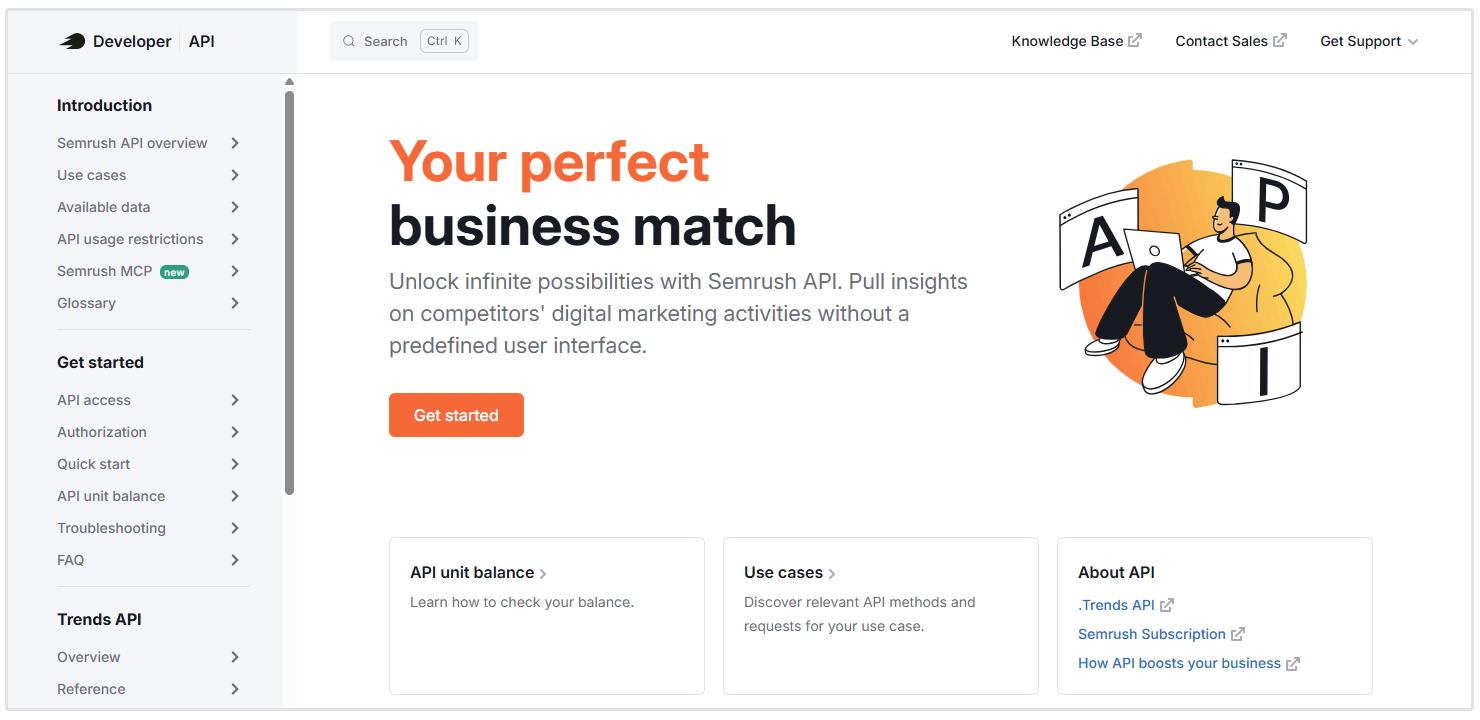
Its API options cover SEO analytics, project data, traffic and market intelligence, and local SEO data.
The main option for SEO teams is the Semrush SEO API, which can pull data from Semrush reports such as domain analytics, organic search, keyword, and backlink reports.
Semrush also offers a Projects API, which can access Position Tracking and Site Audit campaign data, including technical audit issues and site health information.
This makes Semrush a good choice for companies that already rely on Semrush data and want to bring that data into their own dashboards, BI tools, internal reporting systems, or SEO software.
However, Semrush’s API is more complex than many other options in this list.
Standard API access requires a Business subscription, API units must be purchased separately, and many reports consume units based on the number of rows returned.
Key Features
Semrush’s API ecosystem can support a wide range of SEO and marketing data use cases, including:
- Domain analytics data
- Organic search data
- Keyword analytics
- Backlink data
- URL, subdomain, and subfolder reports
- Position Tracking project data
- Site Audit campaign data
- Technical SEO errors, warnings, and notices
- Traffic and market intelligence through the Trends API
- Local SEO and Map Rank Tracker data
- Historical data for many analytics reports
- API unit balance checks
- CSV and JSON outputs, depending on the API type
The Site Audit API is especially relevant for technical SEO workflows. It lets users automatically crawl websites, identify technical SEO issues, monitor crawl progress, and retrieve structured site health reports.
Semrush also has AI-related API use cases. Its documentation says some Trends API methods include insights into traffic from AI-powered search engines and assistants such as ChatGPT, Gemini, and Copilot.
Pricing
Semrush API pricing is not as straightforward as a fixed monthly API plan.
For the Standard API, Semrush says access is available to users on the SEO Classic Business subscription.
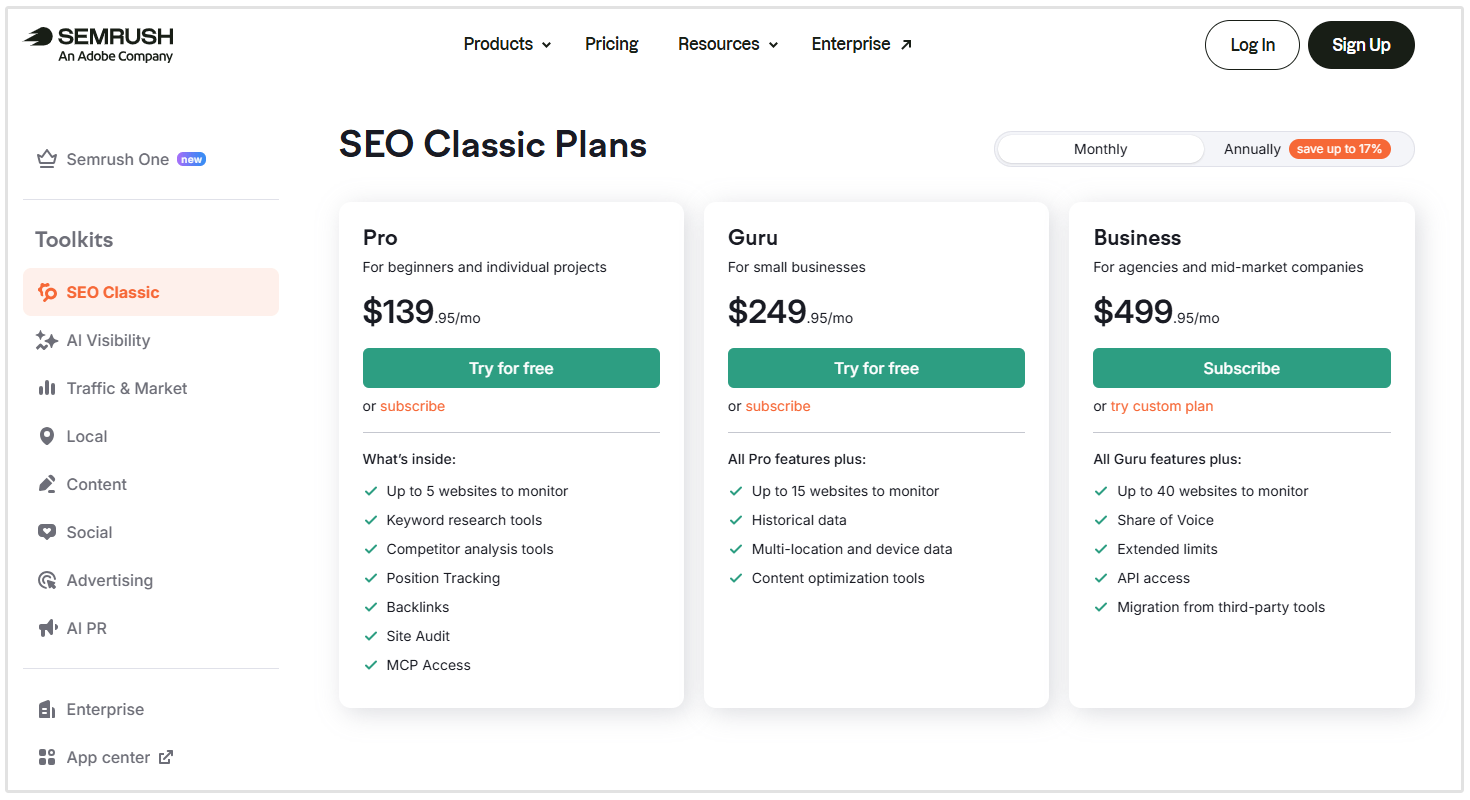
After upgrading to Business, users still need to buy API units before using the API.
Pros
- Very broad SEO and competitive intelligence dataset
- Strong for enterprise SEO teams already using Semrush
- Covers domain, keyword, backlink, URL, subdomain, and subfolder data
- Includes access to project-level data such as Position Tracking and Site Audit
- Site Audit API can retrieve technical SEO issue data
- Supports historical data for many analytics reports
- Useful for BI dashboards, internal tools, and custom reporting systems
- Trends API adds traffic and market intelligence data
Cons
- Standard API access requires a Business subscription
- API units must be purchased separately
- Pricing can be harder to estimate because many reports are charged per line
- SEO and Trends API data is generally CSV, which may require more processing than JSON
- More complex setup than simpler SEO audit APIs
- Not mainly built around white-label client-ready PDF reports
- May be too expensive or complex for smaller agencies that only need website audits and reports
Semrush is one of the top SEO API options for enterprise teams that need access to large-scale competitive SEO data, keyword data, backlink data, traffic insights, and project-level SEO information.
It will be a good fit if your team already uses Semrush and wants to bring that data into internal dashboards or reporting systems.
4. Ahrefs
Ahrefs API gives users access to data from their Ahrefs workspace so they can build custom integrations, dashboards, automations, and reporting workflows.
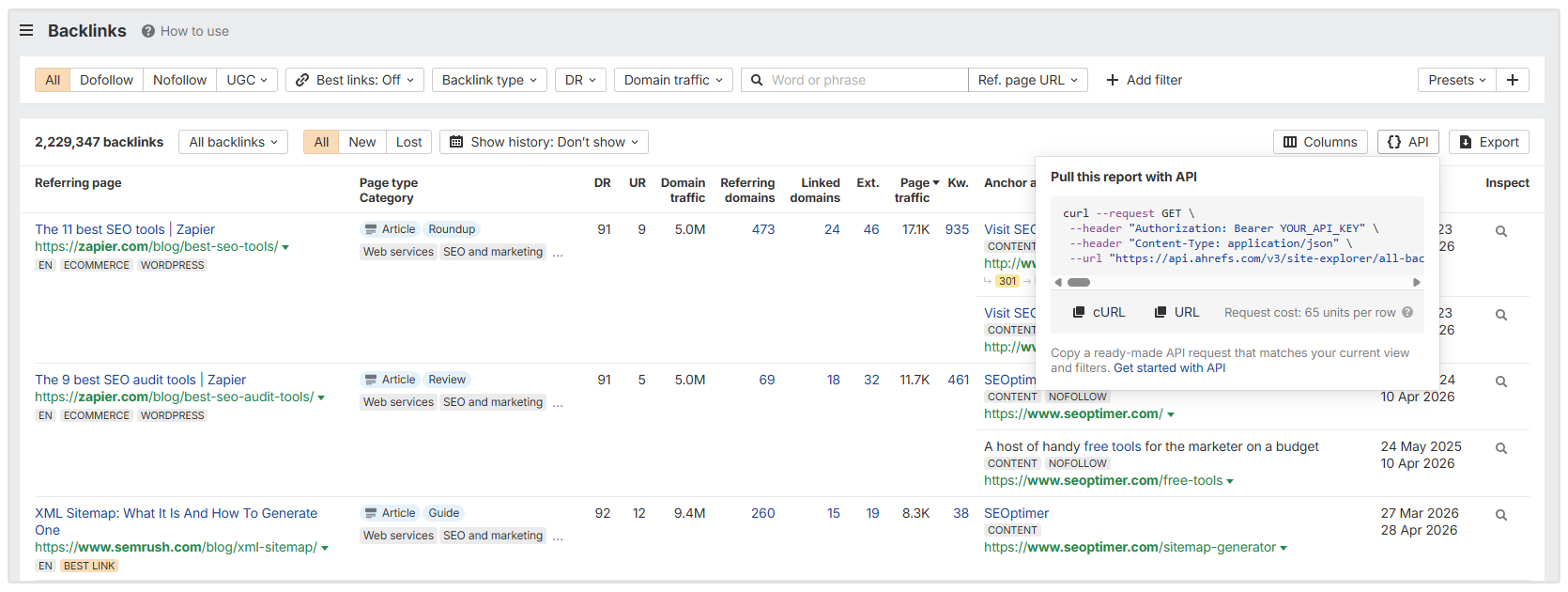
The API is especially good at backlink and competitive SEO data, which is what Ahrefs is best known for.
But Ahrefs API v3 also includes endpoints for Site Explorer, Keywords Explorer, SERP Overview, Rank Tracker, Site Audit, Batch Analysis, Brand Radar, Social Media Management, and more.
This makes Ahrefs a great option for teams that already use Ahrefs and want to pull that data into internal tools or client dashboards.
For example, you could use it to retrieve backlink data, organic traffic reports, keyword metrics, SERP results, project health scores, or rank tracking data.
Key Features
- Ahrefs API v3 includes access to several Ahrefs data sources and reports, including:
- Site Explorer: overview stats, historical charts, backlinks, and organic and paid traffic reports
- Keywords Explorer: keyword metrics, keyword lists, search volume history, country-level volume, and keyword ideas
- Site Audit: project health scores, full issue reports, and crawled page data
- SERP Overview: top 100 SERP results
- Rank Tracker: project overview, competitor reports, and Rank Tracker SERPs
- Batch Analysis: metrics for up to 100 targets per request
- Brand Radar: brand overview stats, historical performance charts, and AI prompt/citation visibility across multiple AI agents
- Management endpoints: Rank Tracker project and Keywords Explorer list management
- Subscription information: API limits and usage data
- Public endpoints: Ahrefs crawler IP addresses and ranges
Pricing
Ahrefs API is available on eligible paid plans.
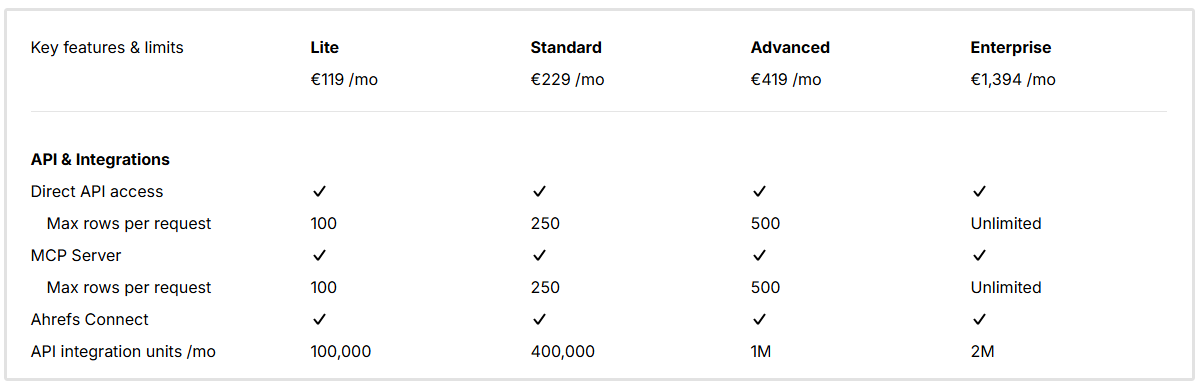
Ahrefs says that eligible paid plans include a monthly API unit allowance, and some plans support pay-as-you-go usage for additional units once the included limit is exceeded.
Ahrefs’ current pricing page lists the main paid plans as:
- Lite: $129/month
- Standard: $249/month
- Advanced: $449/month
- Enterprise: $1,499/month with an annual commitment
The pricing page also lists API access as a plan feature, with Enterprise including uncapped API access.
API usage is based on units. Most requests consume API units, with the cost depending on the number of rows returned and the fields requested.
Ahrefs states that the minimum cost for any unit-consuming request is 50 units.
Ahrefs also lets users set limits on API keys and pay-as-you-go API usage, which is helpful for controlling costs during development.
Pros
- Strong backlink and competitive SEO data
- Broad API coverage across Site Explorer, Keywords Explorer, Rank Tracker, Site Audit, and SERP data
- Useful for internal SEO dashboards and custom reporting systems
- Good option for teams already using Ahrefs
- Includes keyword, backlink, ranking, SERP, and site audit data
- Batch Analysis endpoint can check metrics for up to 100 targets per request
- API key usage limits help control spend
- Brand Radar endpoints add AI visibility and brand tracking use cases
Cons
- API access depends on eligible paid plans
- Usage-based API units can make costs harder to estimate
- Minimum request cost applies to most unit-consuming requests
- Not mainly designed for white-label PDF report generation
- Requires development work to turn raw data into client-ready reports
- May be more expensive than simpler audit-focused APIs
- Better suited for teams that already use or specifically need Ahrefs data
Ahrefs API is one of the best SEO API options for teams that need backlink intelligence, keyword metrics, SERP data, rank tracking data, and competitive SEO insights from Ahrefs.
It is a strong choice for developers and SEO teams building internal dashboards, link analysis tools, competitive research systems, or custom SEO reporting workflows.
5. SE Ranking
SE Ranking offers a broad SEO API with access to keyword research, backlinks, domain analysis, website audits, project data, and AI search visibility.
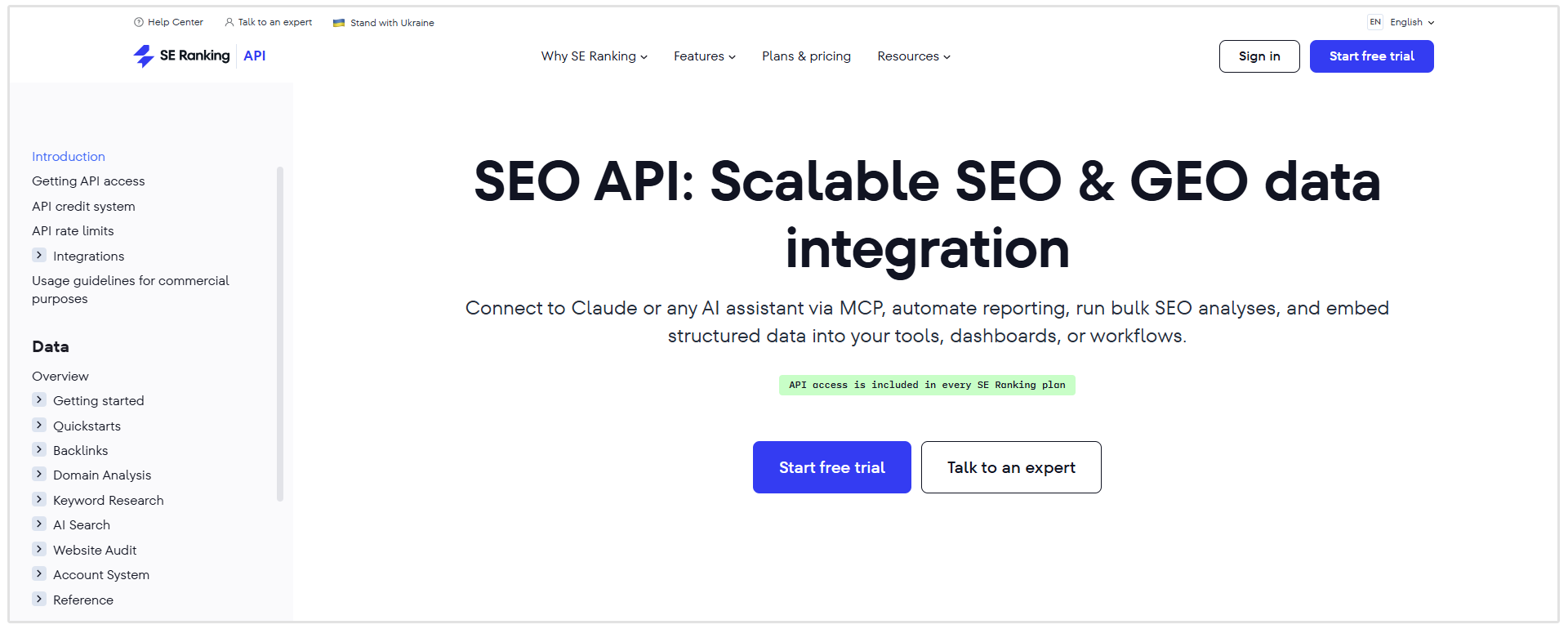
It is a good option for teams that want to build custom dashboards, automate SEO reporting, or connect SEO data to internal tools, CRMs, and BI platforms.
The API supports structured JSON responses, endpoint examples, and Postman collections. SE Ranking also includes API access in every plan, with the option to buy API access separately.
Key Features
SE Ranking’s API includes:
- Keyword Research API
- Backlinks API
- Domain Analysis API
- Website Audit API
- AI Search API
- Project Management API
- Rank tracking and keyword position data
- Technical SEO issue data
- New and lost backlink data
- AI search visibility, prompts, and brand presence data
- MCP support for connecting SEO data to AI assistants
"As an agency owner, I personally use SE Ranking and also guide my team to work with it because it combines multiple SEO and marketing data points into a single platform instead of forcing agencies to manage several disconnected tools.
For agencies managing multiple clients, having all of this accessible through one ecosystem significantly improves workflow efficiency."
- Kshitij Chaudhary, Founder of Dintellects Solutions
Pricing
- SE Ranking uses a credit-based pricing model.
- API access starts at $50 for 250,000 credits on the pay-as-you-go plan.
- The pay-as-you-go API includes access to backlinks, domain research, keyword research, website audit, AI search, and project management APIs.
Pros
- Broad API coverage across several SEO data types
- Includes keyword, backlink, audit, domain, and AI search data
- API access is included in every SE Ranking plan
- Separate pay-as-you-go API option is available
- Developer-friendly JSON responses and documentation
- Useful for custom dashboards and reporting workflows
- Includes MCP support for AI-assisted SEO workflows
Cons
- Credit-based pricing may need careful usage planning
- May be more complex than a simple SEO audit API
- Requires development work to turn API data into polished reports
- Less focused on white-label PDF audit reports than SEOptimer
SE Ranking is an all-in-one SEO API for teams that need access to several SEO datasets from one platform.
6. SerpApi
SerpApi is a search results API provider. It is not a full SEO audit API, but it is useful for teams that need to collect and analyze live search engine results.
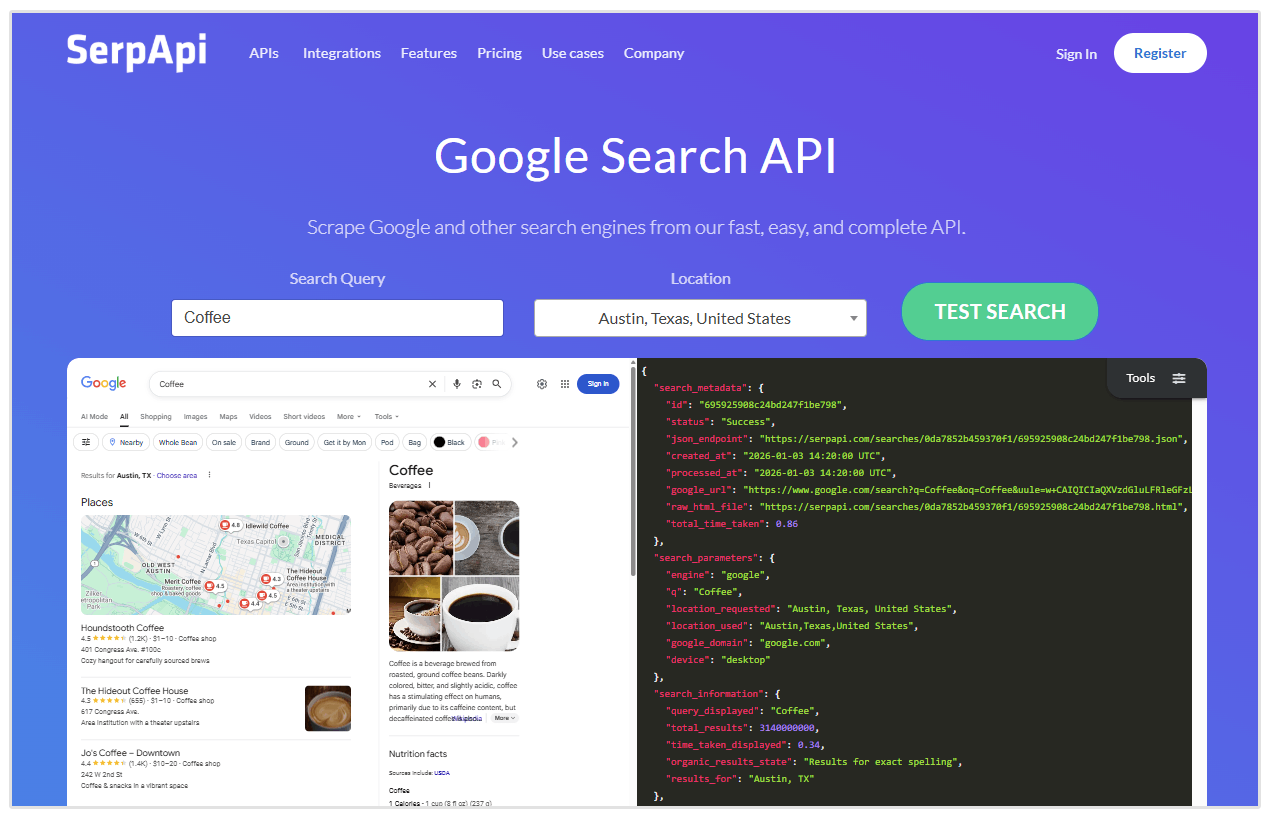
For SEO use cases, SerpApi is most useful when you need to pull Google rankings, SERP features, local results, maps data, shopping results, or AI Overview data into your own tools.
This makes it a good fit for rank tracking tools, SERP monitoring dashboards, local SEO software, and GEO tracking workflows.
SerpApi’s Google Search API lets users scrape Google search results and return structured data. It supports standard Google queries, including advanced search operators such as site:, inurl:, and intitle:.
For GEO use cases, SerpApi is also relevant because it can extract Google AI Overview results. SerpApi says its Google AI Overview API can scrape results from the AI Overview block in Google search results.
Key Features
SerpApi offers several APIs that are relevant to SEO and GEO workflows, including:
- Google Search API for organic results and SERP features
- Google AI Overview Results API
- Google AI Overview API for separate AI Overview requests
- Google Shopping AI Overview Results API
- Google Maps and local search data
- Google Local results
- Google News results
- Google Images results
- Google Shopping results
- Support for location, language, country, and device parameters
For SEO teams, the main value is access to live SERP data.
You can use it to track where pages rank, monitor SERP features, analyze competitors, collect People Also Ask data, review local results, or check whether AI Overviews appear for target queries.
"In my view, SerpApi stands out as one of the most compelling SEO APIs today due to its focus on real-time data and broad search coverage. Unlike many SEO APIs that rely on quickly outdated datasets, SerpApi delivers live results, reflecting exactly what users see as search shifts rapidly."
- Hilman Ramadhan, Customer Success Engineer at SerpApi
For GEO teams, the most relevant feature is the ability to extract AI Overview results and citations. SerpApi notes that AI Overview blocks are currently limited to English searches and a limited range of countries.
Pricing
SerpApi uses monthly plans based on the number of searches included.
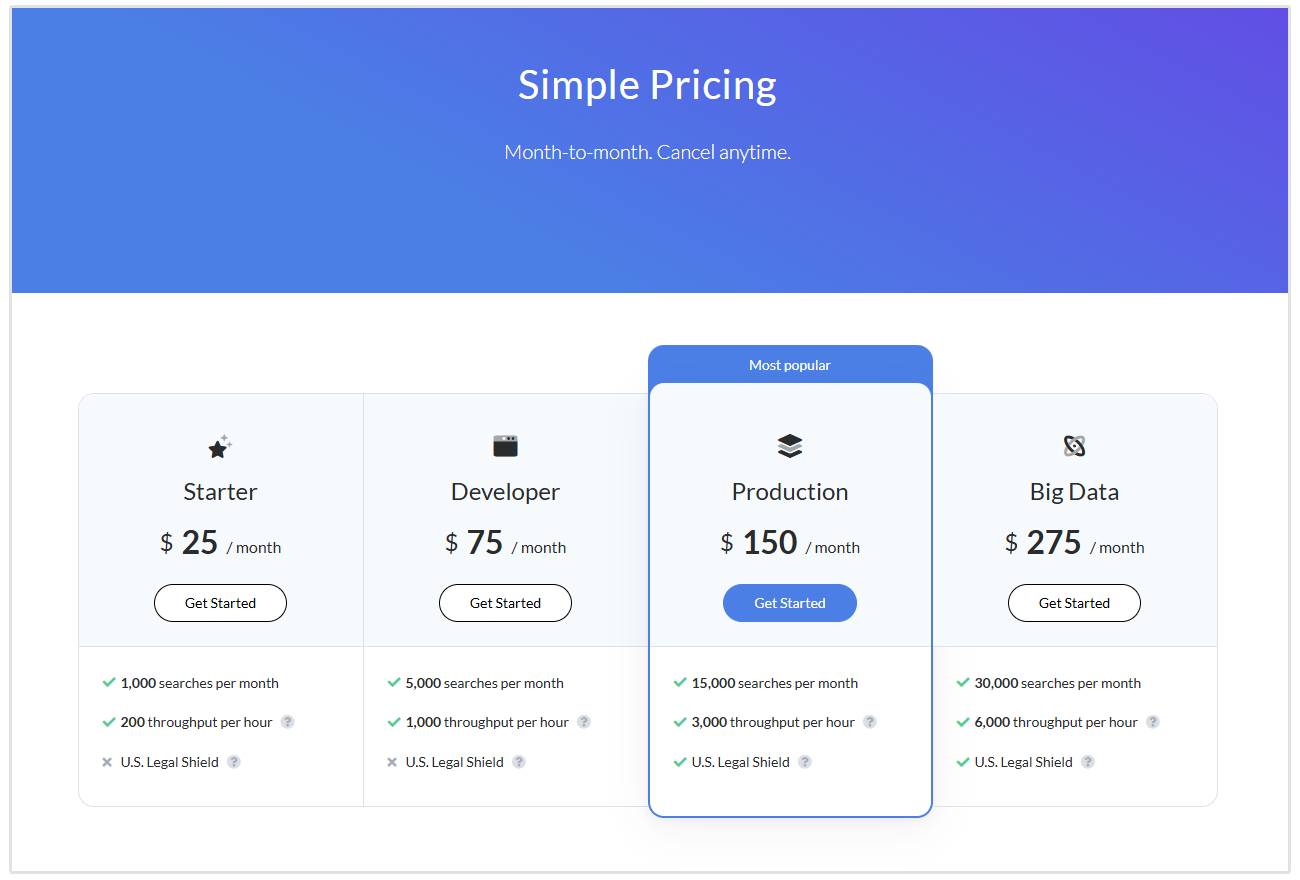
Current pricing includes:
- Free: $0/month for 250 searches per month
- Starter: $25/month for 1,000 searches per month
- Developer: $75/month for 5,000 searches per month
- Production: $150/month for 15,000 searches per month
- Big Data: $275/month for 30,000 searches per month
- Enterprise: Custom pricing
SerpApi’s pricing page also lists hourly throughput limits for each plan, such as 200 searches per hour on Starter, 1,000 on Developer, 3,000 on Production, and 6,000 on Big Data.
Pros
- Strong option for live SERP data
- Useful for rank tracking and search result monitoring
- Supports Google AI Overview extraction
- Good fit for GEO and AI search visibility workflows
- Can return structured JSON data
- Supports local, maps, shopping, news, and image search results
- Free plan available for testing
- Clear monthly pricing tiers
Cons
- Not a full SEO audit API
- Does not generate white-label SEO audit reports
- Does not replace backlink, keyword research, or technical audit platforms
- Search-based pricing can become expensive at high volume
- AI Overview availability depends on Google showing the feature for the query, language, and country
- Requires development work to turn SERP data into reports or dashboards
SerpApi is another good choice if you need a SERP API for SEO ranking, local SEO, competitor monitoring, or GEO tracking.
It is especially useful for teams that want to monitor search results, track SERP features, or collect Google AI Overview data.
7. Morningscore
Morningscore offers an all-in-one SEO API with access to keyword rankings, backlinks, onsite health data, and selected AI SEO features.
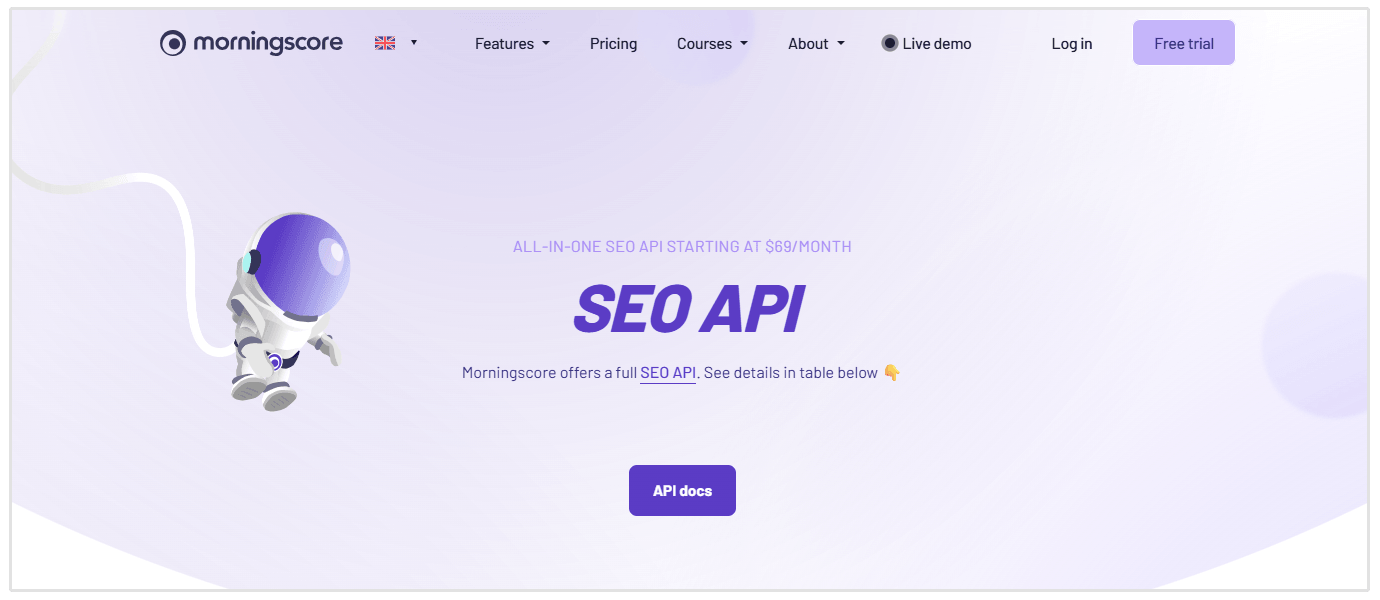
It is a good option for teams that want a more affordable SEO API without needing a large enterprise subscription.
The API can be used to pull ranking data, link data, technical SEO health data, and overall SEO metrics into dashboards, reports, or internal tools.
Morningscore is also more accessible than some enterprise API providers, with pricing starting at a lower monthly cost.
Key Features
Morningscore’s SEO API includes:
- Keyword rank tracking data
- Search volume, CPC, and position data
- Up to 40,000 automatically discovered keywords per website and country
- Onsite SEO health data
- 30+ technical SEO problem categories
- Backlink data
- Top linking domains
- New and lost link filtering
- Overall metrics such as Morningscore, Linkscore, Healthscore, and total ranking keywords
- AI credits for AI fixes and AI article generation
- Google AI Overviews and ChatGPT tracking listed as coming soon to the API
- 2 requests per second rate limit across all plans
Morningscore’s onsite API scans for issues such as missing image alt tags, long title tags, large images, slow page speed, and other technical SEO problems. Its backlink data includes top linking domains and backlink information, with link data provided by Moz.
Pricing
Morningscore’s API pricing starts at $69/month and is included across its main plans.
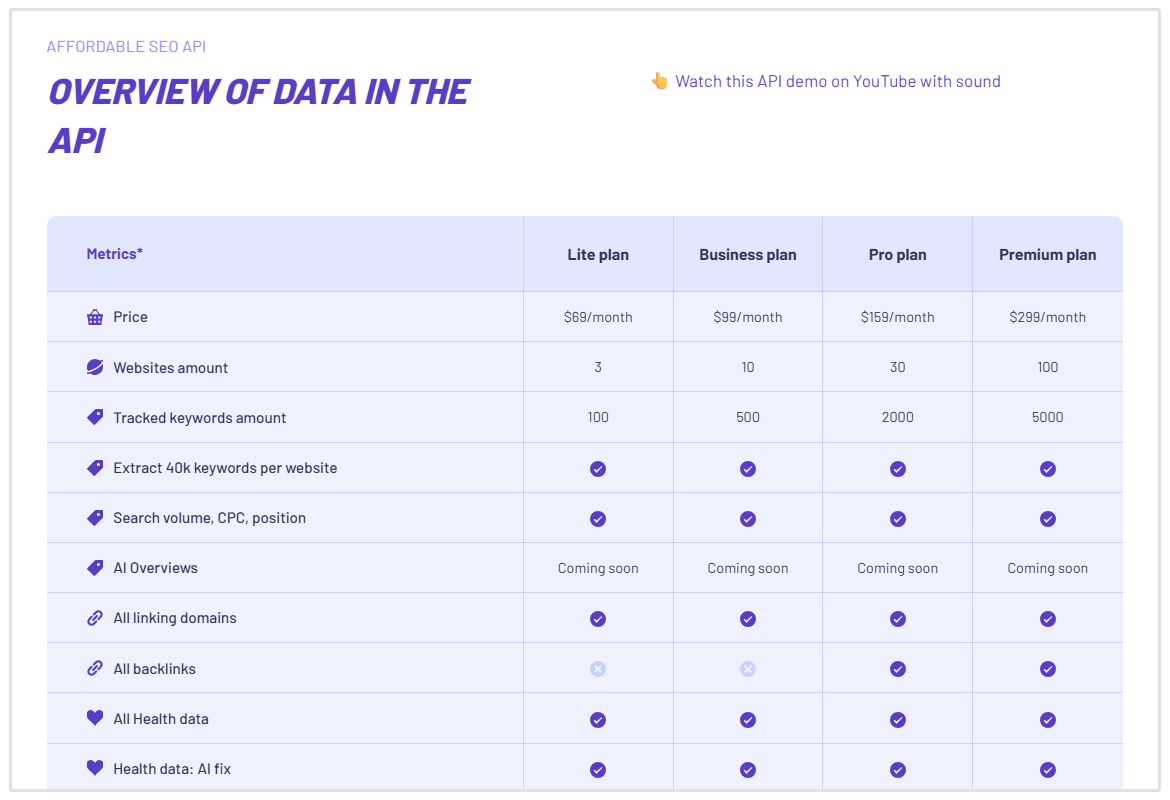
Current pricing includes:
- Lite: $69/month for 3 websites and 100 tracked keywords
- Business: $99/month for 10 websites and 500 tracked keywords
- Pro: $159/month for 30 websites and 2,000 tracked keywords
- Premium: $299/month for 100 websites and 5,000 tracked keywords
Each plan includes access to API data, with limits based on websites, tracked keywords, health crawl limits, and AI credits. Morningscore also states that every plan has a rate limit of 2 requests per second.
Pros
- More affordable starting price than many SEO APIs
- Covers keyword rankings, backlinks, onsite SEO, and overall SEO metrics
- Good option for smaller teams and budget-conscious agencies
- Includes technical SEO health data
- Backlink data is provided by Moz
- Simple pricing tiers
- AI-related features are being added to the API
Cons
- API is focused on Google data only
- Rate limit is 2 requests per second on all plans
- Not ideal for heavy-duty backlink analysis compared to tools like Ahrefs, Semrush, or Moz
- AI Overviews and ChatGPT tracking are listed as coming soon to the API
- No self-service free API test
- Requires development work to turn API data into polished client reports
- Less focused on white-label PDF reporting than SEOptimer
Morningscore is a good SEO API option for smaller teams that want affordable access to keyword, backlink, onsite, and AI-related SEO data.
It is especially useful if you want a lower-cost API for dashboards, internal tools, or lightweight reporting workflows.
8. Majestic SEO
Majestic API gives users programmatic access to Majestic’s backlink database.
Majestic is mainly known for link intelligence. That means it is useful for backlink analysis, competitor link research, link-building tools, domain scoring, and SEO reporting systems that need backlink data.
Majestic is also best known for its proprietary link metrics, including Trust Flow, Citation Flow, and Topical Trust Flow. These metrics help users assess backlink quality, link quantity, and topical relevance.
Unlike broader SEO APIs, Majestic does not focus on website audits, keyword rank tracking, or white-label SEO reports. Its strength is backlink data.
Key Features
Majestic API includes access to backlink and link intelligence data such as:
- Fresh Index backlink data
- Historic Index backlink data
- Trust Flow
- Citation Flow
- Topical Trust Flow
- Referring domains
- Anchor text data
- New and lost backlinks
- Link discovery dates
- Crawl history
- Link type and nofollow markers
- Redirect status
- Image links and ALT text attributes
- Bulk backlink data
- Referring domain data
- Backlink history
- Top pages
- Link profile data
- Related sites data
Majestic maintains two backlink indexes.
The Fresh Index contains more recent backlink data and is updated frequently throughout the day. The Historic Index is used for longer-term backlink analysis and historical link research.
The API works over HTTP and can return responses in XML or JSON. Majestic also provides a development sandbox, so developers can test API access without consuming live subscription resources.
Pricing
Majestic’s full API access is available through its API plan.
Current pricing starts at:
- API: $399.99/month for 100 million analysis units
- API annual: $333.33/month equivalent, billed annually
- Higher API tiers are available for 300 million or 1,000 million analysis units
- Custom monthly data options are also available
The API plan includes Full API access, 5 users, 100 million analysis units, 20 million retrieval units, and 500,000 index item units.
Majestic also offers Lite and Pro plans, but the pricing page lists API access as “No” for those plans.
Pros
- Strong backlink and link intelligence data
- Useful proprietary metrics such as Trust Flow, Citation Flow, and Topical Trust Flow
- Access to Fresh and Historic backlink indexes
- Good fit for link-building tools and backlink reporting
- Includes new and lost backlink data
- Supports XML and JSON responses
- Development sandbox available for testing
- Useful for competitor backlink research
Cons
- Mainly focused on backlinks, not full SEO audits
- Does not replace a keyword ranking API or SERP API
- Not designed around white-label SEO audit report generation
- API pricing starts higher than many lightweight SEO APIs
- May be too specialized for teams that need broader SEO data
- Developers may need to build their own reporting or dashboard layer
Majestic API is one of the best options if backlink data is your main priority.
It is especially useful for link-building platforms, backlink analysis tools, competitor research dashboards, and SEO teams that rely on link intelligence metrics.
9. Moz
Moz API gives users access to Moz’s link and authority data.
It is best known for metrics like Domain Authority, Page Authority, and Spam Score, which are commonly used in SEO reporting, link prospecting, competitor analysis, and domain scoring workflows.
Moz API is a good fit if you need to enrich dashboards, spreadsheets, internal tools, or client reports with authority and link metrics. It is also useful for bulk URL analysis, especially when you want to evaluate many domains or pages at once.
However, Moz API is not a full website audit API. It is better suited for off-page SEO analysis, link metrics, and authority scoring than technical SEO audits or white-label report generation.
Key Features
Moz API can be used to access SEO metrics such as:
- Domain Authority
- Page Authority
- Spam Score
- Linking root domains
- Inbound link data
- Anchor text data
- Top pages data
- Final redirect data
- Link intersect data
- Link status data
- URL metrics
- Usage data
Moz’s API is often used for link analysis, authority checks, domain scoring, SEO reporting, and building custom SEO tools.
Pricing
Moz API pricing is based on rows of data.
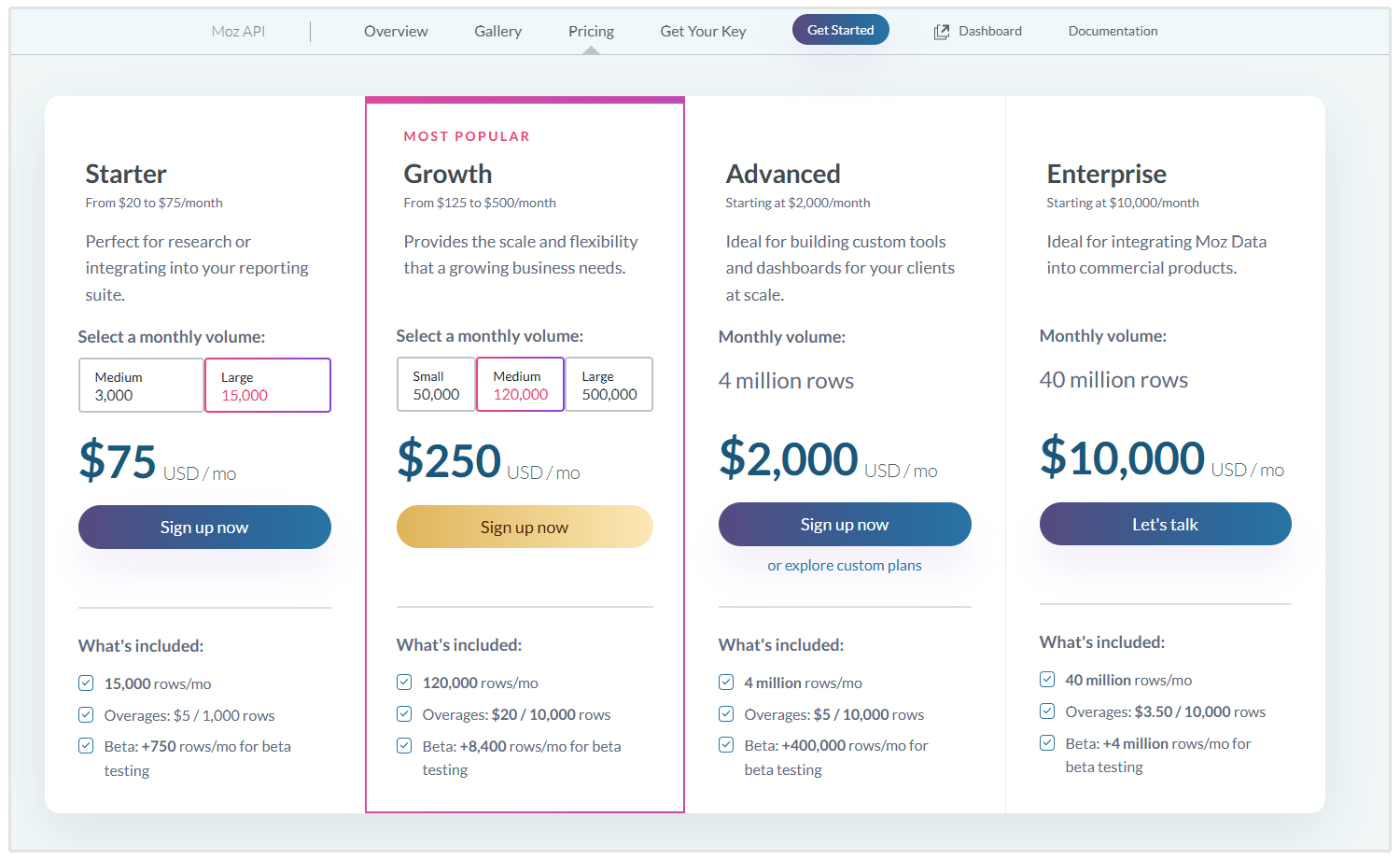
Current publicly listed API pricing includes:
- Starter: from $75/month for 15,000 rows
- Growth: from $250/month for 120,000 rows
- Advanced: from $2,000/month for 4 million rows
- Enterprise: from $10,000/month for 40 million rows
Pros
- Strong authority metrics, including Domain Authority and Page Authority
- Useful Spam Score metric for link quality checks
- Good fit for bulk URL and domain analysis
- Useful for link prospecting and domain scoring
- More affordable entry-level API plans than many enterprise SEO APIs
- Commonly used in SEO reporting tools and spreadsheet workflows
- Good option for adding authority metrics to internal dashboards
Cons
- More focused on link and authority metrics than full SEO audits
- Not a dedicated SEO ranking API or SERP API
- Does not generate white-label SEO audit reports
- Requires development work to turn raw API data into dashboards or reports
- Higher-volume plans can become expensive
- Not ideal if you need technical SEO checks, report PDFs, or lead-generation audits
Moz API works well for domain scoring, backlink analysis, link prospecting, and SEO reporting tools. It is also one of the more accessible options if you only need basic authority data through an API.
How to Choose the Best SEO API
Selecting the right website rank API depends heavily on your specific product goals, technical capabilities, and budget.
Data Coverage
Ensure the API provides the specific datasets you need.
If you are building a reporting tool, you likely need a mix of keywords, backlinks, and site health metrics. If you only need rank tracking, a specialized SERP scraper might suffice.
Data Accuracy and Freshness
Stale data leads to bad decisions.
Look for providers that offer daily updates for rank tracking and frequent refreshes for search volumes.
Test the API's outputs against your own Google Search Console data to verify accuracy before committing to a long-term contract.
Ease of Integration
Your engineering team will thank you for choosing an API with clean documentation, clear response schemas, and reliable uptime.
Look for RESTful APIs that return data in standard JSON formats.
Reporting Capabilities
If your goal is to present data to end-users, consider how the API structures its outputs.
Some APIs simply dump raw metrics, while others categorize issues and provide actionable insights that you can display directly in your software.
Pricing and Usage Limits
Understand the rate limits and concurrency rules of your chosen provider.
A cheap API is useless if it bottlenecks your application by limiting you to one request per second.
Model your expected data volume and calculate the total cost to ensure it aligns with your budget.
"When it comes to choosing an SEO API, I would focus on transparency: how is the pricing structured and can I easily get a sense of what it would cost me? Can I easily run tests to check the pricing? Again, per-usage is an advantage but it does make it unpredictable until you run tests. But in the long run, I prefer this billing model because you don’t overpay for features you don’t need."
- Deian Isac, Founder at goBOFU
White Label and Custom Branding
For agencies, the ability to present data under your own brand is crucial.
Seek out APIs that allow you to generate reports, PDFs, or dashboard widgets without exposing the original data provider's branding.
"A good API for SEO should be set up in a way that allows you to work seamlessly through workflows WITHOUT creating unncessary cleanups every week."
- Timothy Clarke, Local SEO & Reputation Manager at Thrive Local
Why Choose SEOptimer’s SEO API
For agencies and software platforms focused on growth, SEOptimer stands out as the best SEO API available.
While other platforms focus purely on raw data extraction, SEOptimer is built specifically with lead generation and client reporting in mind.
By integrating the SEOptimer API, you can seamlessly embed professional, comprehensive website audits into your own applications.
The API evaluates technical SEO, performance, usability, and security, returning actionable insights in a clean JSON format. F
urthermore, it supports the automatic generation of white-label PDFs, allowing you to deliver immediate value to your prospects and clients without manual intervention.
With straightforward pricing and highly reliable infrastructure, SEOptimer empowers you to scale your agency's acquisition strategy effortlessly.
FAQ
What is the best SEO API?
The best SEO API depends entirely on your use case.
For agency lead generation and white-label auditing, SEOptimer is the top choice. For high-volume, flexible programmatic queries, DataForSEO is excellent. For deep backlink intelligence, Ahrefs leads the pack.
Can I use an SEO API for lead generation?
Absolutely. Many agencies use APIs like SEOptimer to power free website audit widgets on their homepages.
When a prospect enters their URL, the API runs a real-time audit and returns a branded report in exchange for the prospect's email address.
What can you do with an SEO API?
You can build custom client reporting dashboards, automate large-scale technical site audits, track keyword rankings across thousands of locations, monitor competitors' organic strategies, and develop entirely new SaaS products based on search data.
Is an SEO API the same as a rank tracking API?
Not always. A rank tracking API is a specific type of SEO API focused solely on retrieving keyword positions from search results.
A full-stack SEO API provides broader data, including backlink profiles, search volumes, on-page technical audits, and competitor traffic estimations.
How do SEO API credits work?
Many providers use a credit or unit system to manage server loads.
You purchase a block of credits, and different API endpoints cost different amounts.
For example, pulling a simple keyword volume might cost 1 credit, while triggering a real-time site crawl might cost 50 credits. Always review a provider's specific API documentation to understand their consumption rules.
Conclusion
Relying on manual tools to monitor search performance limits your ability to scale.
By integrating a top-tier API, you automate the heavy lifting, ensure data accuracy, and free up your team to focus on executing high-level strategy.
Evaluate your data requirements, compare the pricing models outlined above, and choose the provider that aligns with your business goals. Implement the right technology today, and build a search strategy that drives measurable revenue for your business.