

As you know by now, more people are using AI to discover businesses, products and information online.
But while traditional SEO tools show how your website performs in search results, they don’t reveal whether your brand is being understood, cited or recommended by AI platforms.
That’s why we’re very excited to introduce SEOptimer’s new GEO Audit: a comprehensive report that shows how ready and visible your website is across AI search.
What is SEOptimer’s GEO Audit?
The GEO Audit evaluates how easily AI platforms can access, understand, cite and recommend your website.
It combines technical checks, content analysis, citation data and prompt tracking across ChatGPT, Claude, Gemini and Perplexity.
How to Run your First GEO Audit
Running a GEO Audit only takes a few simple steps, here’s how:
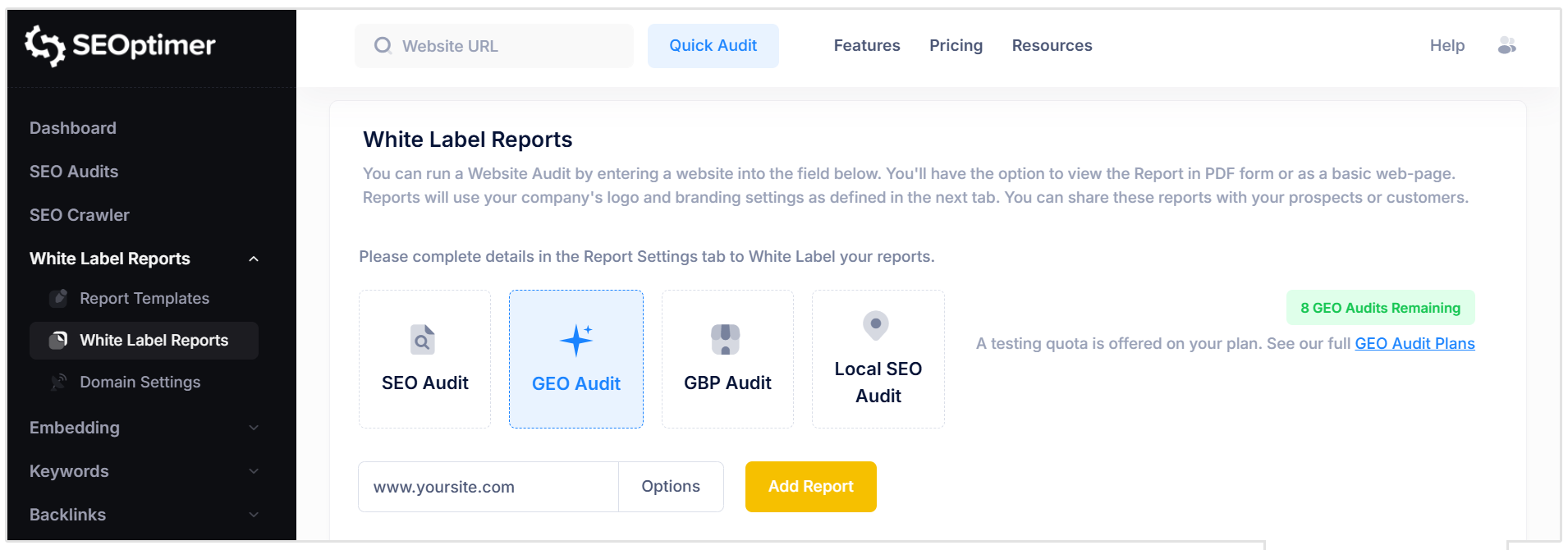
- Sign in to your SEOptimer account and open White Label Reports from the left-hand menu.
- Select White Label Reports and choose GEO Audit from the available report types.
- Enter the website URL you want to audit in the field provided.
- Review the report Options if you need to adjust any settings before running the audit.
- Click Add Report to begin generating your GEO Audit.
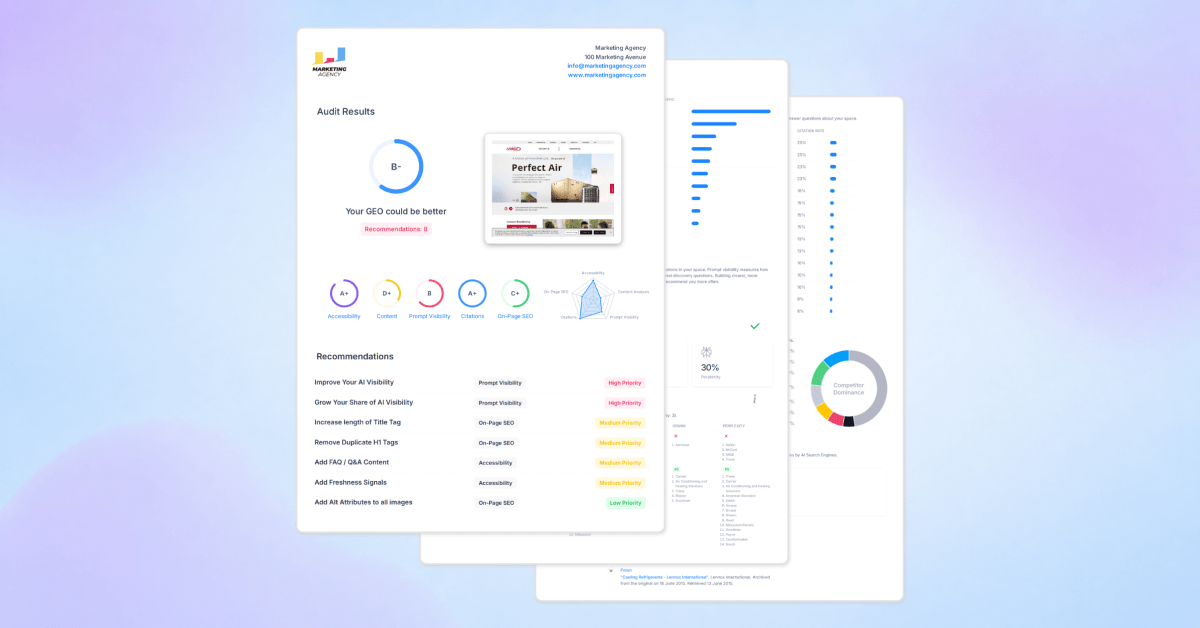
Once the audit is complete, you can open the report to review your GEO score, results across each category and get prioritized recommendations for improving your website’s visibility in AI search.
What the GEO Audit Checks
The GEO Audit evaluates your website across five main areas:
- LLM Accessibility: Checks whether AI crawlers can access and process your website.
- LLM Content Analysis: Evaluates how clearly your website communicates your business, offering and expertise, and whether its content is structured for AI systems to understand and cite.
- Prompt Visibility: Measures whether your brand appears for relevant prompts across ChatGPT, Claude, Gemini and Perplexity, and compares your visibility with competing brands.
- Important Citations: Identifies links to your website from high-authority sources frequently cited by AI platforms, including Wikipedia, Reddit and YouTube.
- On-Page SEO: Reviews essential SEO elements that help search engines interpret your website, such as title tags, headings, structured data, canonical tags and image alt text.
The report also brings these findings together into an overall GEO grade and provides recommendations so you can quickly see what needs attention.
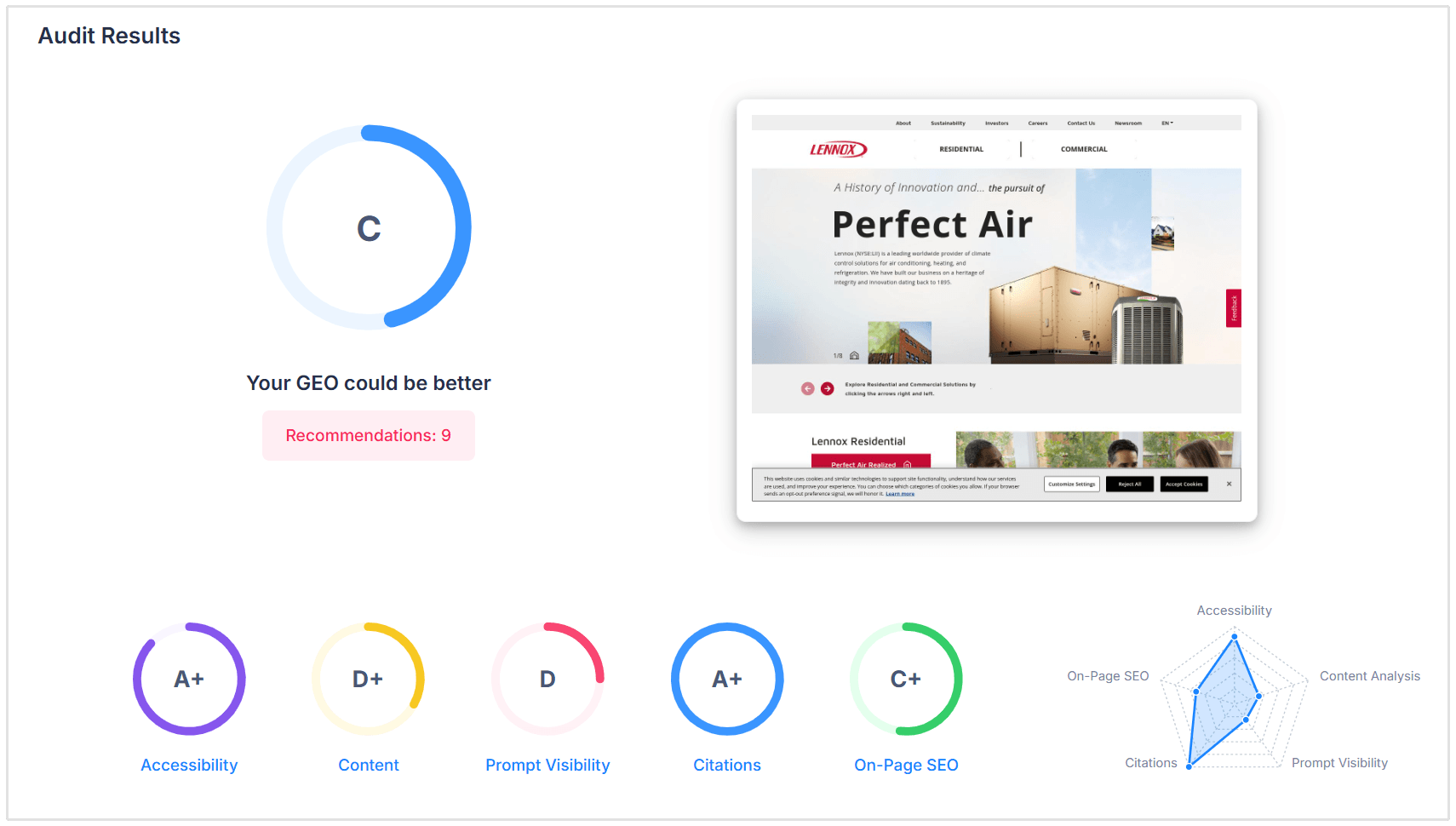
Now, let’s take a look at each of the GEO Audit sections in more detail.
1. LLM Accessibility
The LLM Accessibility section checks whether AI crawlers can access, crawl and process your website’s content.
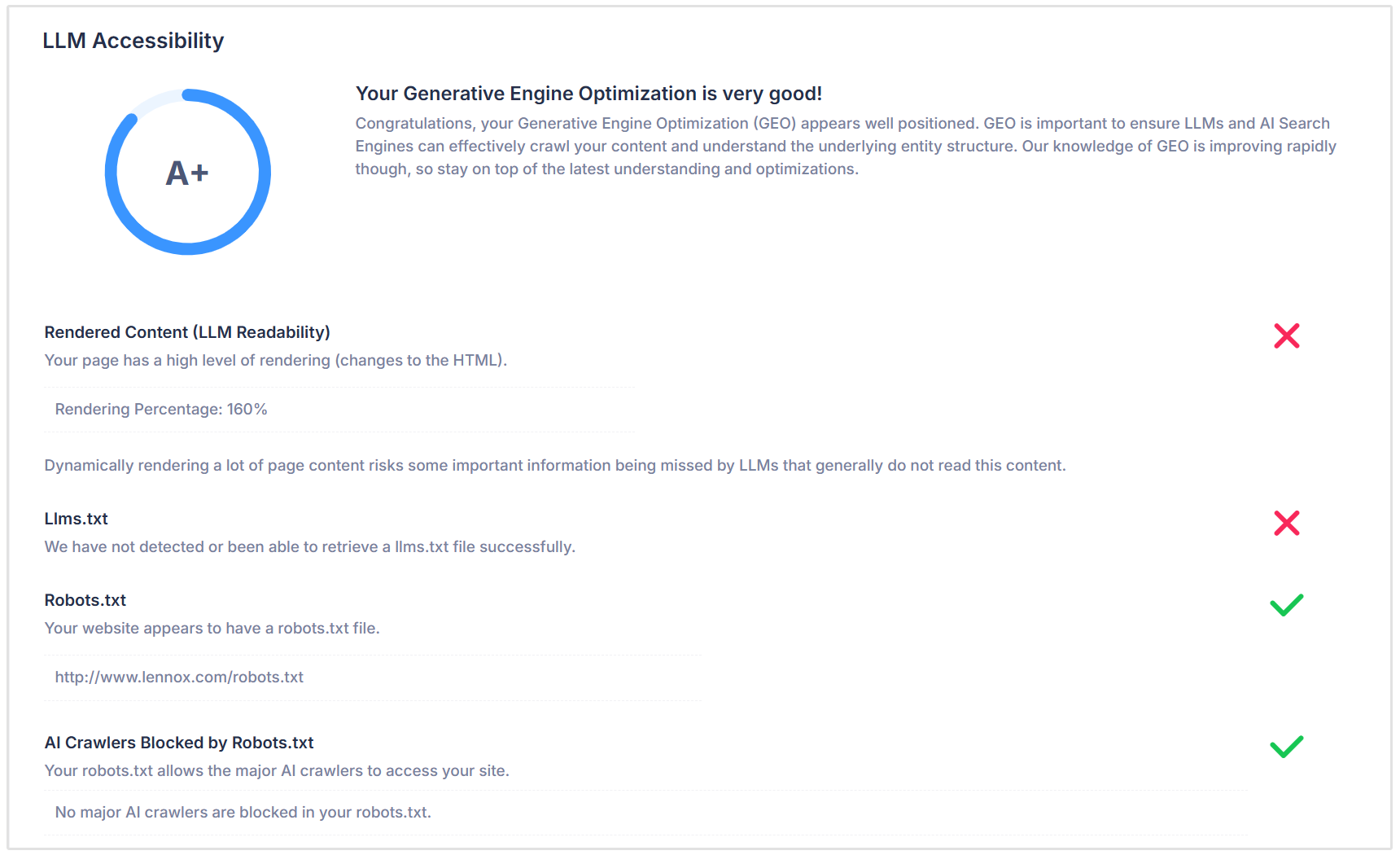
Even good content is unlikely to appear in AI-generated answers if the systems behind them cannot reliably reach or interpret it.
This section includes the following checks:
- Rendered Content: Measures how much additional content is loaded through JavaScript after the initial HTML, which may make important information harder for some AI crawlers to process.
- LLMs.txt: Checks whether your website has an llms.txt file that provides AI systems with guidance about your most important content.
- Robots.txt: Confirms that a valid robots.txt file can be found on your website.
- AI Crawler Access: Identifies whether your robots.txt file blocks any major AI crawlers from accessing the site.
- XML Sitemaps: Checks for XML sitemaps that help crawlers discover and understand the structure of your website.
- Noindex Tag: Detects page-level meta tags that instruct search engines and crawlers not to index the page.
- Noindex Header: Checks for X-Robots-Tag HTTP headers that may prevent the page from being indexed.
These checks highlight technical barriers that could limit your website’s discoverability and visibility across AI search platforms.
2. LLM Content Analysis
The LLM Content Analysis section evaluates how clearly your website communicates its identity, offering, expertise and supporting information.
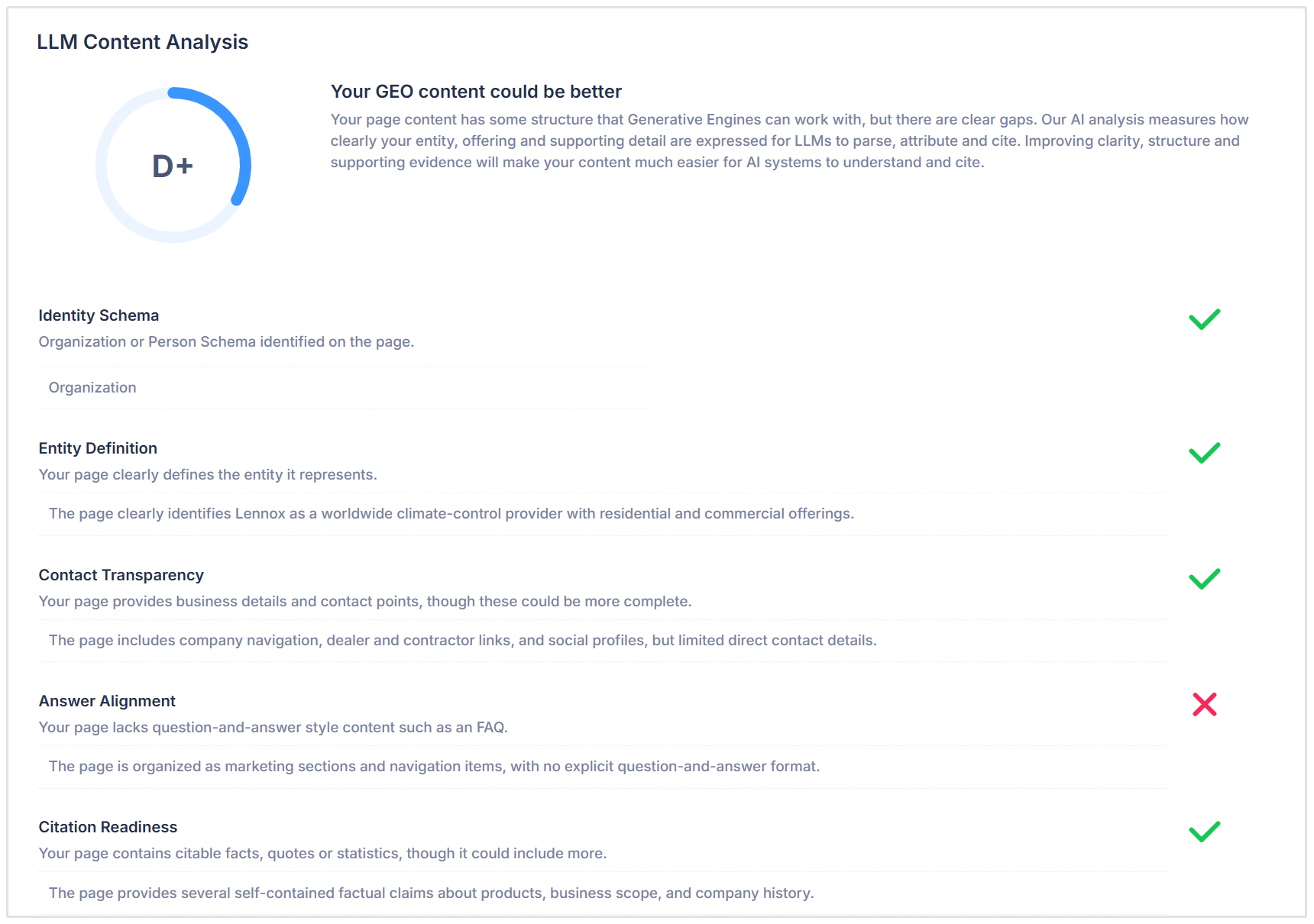
Unlike some of our other technical checks, it uses advanced AI to assess whether your content is easy for large language models to understand, attribute and potentially cite in generated answers.
These are the following checks we show you in this part of the GEO audit:
- Identity Schema: Checks for structured data that clearly identifies the organization or person behind the website.
- Entity Definition: Evaluates whether the content clearly explains who your business is, what it offers, who it serves and where it operates.
- Contact Transparency: Checks whether visitors and AI systems can easily find reliable business and contact details.
- Answer Alignment: Assesses whether the page provides direct, useful answers to questions your target audience may ask.
- Citation Readiness: Evaluates whether the content contains clear, self-contained facts, claims or insights that AI platforms could reference in their answers.
- Content Structure: Reviews how logically the content is organized using headings, short sections, lists and other formatting elements.
- Content Freshness: Looks for signals showing that the information is current, accurate and regularly maintained.
- Authority and Trust Signals: Assesses evidence of credibility, such as author expertise, references, reviews, accreditations and supporting sources.
The main takeaway from this section is to show you how effectively your content helps AI systems understand your business and determine whether its information is useful and trustworthy enough to surface in relevant answers.
3. AI Search Rankings
The AI Search Rankings section shows how your website is currently performing in Google Search and AI Overviews.
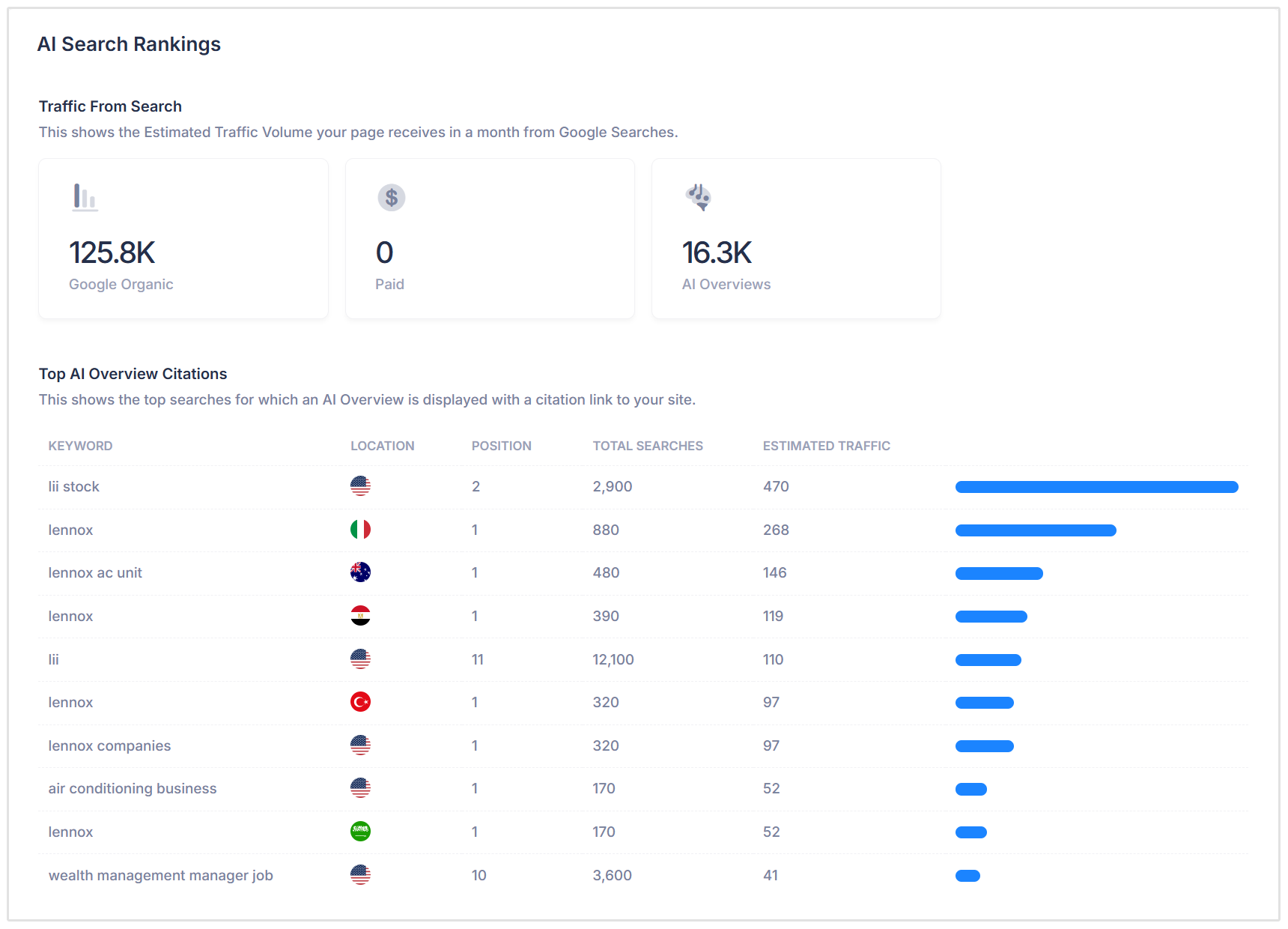
It highlights the search queries already driving visibility and identifies where your website is being cited as a source in AI-generated results.
This section includes the following insights:
- Estimated Organic and PaidTraffic: Shows the estimated monthly traffic your website receives from its organic keyword rankings, as well as from any paid marketing campaigns.
- Top AI Overview Citations: Identifies keywords where your website is cited as a source within a Google AI Overview.
And then under Top AI Overview Citations we show you a table with the following info:
- Keyword: Displays the search query that triggered the AI Overview citation.
- Location: Shows the country or search market where the ranking was detected.
- Position: Indicates your website’s organic ranking position for the keyword.
- Total Searches: Provides the estimated monthly search volume for each keyword.
- Estimated Traffic: Estimates how much organic traffic your website receives from that particular ranking.
The data from this section help you understand where your website is already gaining visibility through both traditional search results and Google’s AI-generated answers.
4. Prompt Visibility
The Prompt Visibility section shows whether your brand is recommended when potential customers ask AI platforms questions related to your business.
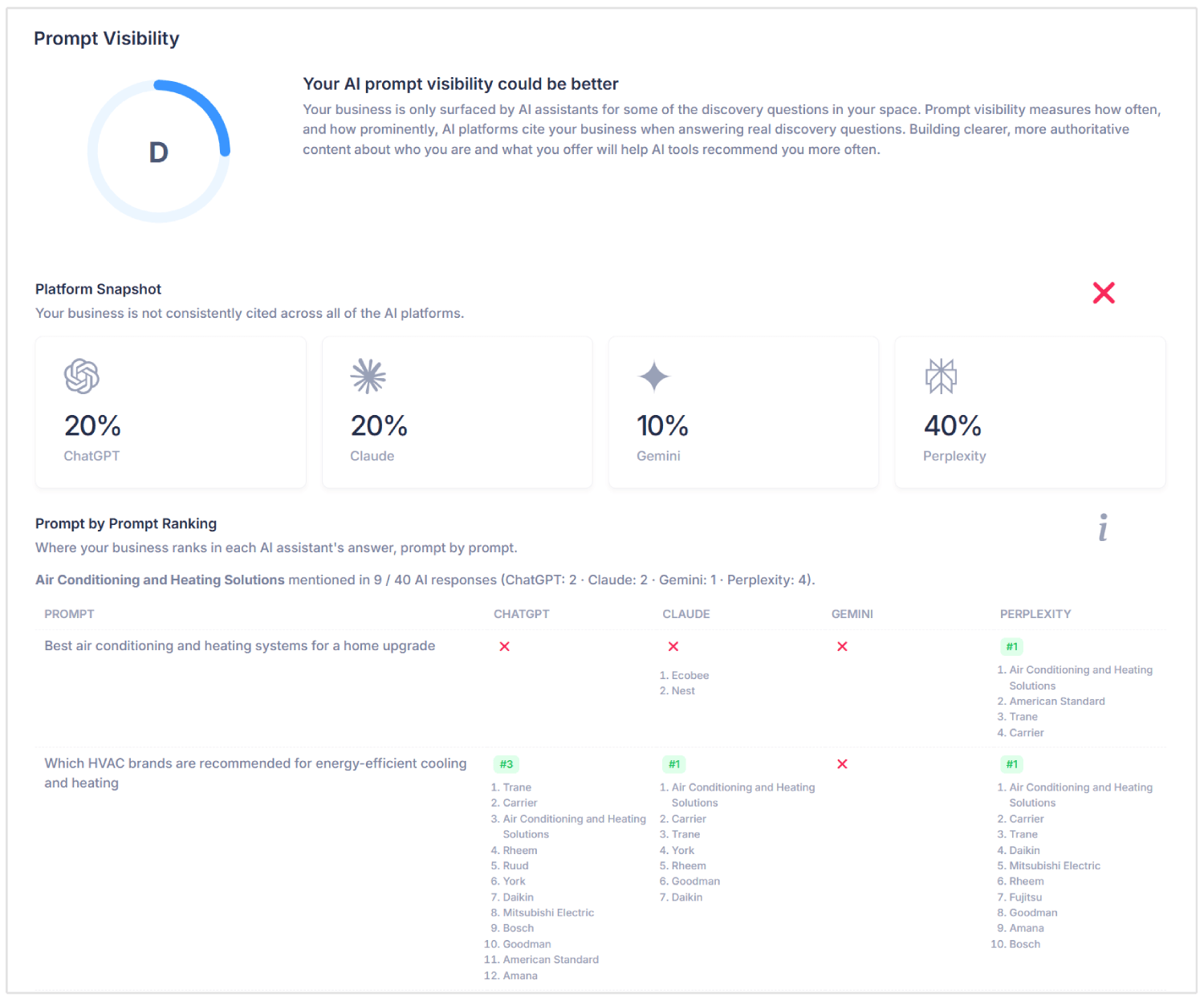
Our tool automatically generates relevant, high-intent prompts based on your website’s content, business category, products or services, and target location. This creates a realistic set of questions someone might use when searching for a business like yours.
We then test these prompts across ChatGPT, Claude, Gemini and Perplexity to see which brands appear and where they are positioned.
Here is what you can see in this section:
- Platform Visibility: Shows the percentage of tested prompts where your brand appeared on each AI platform.
- Prompt Rankings: Breaks down your performance for every prompt, including whether your brand was mentioned and its position in the response.
- Competing Brands: Identifies other businesses recommended alongside your brand.
- Competitor Citation Rate: Compares how frequently your brand and its competitors appeared across the tested responses.
- Average Position: Shows the average ranking position of each brand whenever it was recommended.
- Competitor Dominance: Measures each brand’s overall share of visibility across the tested prompts and AI platforms.
But remember, because AI-generated responses can change between searches, these results represent a snapshot of your visibility at the time of the audit.
5. Important Citations
The Important Citations section checks whether your website is referenced across high-authority platforms that are frequently used as sources by AI search engines and LLMs.
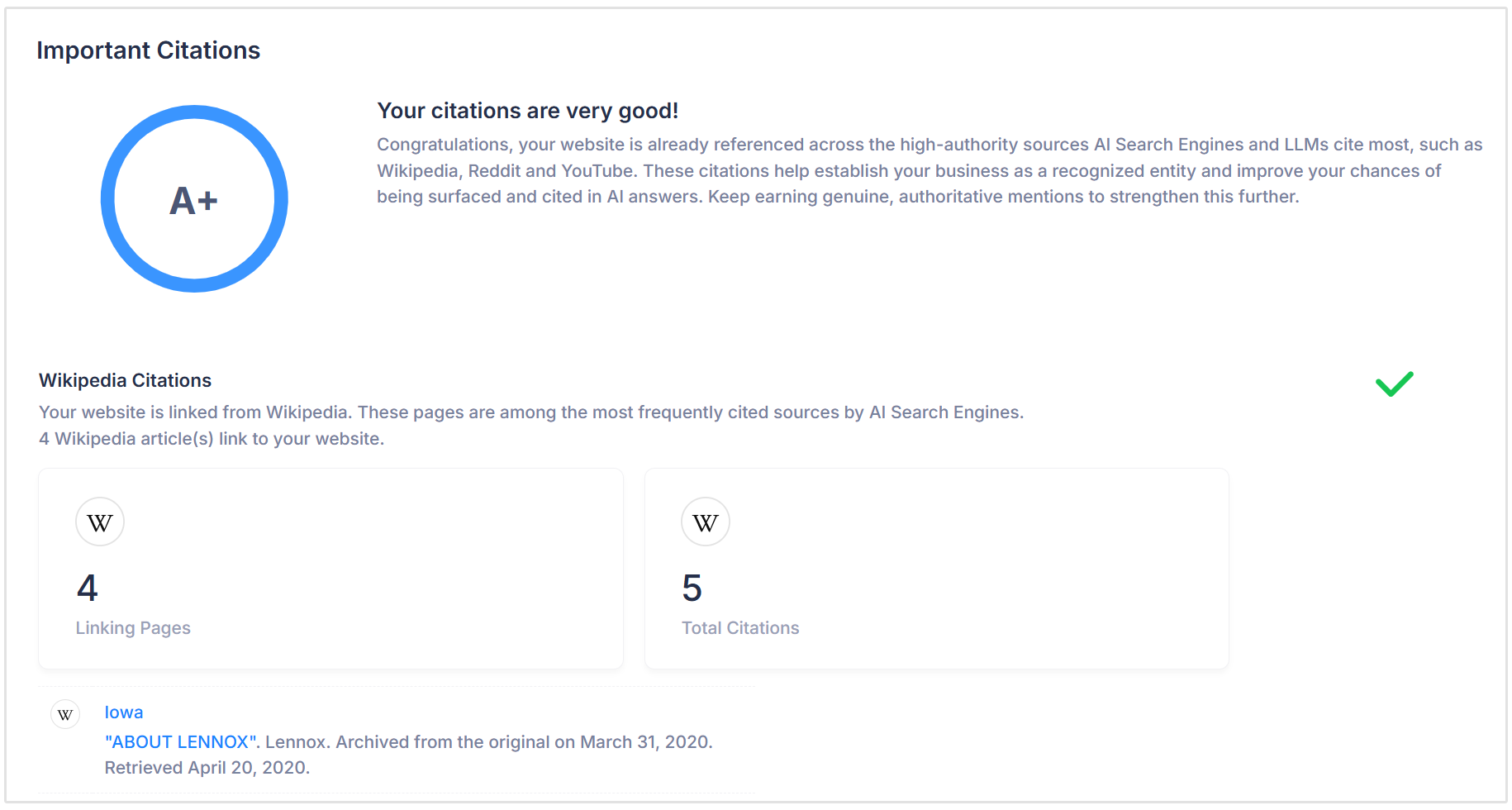
These third-party citations can strengthen your brand’s authority, help establish it as a recognized entity and improve its chances of being surfaced in AI-generated answers.
This section includes citations from:
- Wikipedia: Identifies Wikipedia articles that link to your website, including the number of linking pages and total citations found.
- Reddit: Finds links to your website within relevant Reddit discussions, showing where your brand, content or products have been referenced by online communities.
- YouTube: Detects links to your website from YouTube videos and descriptions, helping reveal where your brand has been referenced through video content.
These checks show whether your website is earning genuine mentions from influential external sources.
While these citations do not guarantee AI visibility, they can provide valuable authority and trust signals that support your wider GEO strategy.
6. On-Page SEO Results
The On-Page SEO Results section reviews the core SEO elements that help search engines understand, index and display your website correctly.
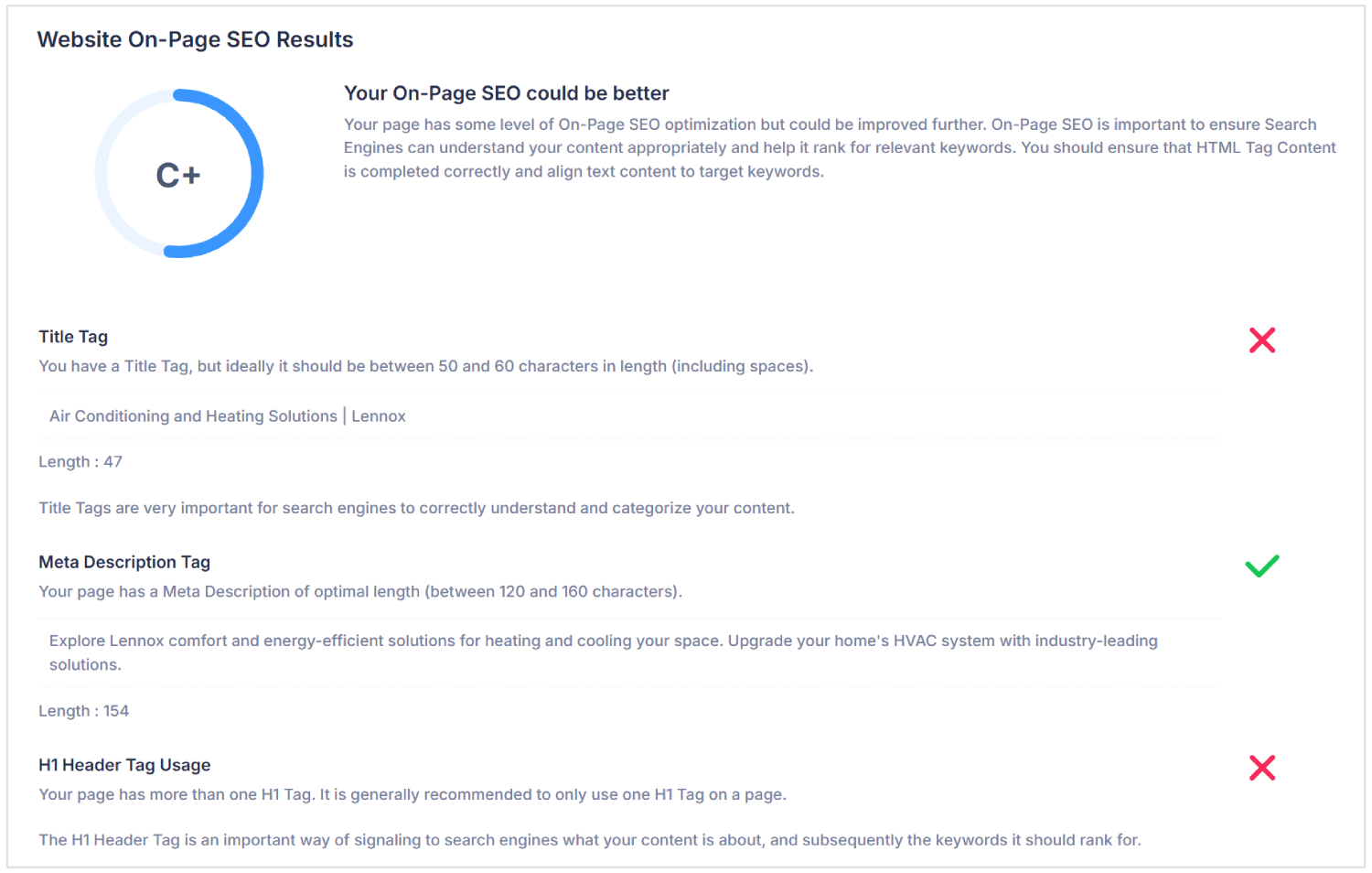
A strong traditional SEO foundation remains important for GEO because AI search platforms often rely on existing search signals to discover and interpret content.
This section includes the following checks:
- Title Tag: Checks whether the page has a relevant title tag of an appropriate length.
- Meta Description: Reviews whether a clear and properly sized meta description is present.
- H1 Header: Checks that the page uses a clear main heading and flags multiple H1 tags.
- Image Alt Attributes: Identifies images that are missing descriptive alternative text.
- Canonical Tag: Confirms whether the page specifies its preferred URL to help prevent duplicate-content issues.
- Search Engine Access: Checks whether conventional search engine crawlers are blocked through the website’s robots.txt file.
- Schema.org Structured Data: Detects structured data that provides search engines with additional context about the page and its content.
These checks highlight foundational SEO issues that could affect how easily your website is discovered and understood in both traditional and AI-powered search.
Which Plans Include GEO Audits
GEO Audits are available on SEOptimer’s White Label and White Label & Embedding plans.
Each plan includes 10 GEO Audits, making them ideal for marketers and agencies that want to assess AI search readiness and visibility for their own websites or client sites.
GEO Audits are not currently included with the DIY SEO plan.
GEO Audit Pricing
Additional GEO Audits are available through the following monthly add-on plans:
- GEO 1: $29 per month for 50 GEO Audits
- GEO 2: $49 per month for 100 GEO Audits
- GEO 3: $79 per month for 250 GEO Audits
FAQs
What is the difference between an SEO Audit and a GEO Audit?
An SEO Audit evaluates how well your website is optimized for traditional search engines such as Google. A GEO Audit focuses on AI search, checking whether AI platforms can access and understand your content, cite your website and recommend your brand in relevant answers.
Which AI platforms does the GEO Audit test?
The GEO Audit tests your brand’s prompt visibility across four leading AI platforms: ChatGPT, Claude, Gemini and Perplexity.
How are the AI prompts selected?
SEOptimer automatically selects relevant prompts based on your website’s content, business category, products or services, and target location. These prompts are designed to reflect the kinds of questions potential customers may ask when looking for a business like yours.
Can free users run the GEO Audit?
No, GEO Audits are currently available on the White Label and White Label & Embedding plans. Additional audits can also be purchased through one of our monthly GEO add-on plans.