



Learning how to find high volume low competition keywords is the secret to driving thousands of visitors and increasing organic traffic to your website.
By focusing your efforts on these low competition keyword opportunities, you can start seeing results much faster, especially if you’re working with a new or growing site that doesn’t yet have strong domain strength.
In this guide, you are going to learn exactly what these low competition and high volume keywords are, why they matter, and the exact step-by-step process you can use to create a low competition high traffic keywords list for your niche.
What are Low Competition Keywords?
Low competition keywords are search phrases that very few websites are trying to rank for.
Because there is less content targeting these terms, search engines have fewer pages to choose from when ranking results. This creates an opportunity for newer or smaller websites to secure visibility on the first page.
Most keyword research tools measure keyword difficulty on a scale from 1 to 100 or label it as Low to High.
A low difficulty score typically means that the websites currently ranking for that term have weaker backlink profiles, poor content, or low domain strength.
This means that if you can create a comprehensive, helpful page targeting one of these keywords, you have a strong chance of outranking the existing results.
Many people confuse low competition keywords with long-tail keywords.
While it is true that longer, more specific phrases (like “best invoicing software for freelancers”) often have lower competition, shorter keywords can also be low competition if they target an emerging trend or a niche topic that has not yet been saturated.
Taking this a step further, high search volume and low competition keywords represent the most valuable opportunities in SEO.
When you identify high search low competition keywords, you are uncovering gaps where your content can quickly gain visibility and capture meaningful traffic.
These opportunities exist in almost every industry.
They often appear when new trends emerge, when user behaviour shifts, or when people begin searching for more specific solutions that larger websites have not yet addressed.
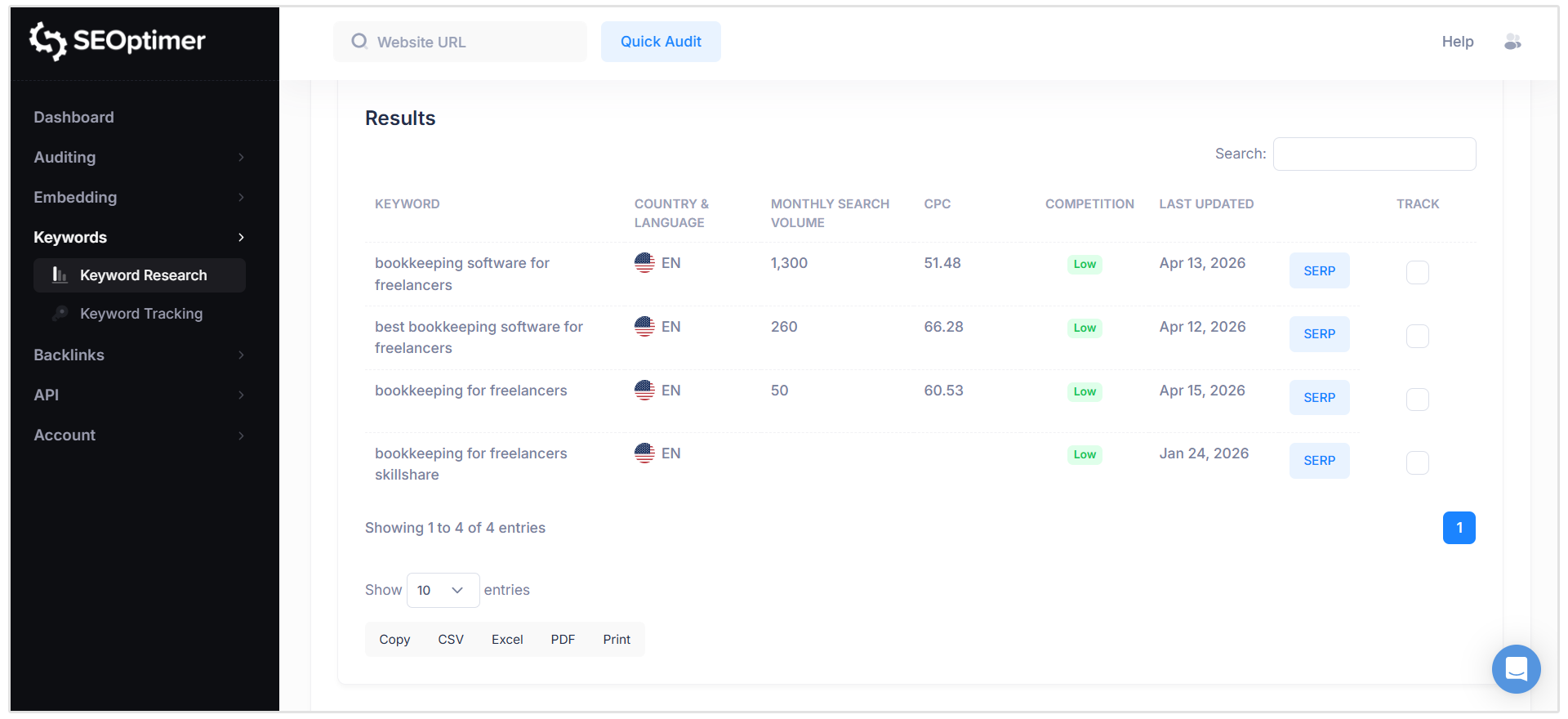
For example, our Keyword Research tool found that a keyword like “bookkeeping software for freelancers” has around 1,300 monthly searches while still being classified as low competition.
Building a low competition high traffic keywords list around these gaps can accelerate your business and website’s growth.
Related Reading: 9 Popular Types of Keywords in SEO (and How to Use Each)
Ben Lund, Founder at Rise Marketing Group, explains that some of the best opportunities come from spotting trends early:
A way to find low competition keywords is to identify keywords that are currently low competition, and low volume now, but will be forecasted to increase in the future.
For example, for any industry, think of upcoming news, changes, etc, and start creating content for these keywords. You'll have a solid chance of securing a good position, and as the demand for these keywords increase, you can ride the wave up.
A good way to think of this is brainstorm for an industry:
- New laws upcoming
- Industry news
- Changes in user behavior, etc.”
How to Find High Volume Low Competition Keywords (Step-by-Step)
You do not need to rely on guesswork to create a low competition high traffic keywords list.
Follow this step-by-step process to uncover low competition keywords for your niche.
1. Brainstorm Broad Topics
Before you use any software, you need to identify some broad, general keywords.
Start by brainstorming broad topics related to your business, products, or services.
Create a Google Sheets document and add the core themes your target audience cares about.
For instance, if you run a pet supply store, your broad topics might include topics like:
- Dog food
- Cat litter
- Aquarium maintenance
- Puppy training
Do not worry about search volume or difficulty at this stage of the process.
You are simply creating a database of seed keywords.
These broad terms will serve as the starting point for your research, allowing you to dig deeper and find the specific variations that are actually easy to rank for.

2. Use a Keyword Research Tool
To find specific keyword data, you need specialized keyword research tools.
SEOptimer has a Keyword Research Tool that reveals search volume, keyword difficulty, and estimated traffic for over 3 billion tracked keywords across 90 countries and several languages.
So take your seed keywords from step 1 and enter them into SEOptimer.
The tool will generate a massive list of related search terms.
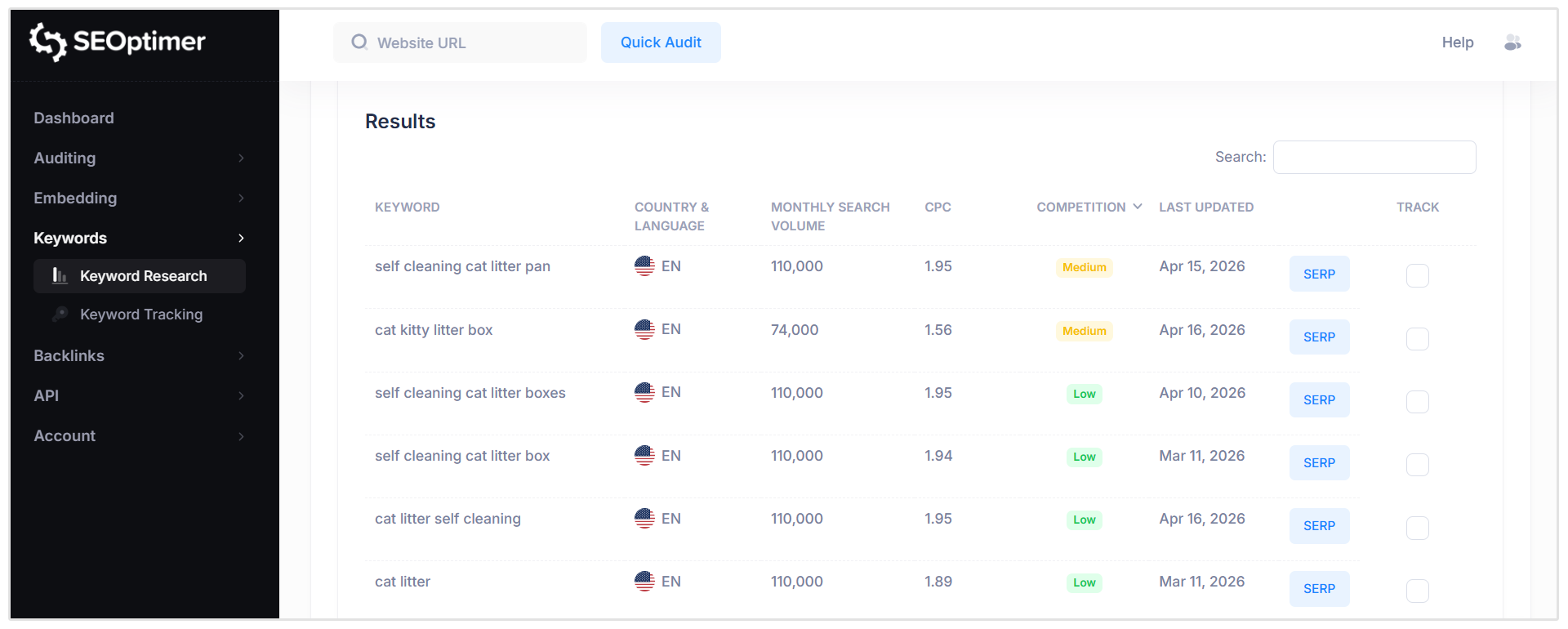
For instance, our keyword research tool found 50 different variations for the keyword “cat litter.”
You will see the monthly search volume for your target phrase, along with adjacent keyword opportunities.
3. Filter for Low Competition Keywords
Once you have a list of hundreds or thousands of keyword ideas, you need to narrow it down to find the low competition keywords.
Going through every keyword manually is not only time-consuming, it is also unnecessary. Most keyword research tools have built-in filters that do the heavy lifting for you.
In SEOptimer, you can do this by sorting or filtering the Competition column until you see keywords labelled as Low.
This filtering process instantly highlights the low competition high search volume keywords you can target.
4. Analyze the SERPs
Before you commit to writing an article or building a page, you must look at the actual Search Engine Results Page (SERP).
SEOptimer's Keyword Research Tool allows you to inspect the first page of results for any keyword instantly by clicking on the blue SERP button.
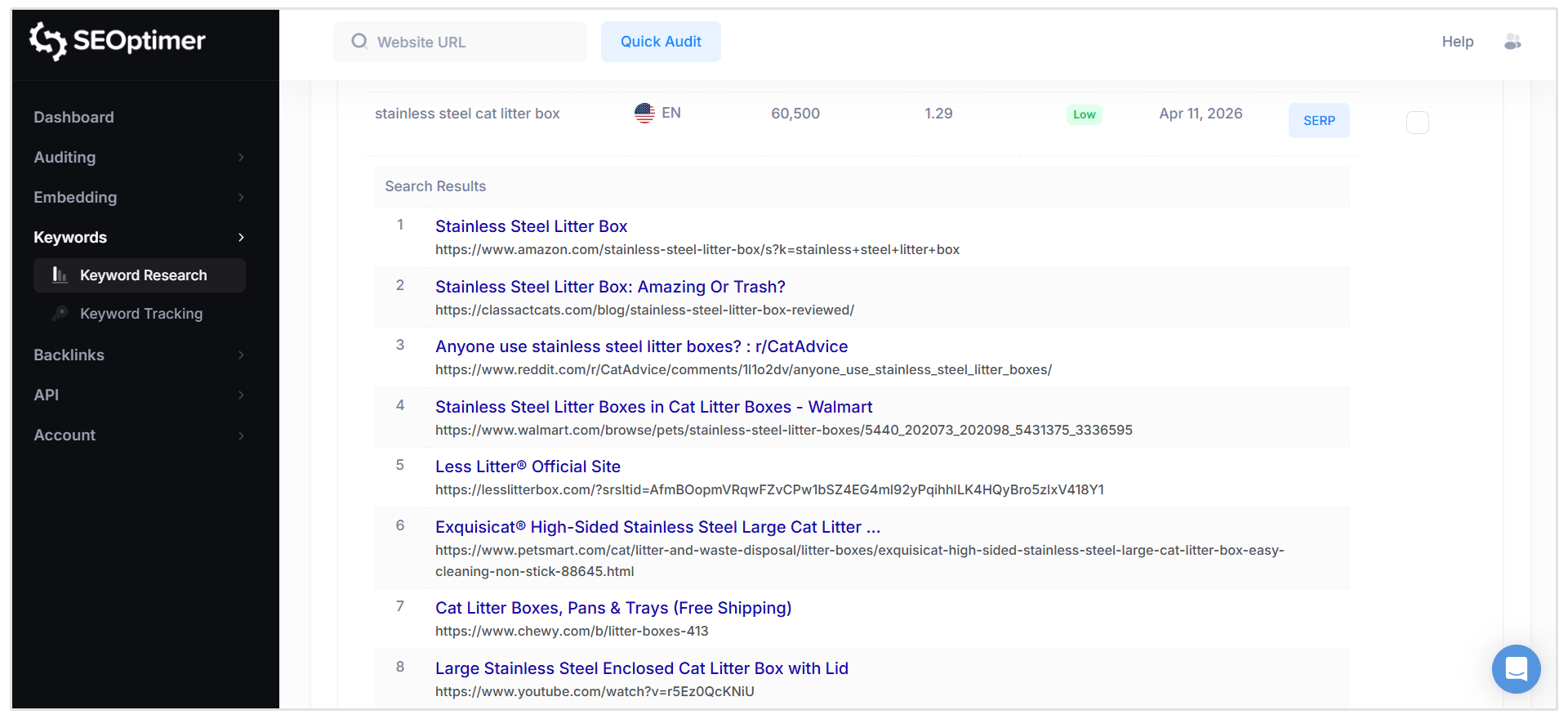
Look closely at the websites currently ranking in the top ten positions.
Are they massive, authoritative brands, or are they small blogs and forum posts?
If you see sites like small independent blogs ranking on the first page, that is a green light.
5. Find Gaps Competitors Miss
Your competitors have likely missed numerous keyword opportunities.
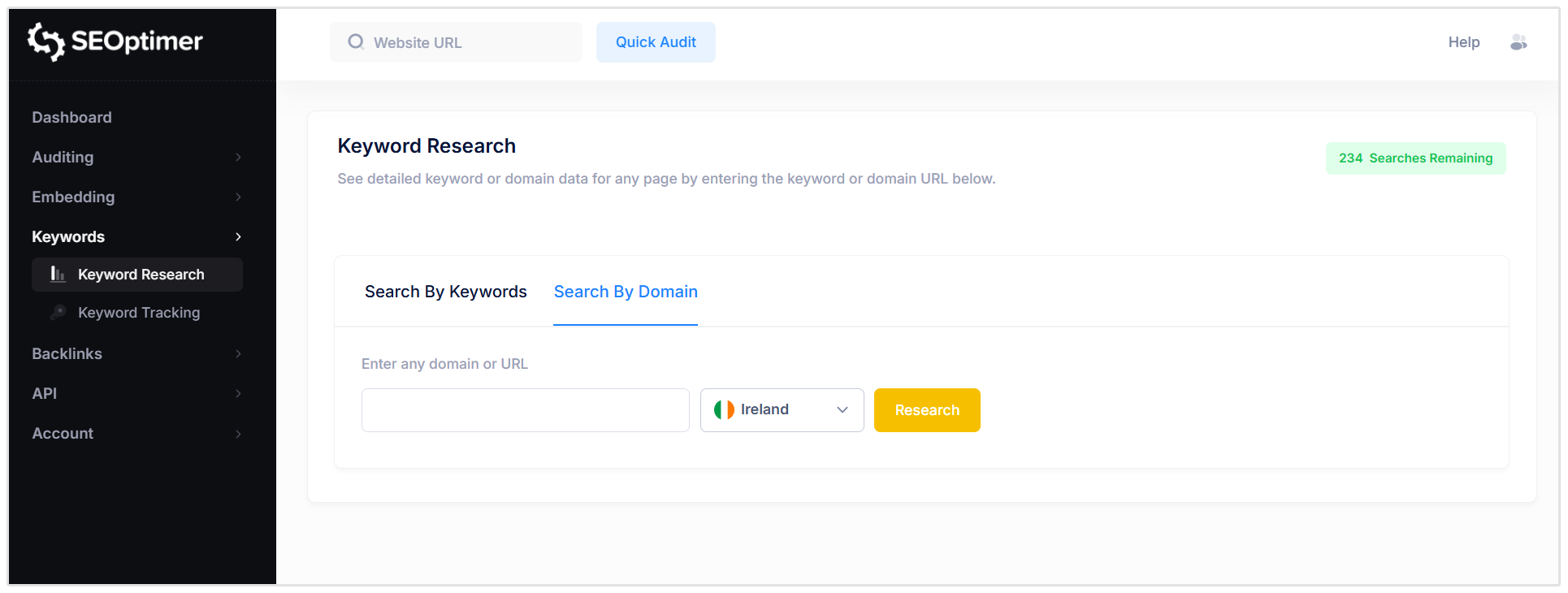
You can use SEOptimer to research a competitor's domain and extract all the keywords their site ranks for.
To do this, simply click on the Search by Domain option in our keyword research tool.
By analyzing multiple competitors, you can identify topics they cover weakly or have ignored entirely.
Inspect competitor websites and pages and look for high-volume questions your competitors have answered poorly.
If a competitor has a thin, 300-word article ranking for a low competition keyword, you can create a comprehensive, 1,500-word guide that can easily outrank them.
This gap analysis is a highly effective way to build a low competition high traffic keywords list.
Related Reading: What is Keyword Gap Analysis & How to Do It in 5 Steps
6. Cluster Related Keywords into Topics
Instead of writing one article for every single keyword, group closely related terms together.
This strategy is known as keyword clustering.
If you find low competition keywords like "best portable blender for travel," "small battery powered blender," and "portable blender for smoothies," you should not write three separate posts.
Create one definitive guide that targets the primary keyword and naturally incorporates the secondary variations in your headings and body paragraphs.
This helps your page rank for dozens of related search queries simultaneously, multiplying your total traffic.
As Tiffany Davidson, Squarespace Web Designer and SEO expert, explains:
This approach creates a compounding effect. Instead of relying on one keyword to perform, the page becomes relevant for multiple searches, which strengthens overall visibility and helps stabilize rankings long term.
It’s a more sustainable way to grow traffic, especially for small businesses or newer websites that can’t compete for highly competitive terms right away.
- Tiffany Davidson, Squarespace Web Designer and SEO Expert
More Strategies to Find Hidden Low Competition Keyword Ideas
Sometimes the best keyword opportunities do not show up immediately in standard keyword reports.
You have to get creative to find the hidden phrases your audience uses.
Here are three manual strategies to uncover low competition high search volume search terms.
Check Google Autocomplete Suggestions
Google wants to help users find information quickly, so it predicts what they are going to type.
You can use this feature to your advantage.
Go to Google and type in your seed keyword, but do not press enter.
Look at the dropdown list of suggestions. These suggestions are based on real, frequent searches performed by users.
To find even more variations, type your seed keyword followed by the letter "a", then "b", and so on.
This alphabet soup method reveals hundreds of long-tail phrases that are highly relevant but often ignored by major sites.
Then take these keyword suggestions and add them to your favourite keyword research tool to check the level of competition
Taking the example of the cat litter keyword, these are the suggestions I found when typing in “cat litter l” into Google.

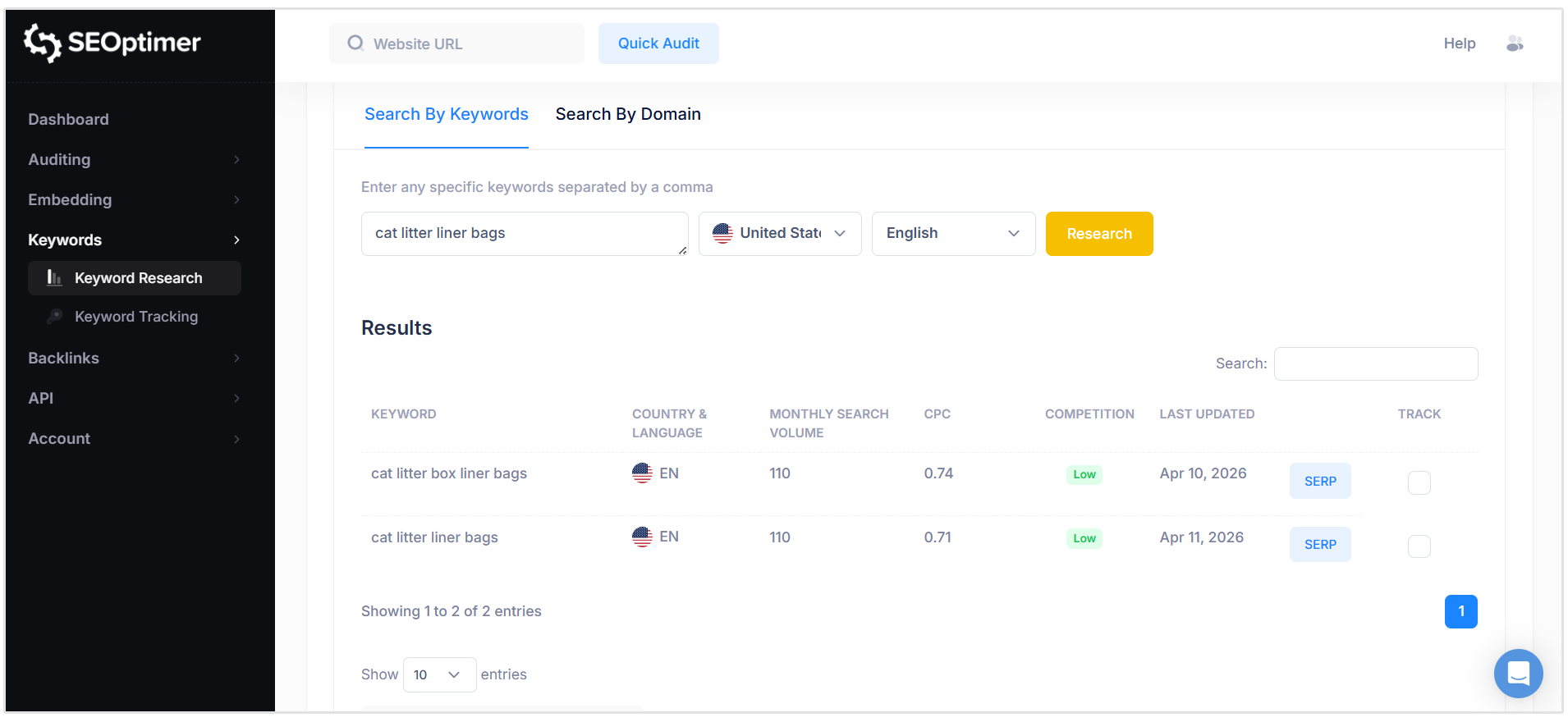
Adding “cat litter liner bags” to SEOptimer’s Keyword Research tool reveals the following data:
Use Reddit to Find Topic Ideas
Reddit is a great place to find low competition keywords.
It is where real people go to ask detailed questions when they cannot find good answers on Google.
Find the subreddits related to your industry and sort the posts by Top over the last month or year.
Look for recurring questions, complaints, or discussions.
If people are constantly asking the same question on Reddit, it usually means there is a lack of helpful content on search engines.
Take these exact questions and type it into Google.
Then, add the ranking domains to SEOptimer in the Search by Domain option to find the keywords that are being used by the ranking sites.
If there are any low competition keywords, you can use them as the basis for your next blog post.
Google's People also ask
When you search for a term on Google, you will usually see a "People also ask" box containing three or four related questions.
Clicking on one of these questions expands the box and generates even more questions.
Let’s take the example of cat litter boxes. If you search for something like “self cleaning litter box,” I found the following People also ask box and questions:
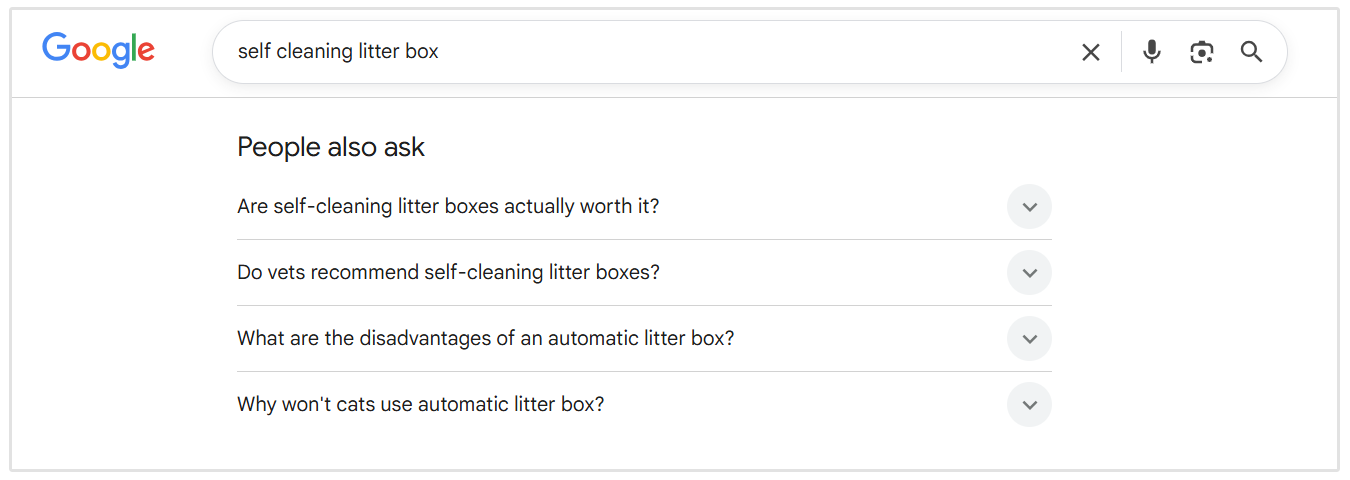
You can click these dropdowns repeatedly to generate an endless list of highly specific questions related to your niche.
These questions represent exact queries users are searching for in Google.
For our example, I clicked on the “Why won't cats use automatic litter box?” question and the box expanded with some more questions like:
- What do vets think about Litter-Robot?
- How often do I empty a self-cleaning litter box?
- What is the 3-3-3 rule for cats?
Because these are often very specific, they naturally serve as excellent low-competition keywords.
You can use these questions as H2 or H3 headings within your articles to capture highly targeted traffic.
Lauren Busby, Founder at Trebletree, shares how they use People also ask questions to strengthen existing content:
What I do with those questions is add them as FAQ sections to existing pages that are already ranking or close to ranking. You're not building new pages from scratch, you're adding depth to something that already has some authority.
Each FAQ entry is basically a long-tail keyword target wrapped in content Google already knows how to read.
- Lauren Busby, Founder at Trebletree
Again, you can add the sites appearing in these "People also ask" questions to the Search by Domain option in our keyword research tool to find the exact keywords they are using, along with their search volumes and competition.
Want to get into Google's People also ask box and other SERP features? Check out our guide on how to get into different types of Google SERP features.
Conclusion
Finding high search volume and low competition keywords is the best way to grow your organic traffic.
By avoiding the “more crowded” search terms and focusing on the specific questions your audience is actually asking, you can build a steady stream of organic traffic and visitors.