Meta Description Checker
SEOptimer's Free Meta Description Checker Tool. Review and Optimize your HTML Meta Description Tag for SEO.
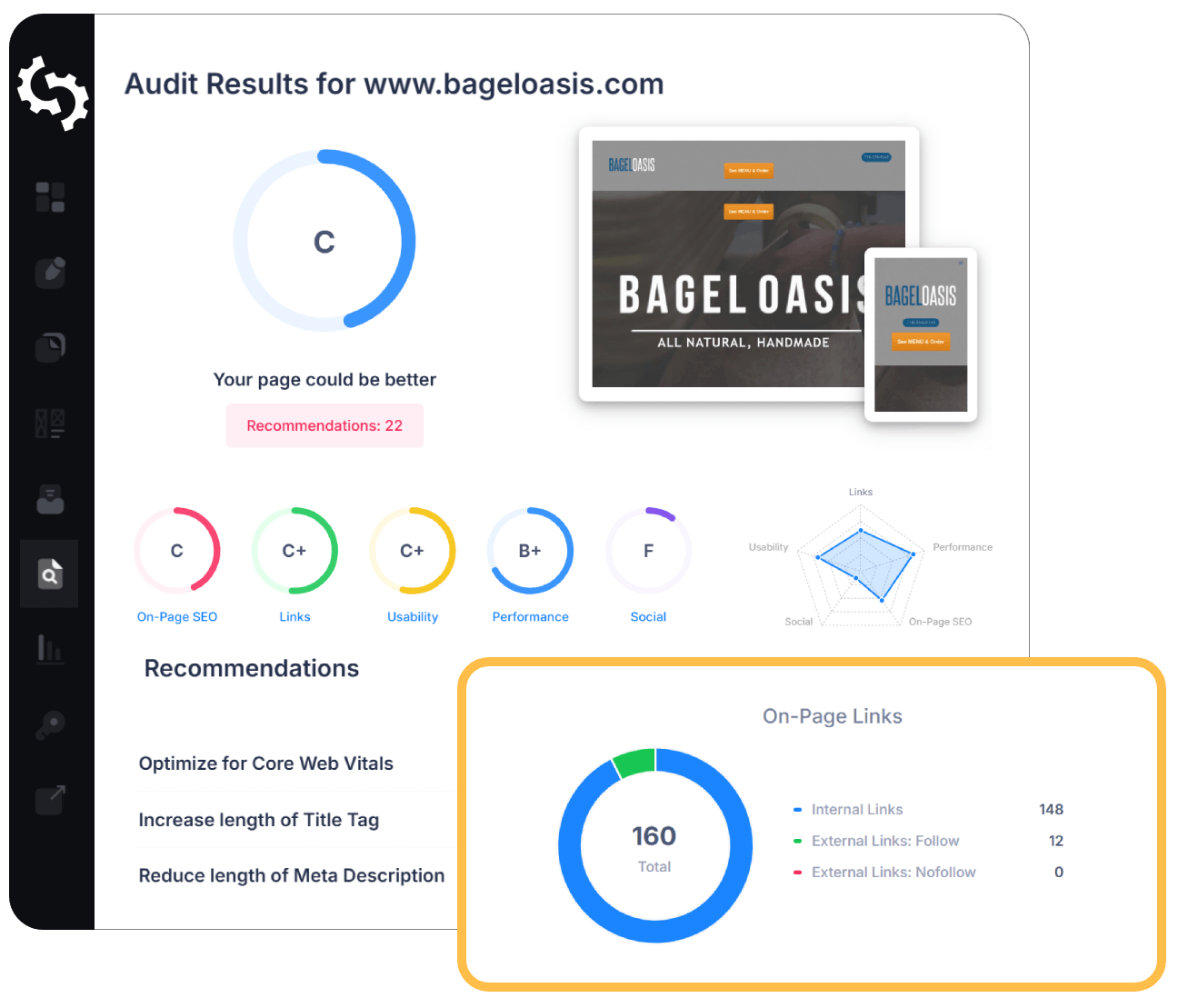
SEO Audit Any Site in Seconds
+ Comprehensive SEO / GEO Tools for Every Function
Run over 100 checks on your website across On-Page SEO, Usability, Performance, Social and Links. Now with GEO in every report. SEOptimer also offers keyword research, rank tracking, backlinks and a full site crawler.

About Meta Descriptions
What is a meta description?
A meta description is a short summary of a page, placed in the HTML head. It is not shown on the page itself and it has never been a ranking factor, but search engines frequently use it as the grey text beneath the blue headline in a result. That makes it the closest thing to advertising copy most pages have.
Its job is narrow and specific. Sitting directly under the title in a crowded results page, it has to confirm that this page answers the question the searcher just asked, and give them a reason to choose it over the results above and below. A meta description checker exists because that job is easy to get wrong invisibly: nothing on your own site shows you what the description looks like in the one place it is actually read.
It is also the tag most often left to chance. When it is missing, the search engine composes something from the page text, usually the first sentences it finds, which are rarely the sentences you would have chosen.
Do meta descriptions still matter in 2026?
They matter for clicks rather than rankings, and that distinction has grown more important rather than less. As results pages fill with ads, shopping units, AI summaries and discussion threads, the organic listings that survive have to work harder to be chosen, and the description is half of what a searcher reads before deciding.
The competitive picture also favours anyone who bothers. A large share of pages on the web carry no description at all, or carry the same one site-wide, so a page with a thoughtful, specific summary is competing against a lot of auto-generated filler.
What has changed is the tolerance for exaggeration. A description that oversells produces a click and an immediate bounce, and search engines have plenty of ways to notice a page that people leave straight away.
How meta descriptions relate to AI search
AI answers summarise sources rather than listing them, so a description is no longer guaranteed to be displayed anywhere. What it still provides is a compact, human-written statement of what a page covers, sitting in a fixed and predictable place in the markup.
That is genuinely useful to any system deciding whether a document is relevant before committing to reading all of it. It is the cheapest possible signal of subject matter, and it is one you control completely.
The practical implication is to write it as a real summary rather than a teaser. A description that withholds the answer to force a click gives a model nothing to work with, and gives a reader no reason to believe the answer is on the page at all.
Why search engines rewrite descriptions
Google replaces the supplied description on a substantial share of results, choosing a passage from the page instead. This is not a fault, and it is not a reason to stop writing them.
Rewrites usually happen for a reason. The query matched a part of the page the description did not mention, or the description was generic, duplicated across pages, or stuffed with keywords. A specific, accurate description written for the query the page targets is far more likely to be kept.
Treat consistent rewriting as feedback. If yours are always replaced, the replacement is telling you what the search engine thinks the page is actually about.
Meta description best practices
- Summarise the page honestly. Overselling costs more in bounces than it gains in clicks.
- Include the phrase the page targets, naturally. Matching terms are shown in bold, which draws the eye.
- Write one per page. A site-wide description tells a searcher nothing about the page they found.
- Front-load the useful part so it survives truncation on a narrow screen.
- Make it readable on its own, without the context of the page around it.
- Give it a reason to act where one fits, without falling back on a generic call to action.
What this tool checks
The meta description checker reads the description from the page HTML and measures its length in characters. It reports one of four outcomes:
- No meta description found, leaving the search engine to compose one from the page.
- Shorter than 120 characters, which usually wastes available space.
- Between 120 and 160 characters, which passes.
- Longer than 160 characters, which risks being cut off mid-sentence.
Length is the only thing the meta description checker measures. Whether the description is unique across your site, and whether it reads like something a person would click, are judgements it leaves to you.
Where to go next
A description is only half of a search result. It is worth checking the title tag that sits above it, previewing the pair together with the SERP preview tool, and using the meta tag generator to produce the finished markup once the wording is right.
Comprehensive SEO Toolbox with over 55 Tools
Check Titles, Meta Descriptions, Headings, Schema, Core Web Vitals, SSL and Robots.txt. Generate Meta Tags, Sitemaps and .htaccess Rules, minify CSS, JS and HTML, and draft copy with our AI Writing Tools - instantly and for free.
Further Reading
See More
How to Write Meta Descriptions that Get More Clicks
Meta descriptions may be small, but they can have an impact on how people decide whether to click on your page in search results.
Ev...
What is a Title Tag? How to Write Better SEO Titles
What is a Title Tag?
A title tag is an HTML element that tells search engines and users what a webpage is about. It appears as the c...

How to Drive Up Your CTR and SEO
What Is CTR?
CTR stands for Click Through Rate, and is defined as the percentage of people who click a search result after seeing it.
To see...
How to Add a Wordpress Meta Description
If you’ve already read our guide on how to create title tags on WordPress, you might have noticed that the meta description input for each i...

How to Update Title and Meta Description in Shopify
You’ve worked on how to optimize your title tag and followed our best practices. If you haven’t read our guide you can find it here:
...

On-Page SEO: Complete Guide + Checklist for 2026
What is On-Page SEO?
On-page SEO is the process of optimizing the content and elements on a webpage so that search engines can bette...