

Steps to Rank in AI Overviews
- Keep your content fresh
- Make your content easily scannable
- Build your online reputation
- Improve your site's E-E-A-T scores
- Optimize for traditional SEO
- Format content for SERP features
- Make sure important content is visible in the HTML
- Create a LLMs.txt file
Google's search results pages (SERPs) have undergone some major changes over the last two years. With Google’s release of AI Overviews, users can now find information without having to click through to websites and online resources.
This means that ranking in the top 10 organic results is no longer enough. And if you want to get a share of that search traffic, your content must be good enough to be cited directly in these AI-generated answers.
Being mentioned in an AI Overview can boost your visibility, drive traffic, and establish your brand as an authority.
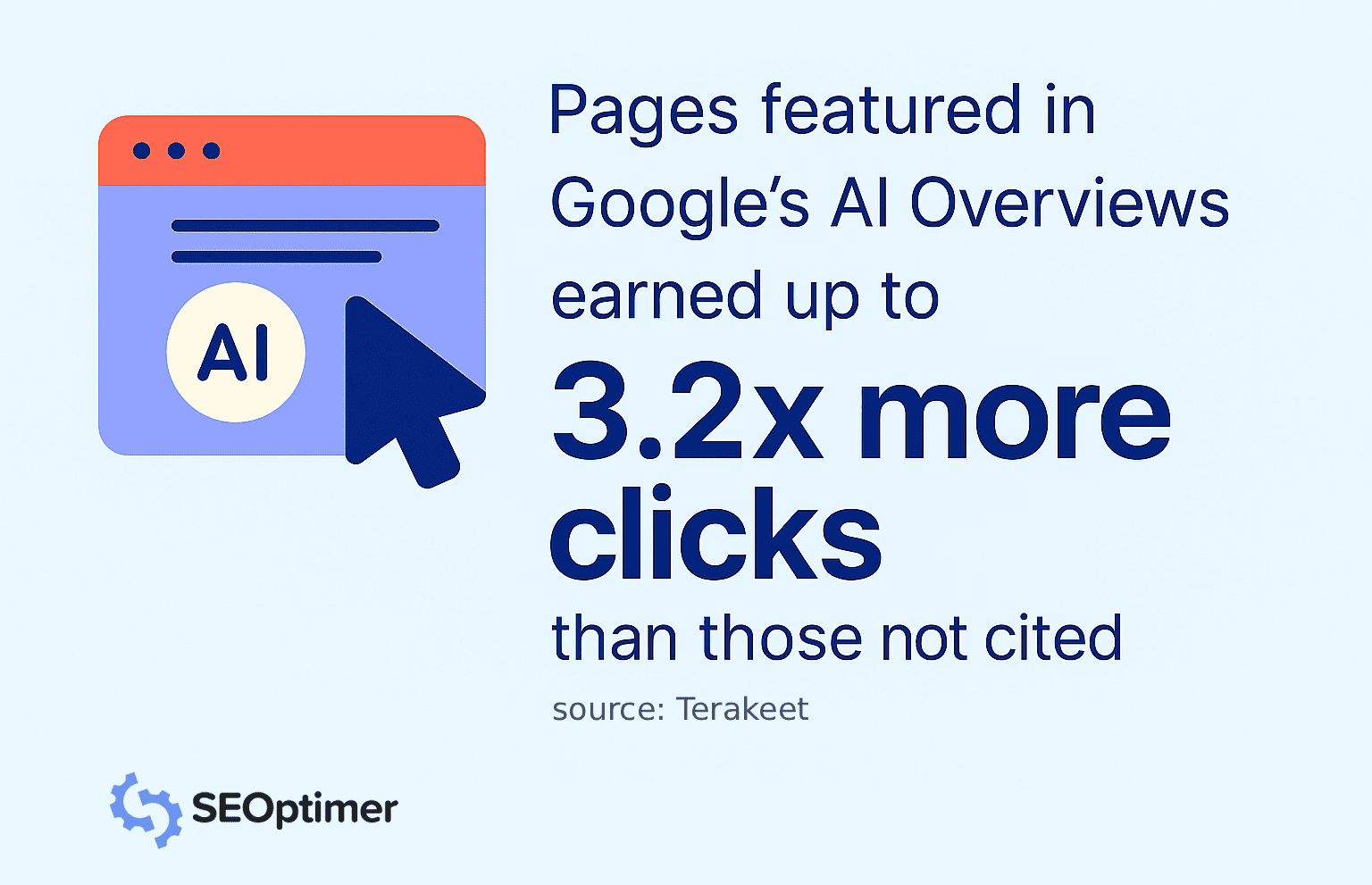
One study from Terakeet found that pages included in AI Overviews, especially those ranking highly for transactional queries, had as much as 3.2x more clicks compared to pages that weren’t cited.
Marketers can’t afford to ignore this new feature. If you’re not optimizing for AI Overviews, you’re missing out on valuable visibility and traffic.
In this blog post, we will show you exactly what AI Overviews are, why optimizing for them is important, and provide some handy tactics to help you optimize your content and increase your chances of being mentioned.
Feature update
New AI Visibility Checks are Here. Is Your Site Ready?
Run a free audit to see how well your site is optimized for Google AI Overviews and LLMs.
Run Free AuditWhat are AI Overviews?
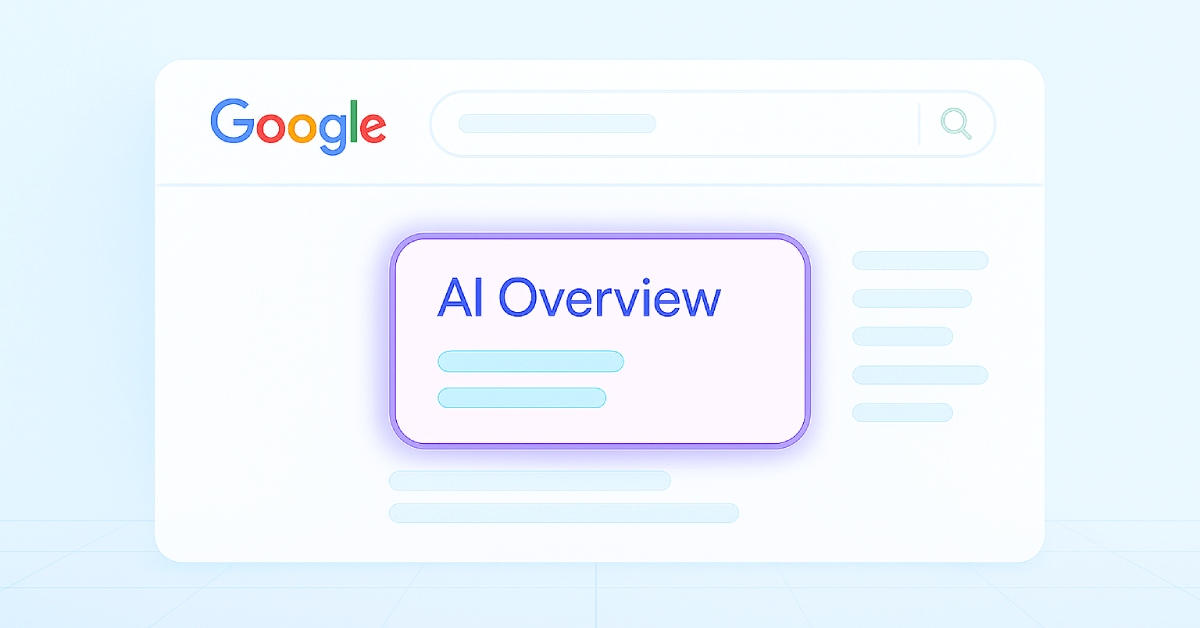
AI Overviews are AI-generated answers that appear at the top of the Google search results page.
Here’s an example of an AI Overview for the search query "best saas hr tools."
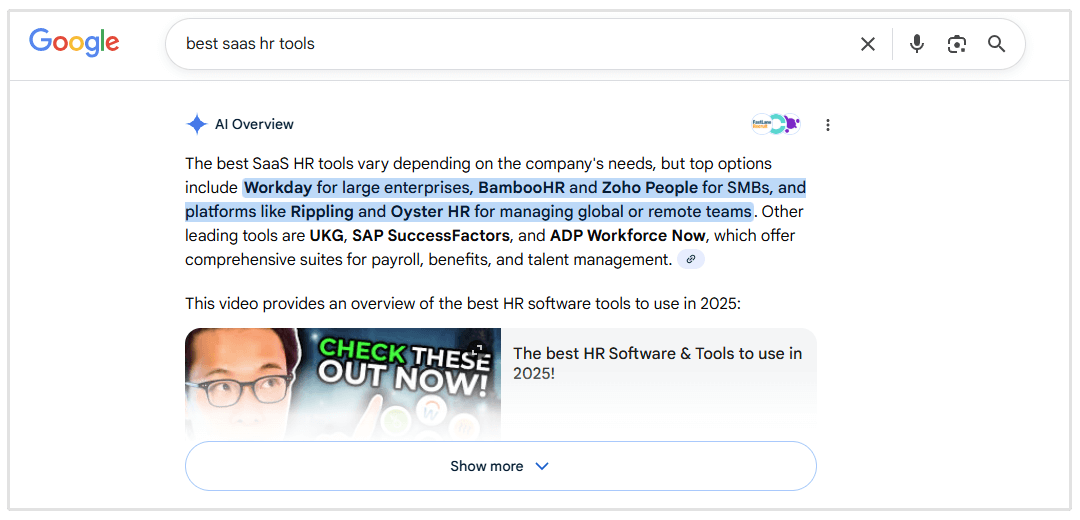
Google uses a Large Language Model to analyze the information from multiple web pages, forums, and other sources to create a concise summary that directly answers a user's search query.
These summaries can take various forms, including short paragraphs, bulleted lists, links to videos, images, or even tables.
For instance, here is an AI Overview that contains a table comparing the differences between rotary vs. piston compressors.
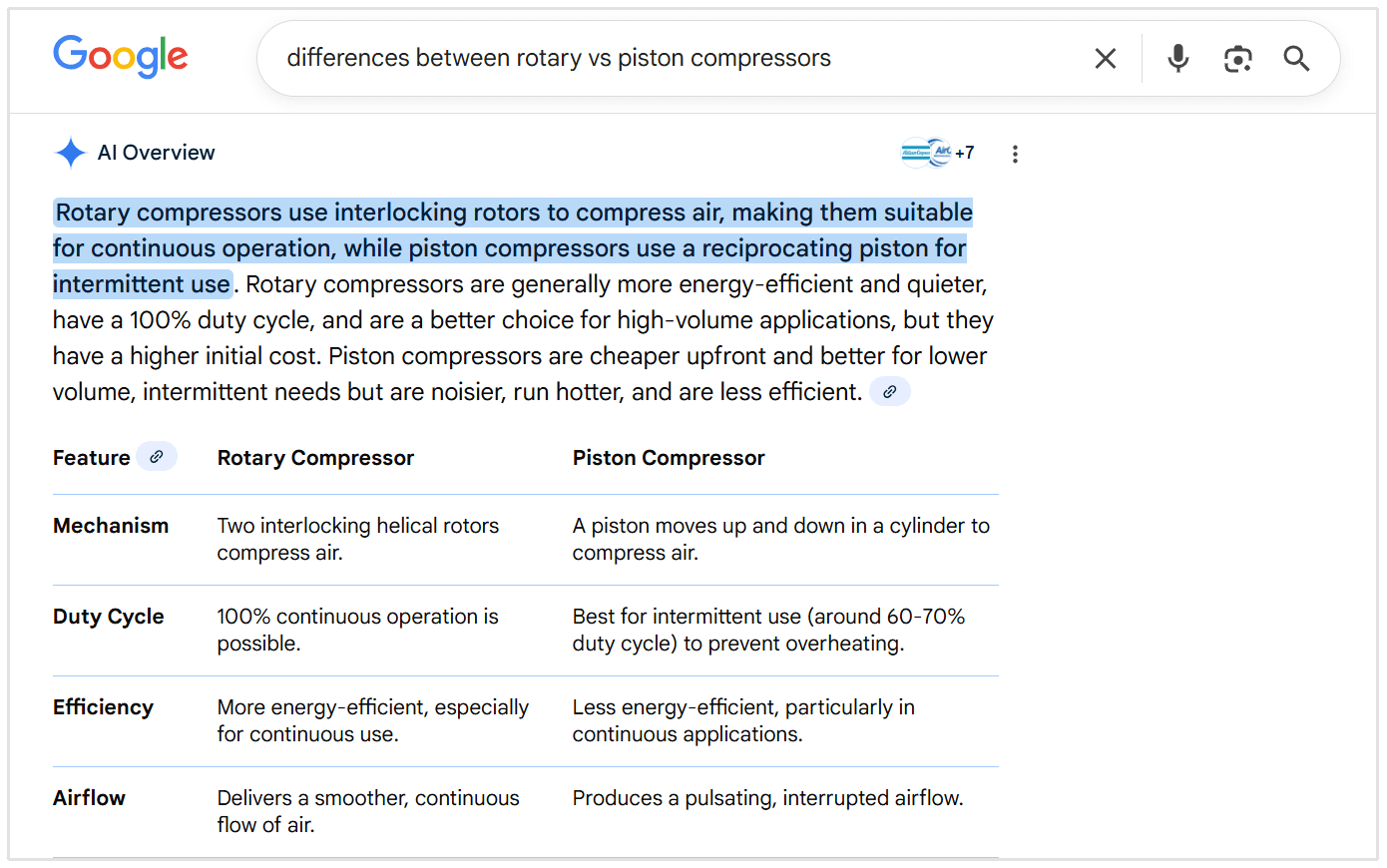
Included in the answer, Google adds links to the sources it used, providing users with a way to dig deeper into the topic.
This feature is designed to help users get answers to complex, multi-faceted questions more quickly, without needing to click through multiple websites.
Why are AI Overviews Important?
AI Overviews are prime digital real estate. Their position in the SERPs have a direct impact on general user behavior and as a result, your SEO strategy.
Because users can get their answers directly on the results page, AI Overviews can lead to more "zero-click searches."
Research from Bain and Dynata showed that "80% of consumers rely on these “zero-click” results at least 40% of the time."
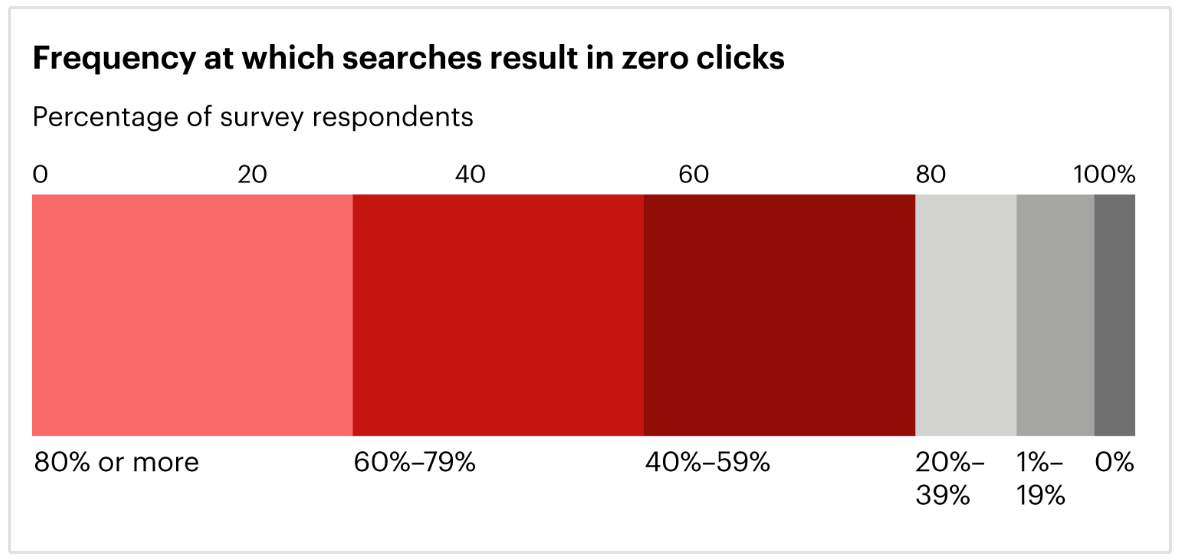
The same research found that 40% to 70% of users of large language models now use them for tasks traditionally handled by search engines. Specifically, around 68% use them for research and summarising information, 48% to check the latest news and weather, and 42% for shopping recommendations.
This increases the stakes. If your site isn't cited in the overview, you risk missing out on a significant portion of traffic and clicks, even if you manage to rank on the first page of traditional search results.
Being mentioned offers a massive advantage.
A citation in an AI Overview positions your website as a credible and authoritative source, signaling trustworthiness to both Google and potential customers. This can drive highly qualified traffic and strengthen your brand's reputation.
How to Optimize for AI Overviews and Get More Mentions
Optimizing for AI Overviews requires a blend of traditional SEO best practices and a new focus on creating content that is easily understood by language models.
Here are eight tactics you can use to improve AI visibility.
1. Keep Your Content Fresh
Google uses both relevance and timeliness when evaluating which websites to cite in AI Overviews.
According to research from SEO specialist Todd Stager, updating older content can improve AI Overview inclusions by 46%.
Todd shared that one of his B2B clients updated some blog posts from 2021 in March 2025. And by May, 5 of them showed up in AI Overviews.
Another online resource found that content published within 12 months has a high citation rate, whereas content older than 18 months experienced a 60-70% reduction in citation rates.
Regularly updating your content shows that your information is fresh and valuable.
Here are a few quick tips on updating blog posts:
- Refresh older content: Schedule regular reviews of your existing blog posts and pages. Update outdated statistics, replace broken links, and add new examples or insights.
- Incorporate new data: Add the latest research findings and industry statistics to your articles. This not only keeps your content fresh but also builds credibility.
- Add unique perspectives: Look for ways to include original insights or proprietary data. This makes your content a more valuable resource for both readers and AI.
2. Make Your Content Scannable
Both humans and AI algorithms appreciate well-structured content that is easy to digest.
A page's scannability helps LLMs quickly identify key information and pull it into an AI Overview.
A key factor in gaining visibility within AI Overviews is to ensure that content is well structured and easily digestible for both users and search engines. Pages should present information clearly, use a structure that flows well and answer questions clearly and directly without unnecessary complexity.
- Andrew Witts, Founder at Studio36Digital
Here are some top tips on how to make content more scannable for AI Overviews.
- Use short paragraphs: Break up long walls of text into smaller, more digestible chunks. You should aim for paragraphs of two to three sentences.
- Add lists: Use bulleted or numbered lists to present steps, features, or key points.
- Make use of clear headings: Use a logical hierarchy of H1-H6 tags to structure your content. Headings help both readers and search engines understand the flow of your article and locate specific information.
- Highlight key information: Use bold (<strong>) tags to emphasize important terms or phrases to draw attention to the most critical parts of your content.
3. Focus on Building Your Online Reputation
Google’s AI favors content from sources it considers trustworthy, which means your brand’s overall online reputation can heavily influence whether your content is cited in an AI Overview.
Stella Morrison from The Stellastra Effect, an SEO agency based in New Jersey, notes that they are seeing a clear correlation between a client's brand reputation and their appearance in AI Overviews.
Among our clients, the sites that are appearing most often in AI Overviews are the ones with significant brand recognition, especially in their niches. To me, that's a sign that Google is taking brand recognition into account when pulling content.
- Stella Morrison, Founder at The Stellastra Effect
One way to strengthen your reputation is to engage on other platforms where your audience is active.
This includes forums like Reddit or Q&A sites such as Quora.
Nellia Melnyk is a Digital Marketing Specialist at Real FiG, a full-service digital agency, and she says that her team puts a lot of focus on generating brand mentions on sites that LLMs cite.
My team and I focus on generating brand mentions on sites that LLMs already actively cite, such as Quora, Reddit, LinkedIn, YouTube, and reputable media outlets in our niche or our clients’. This gives LLMs a reason to include you in their responses through credible signals, since they tend to rely on verified, open, and frequently cited sources.
- Nellia Melnyk, Digital Marketing Specialist at Real FiG
By providing helpful, authoritative answers, you not only establish credibility but also create signals that Google can pick up when evaluating your content.
Another important factor is user-generated content. Real customer experiences are often cited by AI, so encourage reviews on relevant platforms and showcase testimonials directly on your website.
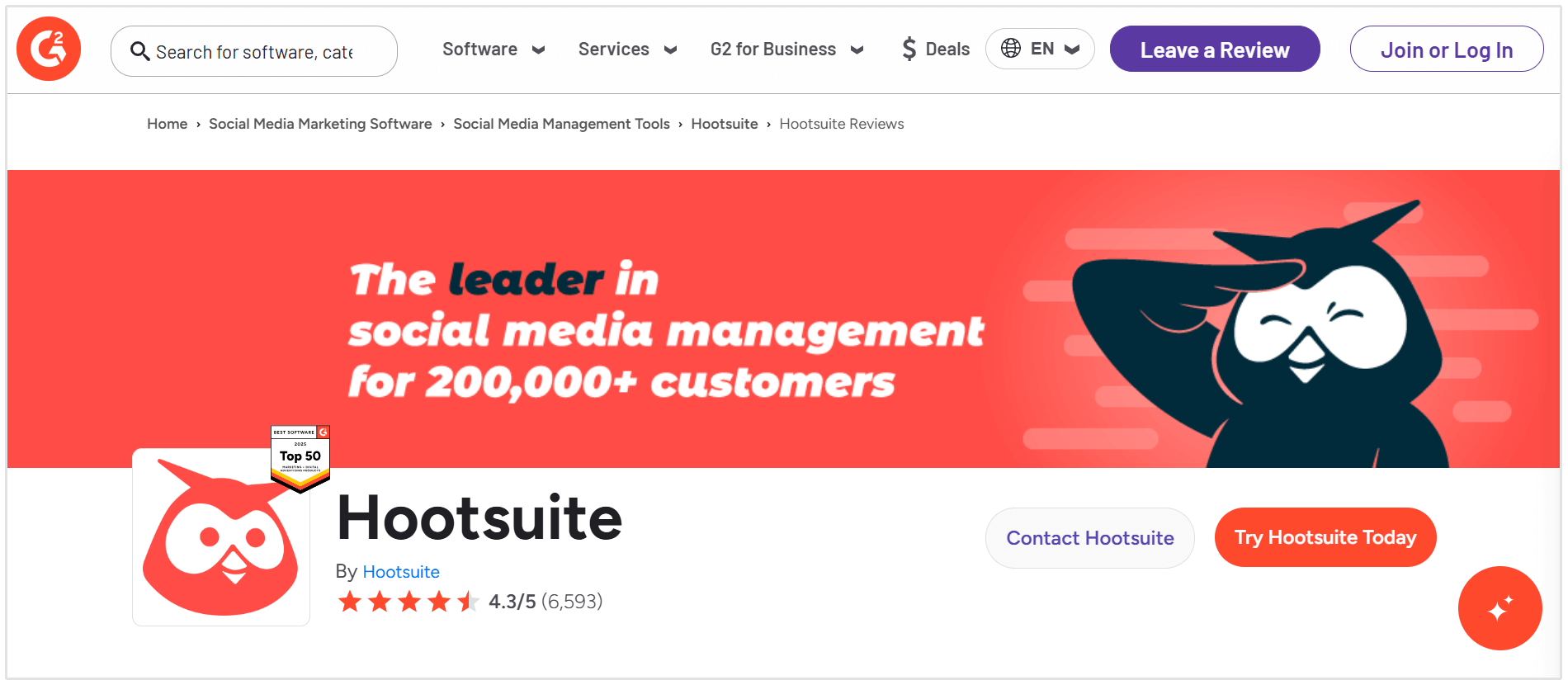
For instance, software companies can encourage customers to leave reviews on several software review sites, including:
- G2
- Capterra
- SoftwareAdvice
- GetApp
- Crozdesk
And likewise, local service businesses like dentists, plumbers, lawyers, etc. can build local citations in directories and encourage customers to leave reviews on customer review sites like TrustPilot, TrustRadius, and Google Business.
Finally, you should try to put some effort into improving your brand's digital PR.
Look for guest posting opportunities, form partnerships with reputable sites in your industry, and focus on earning backlinks from authoritative domains.
Mentions and links from well-respected sources help reinforce your brand’s credibility and make your content more likely to appear in AI Overviews.
Feature update
New AI Visibility Checks are Here. Is Your Site Ready?
Run a free audit to see how well your site is optimized for Google AI Overviews and LLMs.
Run Free Audit4. Increase Your Site’s E-E-A-T Scores
E-E-A-T (Experience, Expertise, Authoritativeness, and Trustworthiness) is at the core of Google's content quality guidelines.
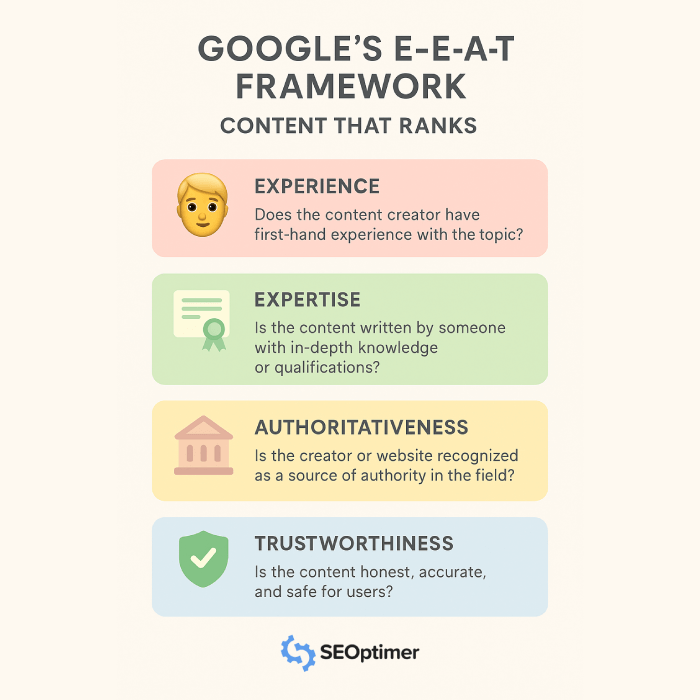
Demonstrating high levels of E-E-A-T is essential for ranking in traditional search and is even more critical for being cited in AI Overviews.
Here's how you can improve your site's general E-E-A-T scores:
- Demonstrate firsthand experience: Add unique insights, personal stories, or case studies that show you have real-world experience with the topic your are talking about.
- Highlight author expertise: Create detailed author bios that list qualifications, credentials, and relevant experience. Link to authors' social media profiles or other publications to further establish their authority.
- Fact-check everything: Ensure all claims are backed by credible sources. Link to original research and reputable studies to prove your content is accurate and well-researched.
5. Optimize for Traditional SEO
Having a strong SEO foundation is a requirement for appearing in AI Overviews, especially since many of these summaries pull information from pages already ranking in the top 10 organic results.
Christophe Deneulin, SEO Manager at Orange Line, says that they purposely focus on improving their client's topical authority and just following SEO best practices to optimize for AI Overviews.
Building your topical authority and following best SEO practices, coupled with a structure optimised for users and LLMs can help get your more visibility in AIO. At the end of the day, AI Overviews are part of Google, so keep following Google's best practice if you want to appear there.
- Christophe Deneulin, SEO Manager at Orange Line
Start by conducting regular technical SEO audits to ensure your site is sound and to find areas where you can improve.
Implement schema markup such as Article, FAQ, or HowTo to help search engines better understand your content.
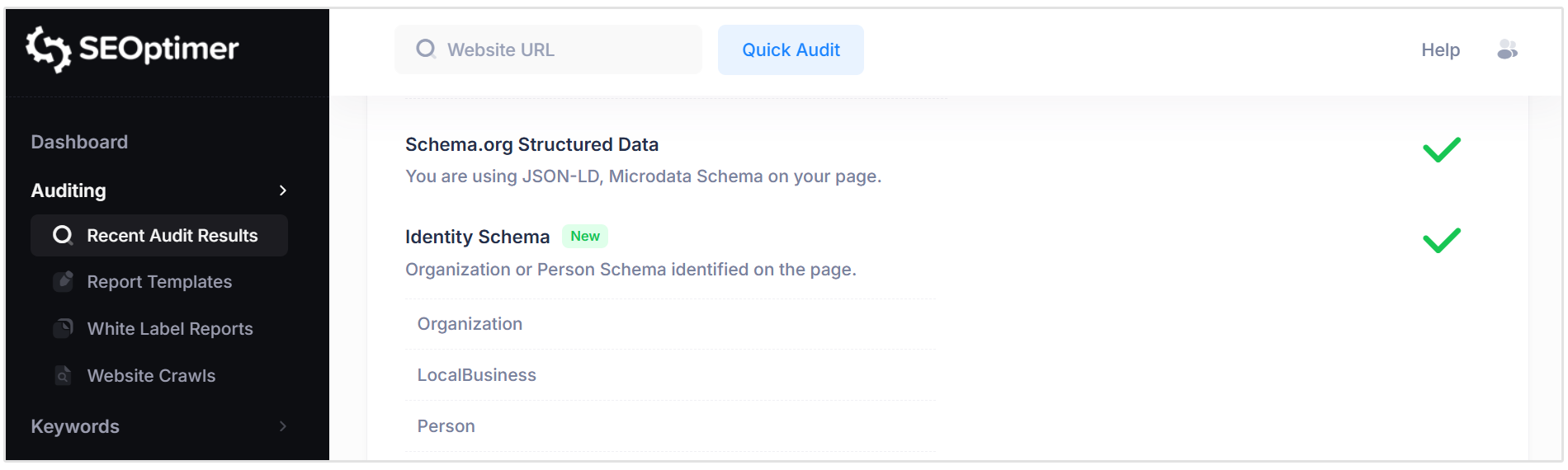
It’s also important to add Person, Organization, and LocalBusiness schema to your site to ensure Google understands who you are, what your business does, and where you operate.
You can check if your site has any of these schema types by running a Free SEO Audit with SEOptimer.
Our tool features a bunch of Generative Engine Optimization (GEO) checks including an Identity Schema check.
Next, focus on on-page optimization. Make sure your content includes relevant keywords, clear meta descriptions, and descriptive image alt text so both users and AI can easily interpret your pages.
It's equally important that you monitor your site's performance using tools like Google Search Console.
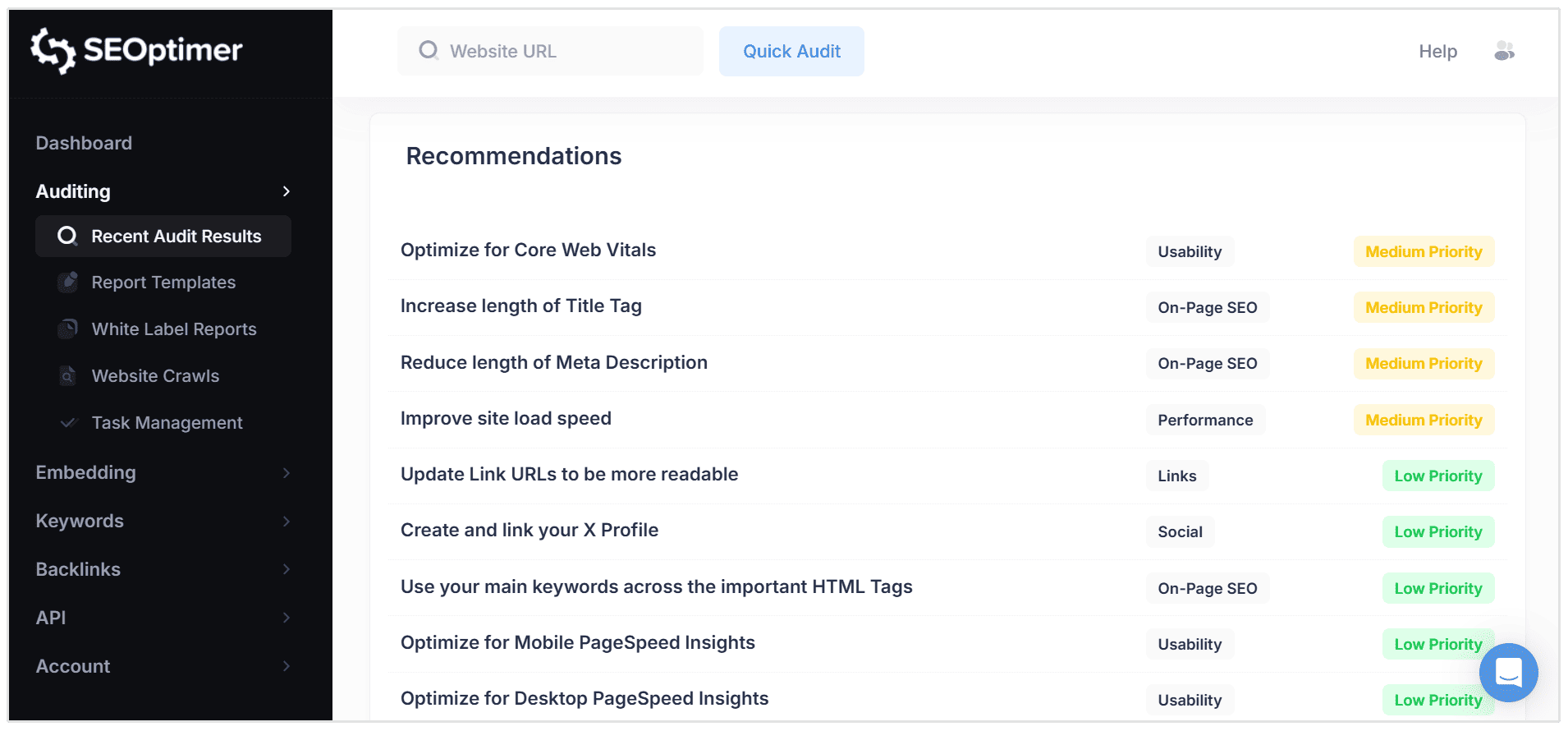
Our SEO audit tool can help simplify this process, giving you a clear picture of your site’s SEO health and where improvements are needed.
6. Format Content for SERP Features
Pages that appear in other SERP features, like Featured Snippets and People Also Ask (PAA) boxes, often signal the kind of content Google’s AI favors, even though there’s no concrete evidence showing a direct correlation with AI Overview inclusion.
The content characteristics that help a page appear in these SERP features (clear, structured answers, up-to-date information, proper schema, and authority) are very similar to what Google’s AI looks for when citing sources.
To align your content with these signals, structure it to answer questions directly, provide concise explanations before elaborating, and address related queries your audience is asking.
Formatting your content in ways that commonly appear in Featured Snippets, such as step-by-step guides or short, clear definitions, can further increase the chances that Google will reference your page in an AI Overview.
7. Render Your Pages for AI Visibility
When optimizing for AI Overviews, it’s important to consider how your content is rendered, especially if you rely heavily on JavaScript.
While Googlebot can execute JavaScript, Google’s own documentation states:
Keep in mind that server-side or pre-rendering is still a great idea because it makes your website faster for users and crawlers, and not all bots can run JavaScript.
- Google Search Central
If your key content, metadata or schema markup only appears after JavaScript execution (for example in a single‑page app with client-side rendering), AI systems may miss it.
To maximize your chances of being cited in an AI Overview, ensure that your core content, structured data (like Person, Organization or LocalBusiness schema) and headings are included in the initial HTML response via server‑side rendering (SSR) or pre‑rendering.
This ensures that both Googlebot and AI‑driven systems can access it reliably.
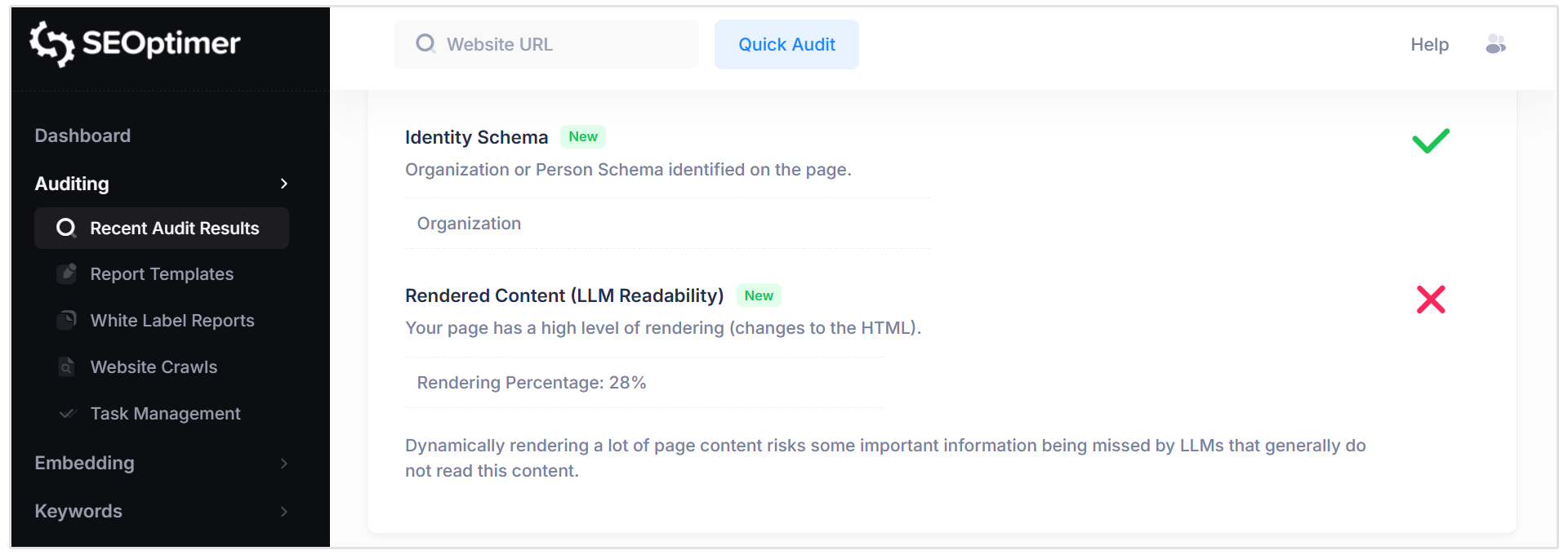
You can easily check the level of Javascript rendering on your site in SEOptimer's SEO and website audits.
We recently added a "LLM Readability" check which evaluates your page's level of rendered content.
8. Create a LLMs.txt File
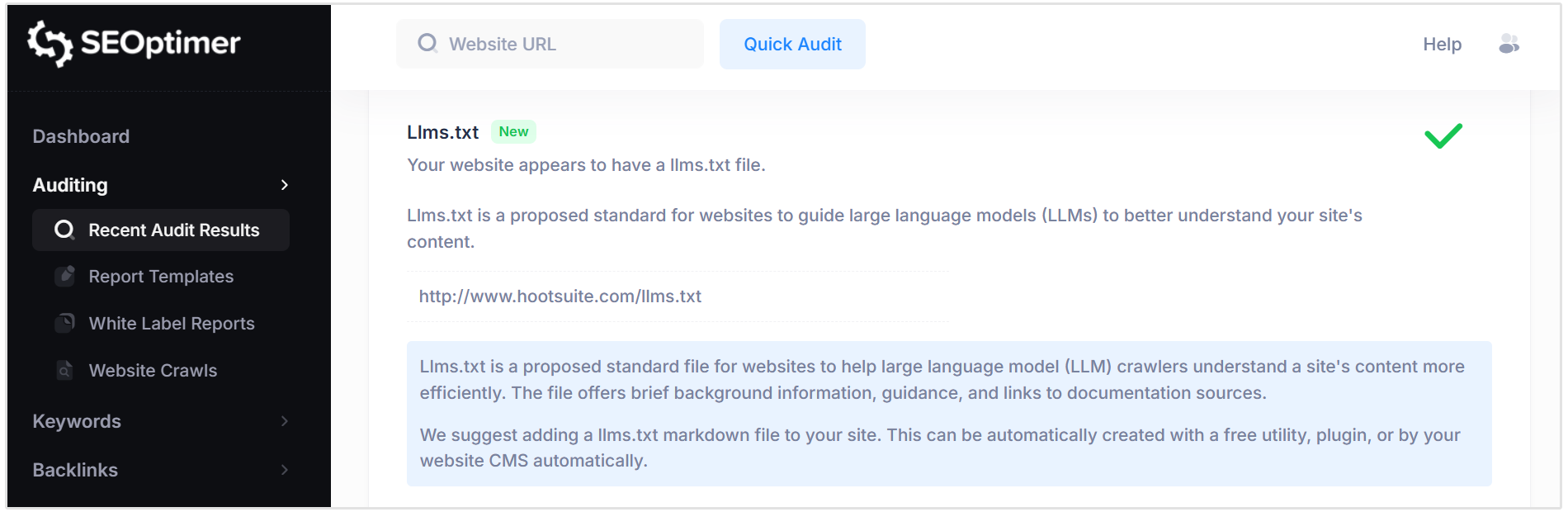
LLMs.txt is a proposed standard file that helps large language model (LLM) crawlers understand a website’s content more efficiently.
It can include brief background information about your site, guidance for crawling, and links to important documentation or resources.
While this standard is not yet widely adopted by LLMs, it could become an important way for AI systems to better interpret your content in the future.
We recommend adding a llms.txt file to your site. This can be done manually, or automatically using a free utility, a plugin, or your website CMS.
To make the process even easier, try our new LLMs.txt file check, which helps ensure your file is correctly formatted and ready for AI crawlers.
How to Track AI Overview Mentions and Visibility
Tracking whether your site is being cited in AI Overviews is still a relatively new idea and dedicated AI tracking tools are limited.
However, you can use existing methods and many traditional SEO tools like SEOptimer now have features to monitor your AI Overview mentions:
Manually Check SERPs
A quick and easy way to track if your brand is being mentioned is to just search for your target keywords in an incognito browser to see if your domain appears in AI Overviews.
Use an AI Overview Citation Tracker
If you don't want to go through through the process of manually checking if you are being mentioned, you need to use a tool to monitor and check AI Overview citations.
Not only will this save you a lot of time, but it also eliminates the potential for human error.
Our new AI Overview Citations and Traffic check makes it easy and fast to check and track citations. In each audit that you run, you'll see a "Top AI Overview Citations" section which shows the top searches where an AI Overview is displayed with a citation link to your site.
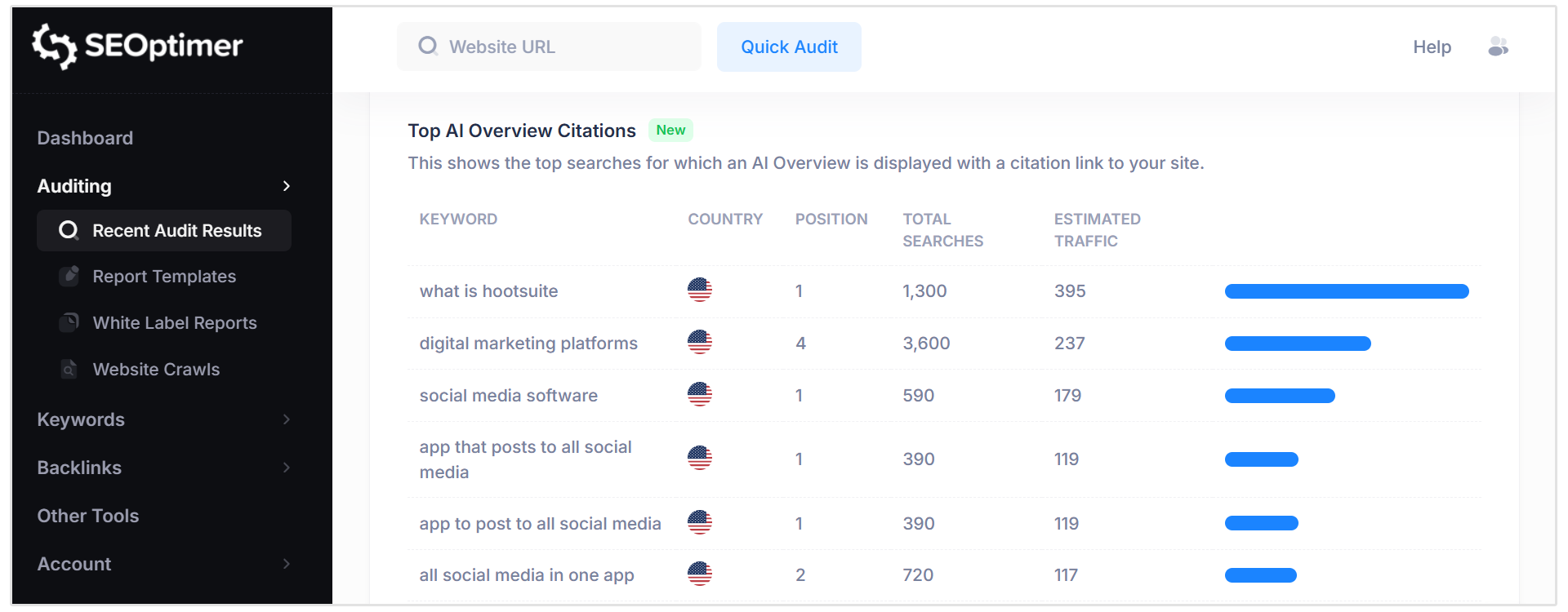
The table provides key metrics at a glance:
- The keyword that triggered the AI Overview
- Your estimated traffic
- Monthly search volume
- Your position within the AI Overview.
This makes it easy to see which queries are driving attention, measure performance over time, and spot new opportunities for optimization.
Feature update
New AI Visibility Checks are Here. Is Your Site Ready?
Run a free audit to see how well your site is optimized for Google AI Overviews and LLMs.
Run Free AuditMonitor Branded Search Volume
An increase in branded search queries can be an indirect indicator of growing brand authority and influence at the top of the funnel.
If more people are searching for your brand name directly, it could mean they are seeing you in AI Overviews.
Track Organic Traffic and Clicks
You can use Google Search Console to monitor click-through rates for pages ranking in top positions.
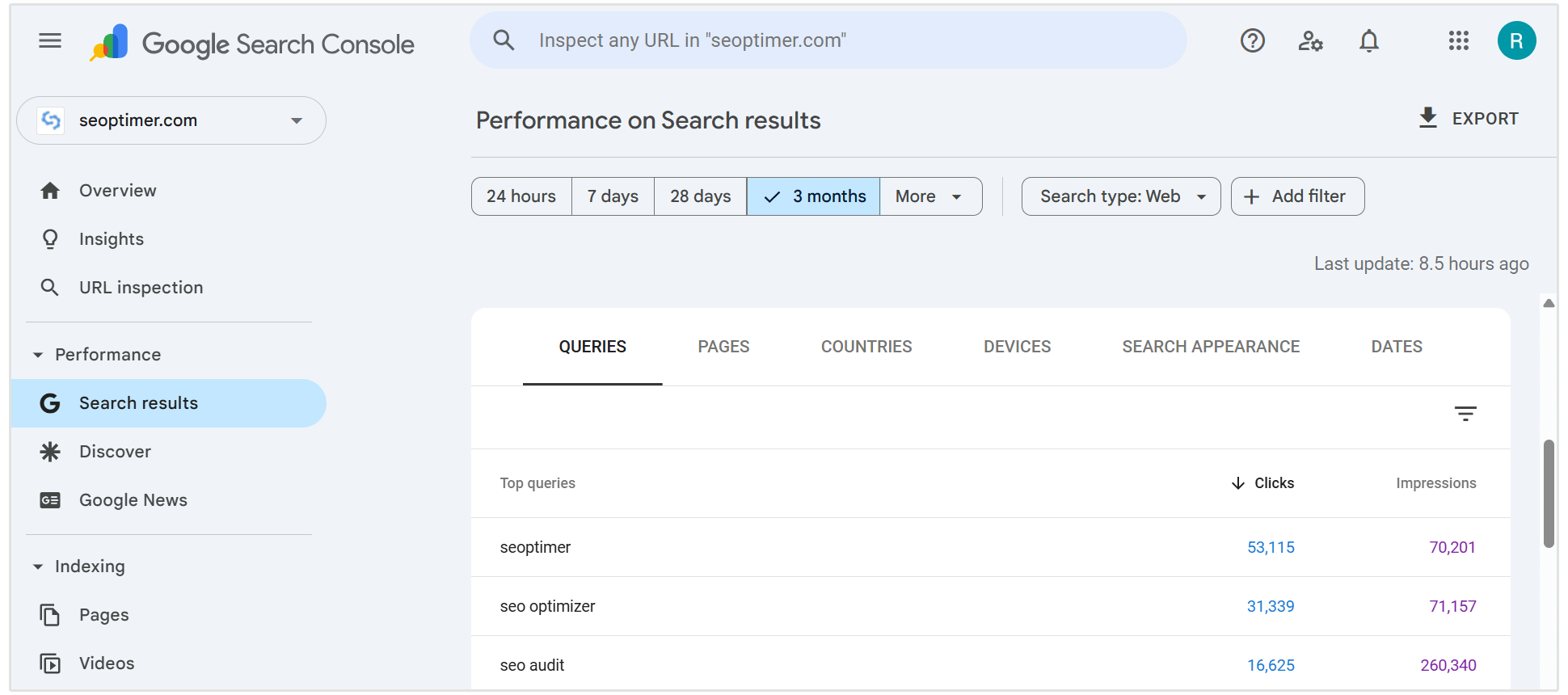
A sudden drop in clicks for a high-ranking page might indicate that an AI Overview is answering the query, reducing the need for users to click through.
Mistakes to Avoid if You Want to Get AI Overview Mentions
As you optimize for ranking in AI Overviews, be sure to avoid these common mistakes:
Keyword Stuffing
If you think that stuffing pages with your target keyword is going to help improve AI visibility, then you're wrong.
Forcing keywords into your text unnaturally will hurt readability and can be penalized by Google.
Using Overly Complex Language
AI Overviews aim to present concise, clear answers.
If your content is full of jargon or dense academic phrasing, it may be less likely to be used in AI Overviews.
Ignoring SEO Basics
Even though we've entered a new era of SEO, you shouldn't abandon traditional SEO.
A strong technical and on-page foundation is necessary to rank high enough to be considered for an AI Overview.
Not Updating Old Content
Outdated content is unlikely to be seen as authoritative or trustworthy by Google's AI.
Wrapping Up
The increasing visibility of AI Overviews in SERPs marks a huge change in the SEO landscape.
SEO success is no longer just about ranking; it's about becoming a trusted source of information that Google's AI chooses to cite.
Start by auditing your existing content through an "AI lens."
Focus on building your brand's reputation across the web and consistently creating high-quality, helpful content that answers your audience's questions directly.
By following these strategies, you can position your brand to get more AI Overview mentions.
The businesses that adapt quickly will be the ones that capture attention, drive traffic, and establish themselves as the definitive authorities in their space.
Feature update
New AI Visibility Checks are Here. Is Your Site Ready?
Run a free audit to see how well your site is optimized for Google AI Overviews and LLMs.
Run Free Audit