AI Tone Rewriter
Easily modify the tone of a piece of text without changing it's original meaning with SEOptimer's AI Tone Rewriter. This tool creates a new version of the text, in the chosen tone, in seconds.
Input
Output
Generated content:
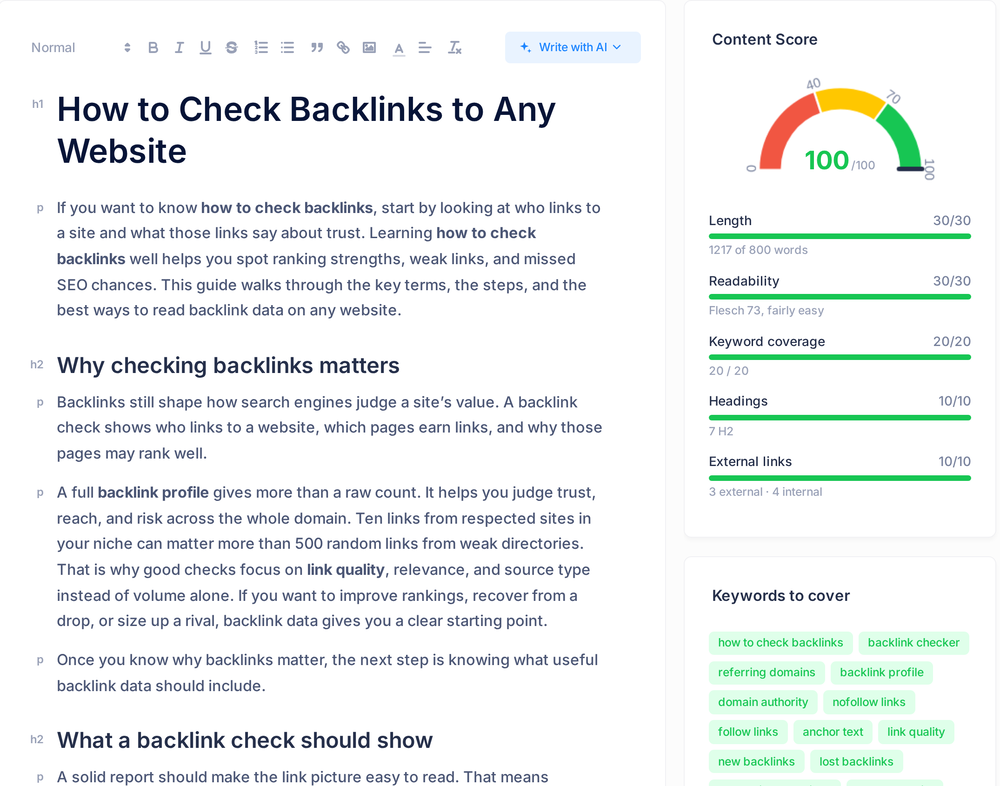
Write SEO Optimized Articles Instantly with AI Writer
AI Writer researches the pages ranking for your target keyword, instantly writes a full article and scores it for keywords, readability, links and length. Create the best content possible with the highest ranking potential with our proprietary algorithms.

About Tone of Voice
What is tone, and what is it not?
Tone is the relationship the writing assumes with the reader. Formal or casual, confident or tentative, warm or neutral: these are choices about how you are speaking to someone, not decoration applied afterwards.
Tone is not the same as voice. Voice is what makes writing recognisably yours and should stay constant; tone shifts with the situation, in the same way a person sounds different in a complaint and a birthday card without becoming someone else.
Most tone problems are really audience problems. Writing that feels wrong usually assumes a relationship the reader does not think they have.
There is a growing premium on sounding like a person. As competent, generated prose becomes ubiquitous, a distinct voice is one of the few things left that reads as human.
Choosing the right tone
- Match the stakes. A billing error and a product launch do not warrant the same register.
- Match the relationship. Familiarity you have not earned reads as presumptuous.
- Match the medium; the same message is written differently for an email and a legal notice.
- Prefer plainness under pressure. Formality in bad news reads as evasion.
- Stay consistent within a piece, since shifting tone midway is disorienting.
Common mistakes
- Confusing formal with professional; stiff writing is not more competent.
- Forced casualness, which reads worse than plain neutrality.
- Softening bad news until the reader cannot tell what happened.
- Applying a brand tone rigidly to situations it was never designed for, such as an outage notice.
- Changing tone so thoroughly that the voice disappears with it.
Where an AI tone rewriter helps, and where it does not
It is genuinely good at register shifts, which are mechanical: making something more formal, warmer, more concise. Given a clear instruction it applies it consistently across a passage.
It cannot judge which tone the situation calls for, and that judgement is the actual skill. It will make a message about a security incident sound cheerful if asked.
It also tends to flatten voice while adjusting tone, so distinctive phrasing is often the first thing lost.
Using the AI tone rewriter
Enter your text and the tool rewrites it in a different register. Being specific about the audience produces a better result than naming a tone in the abstract.
Then check that the meaning survived unchanged, particularly with anything sensitive, and put back any phrasing that was yours rather than generic.
Where to go next
Tone is one dimension of a rewrite. Use the AI text enhancer for clarity, the AI rewording tool to say something differently at the same register, and the AI letter generator when the whole message needs rebuilding.

SEO Audit Any Site in Seconds
+ Comprehensive SEO / GEO Tools for Every Function
Run over 100 checks on your website across On-Page SEO, Usability, Performance, Social and Links. Now with GEO in every report. SEOptimer also offers keyword research, rank tracking, backlinks and a full site crawler.