AI Rewording Tool
Easily rewrite any text with our AI Rewording Tool. Choose your tone and language, and our tool will generate a new, high-quality version of your content.
Input
Output
Generated content:
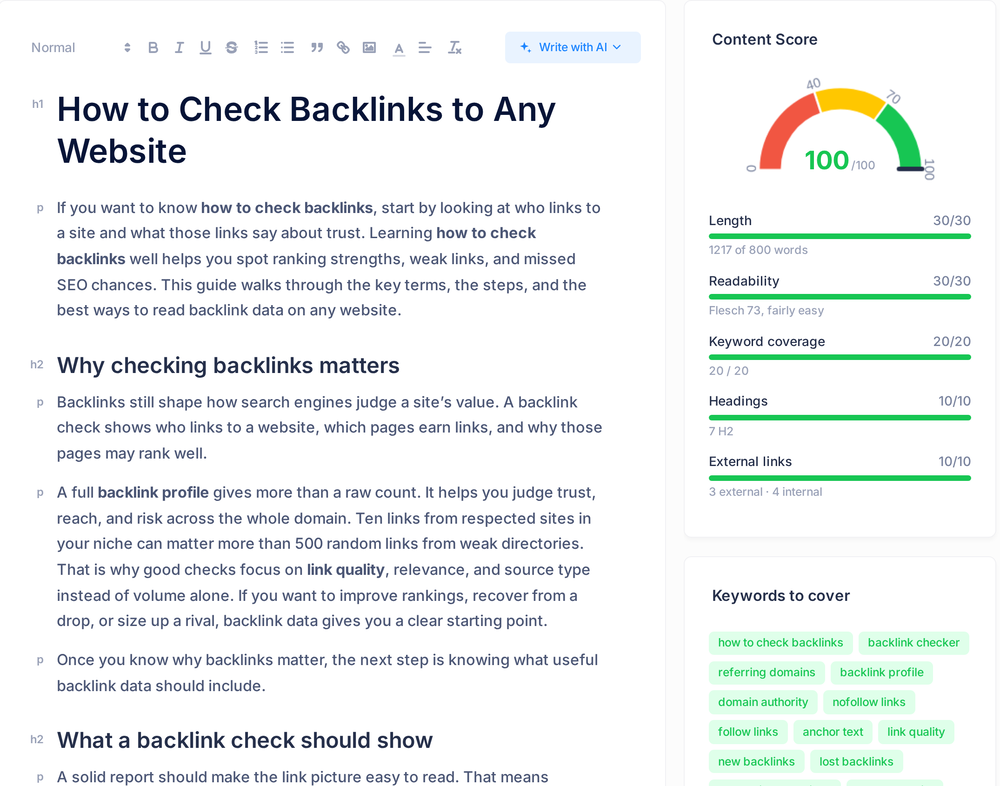
Write SEO Optimized Articles Instantly with AI Writer
AI Writer researches the pages ranking for your target keyword, instantly writes a full article and scores it for keywords, readability, links and length. Create the best content possible with the highest ranking potential with our proprietary algorithms.

About Rewording Text
What is rewording, and when is it the right tool?
Rewording means saying the same thing in different words. The meaning is meant to survive; only the expression changes, which makes it a narrower operation than editing and a different one from rewriting.
The legitimate reasons are specific. You are quoting a source and need a paraphrase rather than a quotation. You have used the same phrasing three times on one page. You are adapting copy written for one audience to another.
The illegitimate reason is passing off someone else work as your own. An AI rewording tool changes the words, not the ownership, and reworded plagiarism is still plagiarism.
What good paraphrasing looks like
- The meaning survives intact, including any qualifications the original made.
- The sentence structure changes, not just individual words.
- Technical terms stay as they are, since replacing them changes the meaning.
- The source is still credited where the idea came from someone else.
- The result reads naturally rather than as an evasion of the original phrasing.
Common mistakes
- Synonym substitution, which produces stilted text and often changes meaning.
- Rewording technical terms that have no synonym.
- Losing a qualification, so a careful claim becomes an absolute one.
- Paraphrasing to avoid citing, which is the misuse this tool is best known for.
- Rewording your own clear sentence until it is no longer clear.
How this relates to AI search
Reworded content adds nothing to the web that was not already there, and systems choosing what to cite are actively trying to identify original sources rather than restatements.
That makes rewording a poor content strategy and a reasonable editing operation. Using it to produce a page is the failure mode; using it to fix a repetitive paragraph is not.
The durable position is to be the source worth paraphrasing rather than the paraphrase.
Where an AI rewording tool helps, and where it does not
It is genuinely useful for producing alternatives when you know what you mean and dislike how you have said it. Seeing three versions often reveals which part was the problem.
It cannot judge whether the reworded version still means what you intended, and small shifts in qualification are easy to miss when the result reads well.
Check any sentence carrying a factual claim particularly closely, since fluent output is persuasive whether or not it survived the change accurately.
Using the AI rewording tool
Paste in the text you want to reword and the tool returns alternatives. Short passages produce better results than long ones, since meaning drifts over distance.
Then compare against the original for meaning rather than for style, and keep the version that is clearer rather than the one that is most different.
Where to go next
Rewording is one of several fixes. Use the AI text enhancer for a general tightening pass, the AI tone rewriter when the register is the problem, and the sentence rewriter when a single sentence is not working.

SEO Audit Any Site in Seconds
+ Comprehensive SEO / GEO Tools for Every Function
Run over 100 checks on your website across On-Page SEO, Usability, Performance, Social and Links. Now with GEO in every report. SEOptimer also offers keyword research, rank tracking, backlinks and a full site crawler.
Further Reading
See More
SEO Copywriting Checklist for Higher Ranking Content
Following an SEO copywriting checklist is quite important if you want to improve your website’s search engine visibility and outrank your co...