AI Text Enhancer
Easily enhance any text with our AI Text Enhancer Tool. Choose your tone and language, and our tool will generate a new, higher quality version of your content that is more articulate and polished.
Input
Output
Generated content:
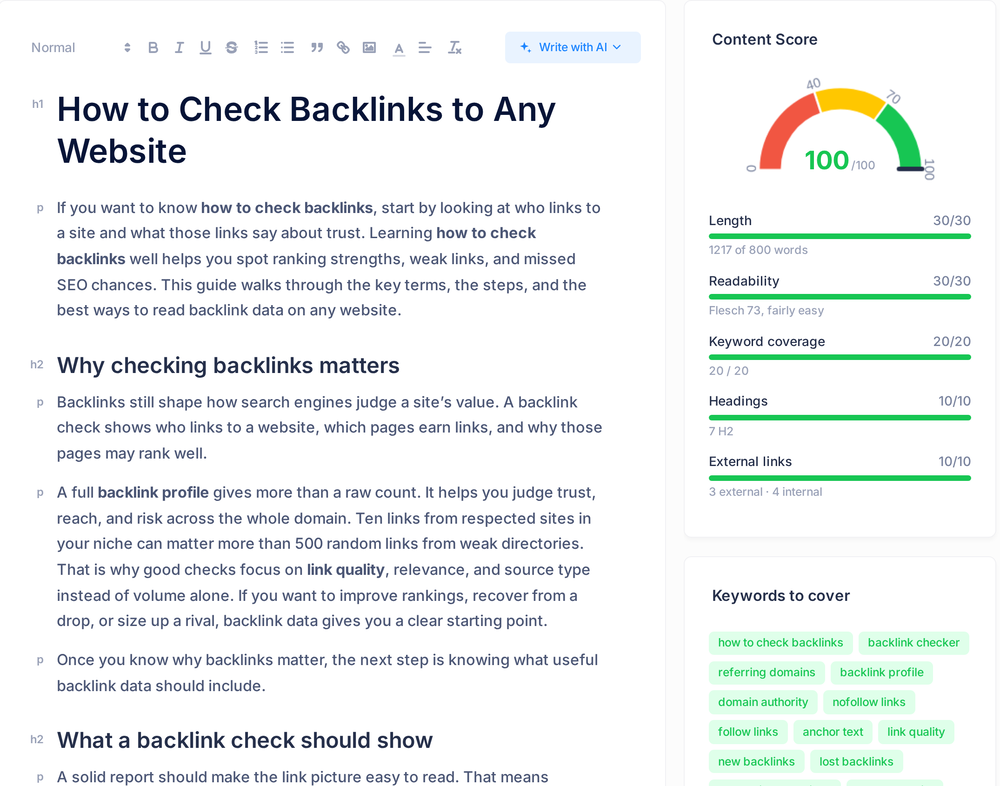
Write SEO Optimized Articles Instantly with AI Writer
AI Writer researches the pages ranking for your target keyword, instantly writes a full article and scores it for keywords, readability, links and length. Create the best content possible with the highest ranking potential with our proprietary algorithms.

About Improving Your Writing
What does it mean to improve writing?
Improving writing almost always means removing rather than adding. Clearer prose is shorter, more concrete and less hedged than the draft it came from, and most edits that make writing better also make it smaller.
That runs against the instinct that better writing is more elaborate. Elaborate writing is harder to read, and the reader interprets difficulty as either the writer showing off or the writer not being sure.
An AI text enhancer works on the surface layer: word choice, rhythm, redundancy. That is genuinely useful, and it is not the same as improving what the text says.
What actually makes writing better
- Cutting words that carry no information: very, really, quite, in order to, the fact that.
- Replacing abstractions with specifics, especially numbers and named examples.
- Using active constructions where the actor matters.
- Varying sentence length, since uniform sentences read as flat regardless of content.
- Removing hedges that were protecting you rather than informing the reader.
- Saying the point once, clearly, rather than three times in different words.
Common mistakes
- Confusing formality with quality; formal prose is often just harder to read.
- Adding transitional phrases to text that flowed fine without them.
- Swapping plain words for longer synonyms, which reads as padding.
- Polishing a paragraph that should be deleted.
- Editing so much of the voice out that the result could have been written by anyone.
How this relates to AI search
Clear writing is easier to extract from, because a passage that says one thing plainly can be quoted without the surrounding context.
The risk with automated enhancement runs the other way. Text smoothed toward the average reads as generated, and content that reads as generated is exactly what systems and readers are learning to discount.
The specifics are what protect you: your data, your examples, your particular way of putting things. Those are the first casualties of over-enhancement.
Where an AI text enhancer helps, and where it does not
It is good at the mechanical pass: catching repetition, tightening clumsy constructions, and fixing the sentences you have read so many times you can no longer see.
It cannot tell you the argument does not hold, the example is unconvincing, or the whole section is unnecessary. Those are the edits that actually improve a piece, and they require knowing what you were trying to say.
Run it on prose you already believe in. Running it on a weak draft produces a fluent weak draft, which is harder to fix because the problems are now better dressed.
Using the AI text enhancer
Paste in your text and the tool returns a revised version. Working in small sections gives you more control than pasting an entire article at once.
Then read both versions side by side and accept only the changes that made it clearer. Anything that made it merely smoother is worth rejecting, because smoothness is what makes writing anonymous.
Where to go next
Different problems need different tools. Use the AI rewording tool to say something a different way, the AI tone rewriter to change register, and the paragraph rewriter when the structure rather than the wording is wrong.

SEO Audit Any Site in Seconds
+ Comprehensive SEO / GEO Tools for Every Function
Run over 100 checks on your website across On-Page SEO, Usability, Performance, Social and Links. Now with GEO in every report. SEOptimer also offers keyword research, rank tracking, backlinks and a full site crawler.
Further Reading
See More
SEO Copywriting Checklist for Higher Ranking Content
Following an SEO copywriting checklist is quite important if you want to improve your website’s search engine visibility and outrank your co...

6 Elements of an Effective Content Production Process
Content production is the cornerstone of a solid online marketing strategy.
As the saying goes, “content is king,” and without en...