AI Answer Generator
Get instant, accurate answers to any question with our AI Answer Generator. Whether it's for school, work, or curiosity, just type your question and get a clear response in seconds.
Input
Output
Generated content:
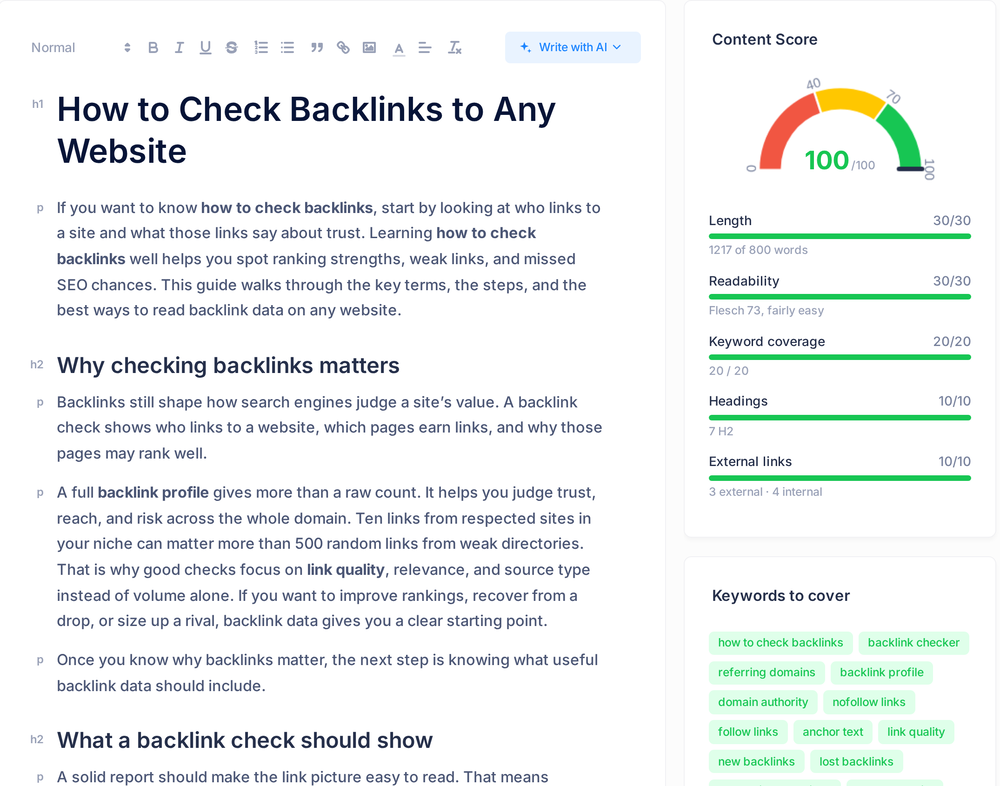
Write SEO Optimized Articles Instantly with AI Writer
AI Writer researches the pages ranking for your target keyword, instantly writes a full article and scores it for keywords, readability, links and length. Create the best content possible with the highest ranking potential with our proprietary algorithms.

About Writing Good Answers
What makes a good answer?
A good answer states the answer first. That sounds obvious and is routinely ignored: most writing about a question spends three paragraphs establishing why the question matters before addressing it, by which point the reader has left or scrolled past.
After the answer comes the reasoning. Someone who accepts your first sentence can stop reading; someone who does not needs to understand why you are confident. Putting the reasoning first serves neither.
The best answers also acknowledge their limits. "This depends on whether you are running Apache or Nginx" is more useful than a confident answer that is wrong half the time, and readers trust writing that tells them when it does not apply.
What to include in an answer
- The direct answer, in the first sentence or two.
- The reasoning behind it, so the reader can judge whether it applies to them.
- The conditions under which it changes, stated plainly rather than buried.
- A concrete example, since abstractions are hard to act on.
- What to do next, if the answer implies an action.
- What you are not covering, where the scope could reasonably be misread.
Common mistakes
- Burying the answer under context nobody asked for.
- Hedging so thoroughly that no position is taken at all.
- Answering a slightly different question than the one asked, usually an easier one.
- Padding with restatement, which is the most common failure of generated text.
- Claiming certainty on something genuinely contested.
How this relates to AI search
The same structure that helps a reader helps a system quoting you. Answers are extracted as passages, and a passage that leads with its conclusion can be lifted intact; one that builds to a conclusion over four paragraphs usually cannot.
Writing under a heading phrased as the question is the other half. It matches how people actually ask, and it makes the boundaries of the answer explicit rather than inferred.
Being clear about scope matters more here than in traditional search, because an answer quoted without its conditions can be repeated somewhere it does not hold.
Where an AI answer generator helps, and where it does not
It helps with the blank page and with structure. Given a question, an AI answer generator will produce something correctly shaped, which is often enough to get past the hardest part of writing.
It cannot supply what it does not have: your data, your experience, the reason your view differs from the obvious one. Generated text is fluent by default and specific only if you make it so, and fluency without specificity is exactly the word salad that makes people distrust AI content.
The productive use is as a first draft to react to. Read what it produces, notice where it is generic, and replace those parts with what you actually know.
Using the AI answer generator
Enter your question and the tool produces a draft answer. The more specific the question, the more useful the result: "how long should a title tag be" produces something usable, while "tell me about SEO" produces exactly what you would expect.
Then edit it as a first draft rather than publishing it. Cut the restatement, add the specifics only you have, and check every factual claim, since fluent text is persuasive whether or not it is correct.
Where to go next
An answer usually sits inside something longer. Draft the surrounding piece with the AI blog post generator tool, open it with an introduction paragraph generator that does not waste the reader time, and close it with a conclusion generator that adds something.

SEO Audit Any Site in Seconds
+ Comprehensive SEO / GEO Tools for Every Function
Run over 100 checks on your website across On-Page SEO, Usability, Performance, Social and Links. Now with GEO in every report. SEOptimer also offers keyword research, rank tracking, backlinks and a full site crawler.
Further Reading
See More
How to Structure Content to Get Cited in AI Answers
How to Structure Content for AI Citations
Put the main point at the top of each section.
Make headings describe the exact quest...

Google AI Overviews: A Deep Dive into How Search is Changing
Google AI Overviews is one of the latest announcements and product updates from the search engine giant this year.
Google held its a...

LLM Optimization: How to Get Cited in AI Answers
LLM optimization can help increase the chances of your website being mentioned or cited in answers generated by ChatGPT, Gemini, Claude, and...

SEO Copywriting Checklist for Higher Ranking Content
Following an SEO copywriting checklist is quite important if you want to improve your website’s search engine visibility and outrank your co...