Deprecated HTML Tags Checker
SEOptimer’s Deprecated HTML Tags Checker scans your webpage for outdated HTML tags that may no longer function correctly or could disrupt your page’s execution

SEO Audit Any Site in Seconds
+ Comprehensive SEO / GEO Tools for Every Function
Run over 100 checks on your website across On-Page SEO, Usability, Performance, Social and Links. Now with GEO in every report. SEOptimer also offers keyword research, rank tracking, backlinks and a full site crawler.

About Deprecated HTML Tags
What are deprecated HTML tags?
Deprecated tags are elements removed from the HTML standard, generally because they described appearance rather than meaning: font, center, big, strike, marquee and their contemporaries. They belong to an era when HTML was expected to control how a page looked.
Browsers still render most of them, which is why they survive. Being rendered is not the same as being supported, and support is a courtesy rather than a guarantee.
A deprecated HTML tags checker is really asking a question about maintenance. Markup of that vintage does not appear in pages anyone has revisited recently.
Does this still matter in 2026?
The direct penalty is negligible, and it would be dishonest to suggest otherwise. No search engine demotes a page for a font tag.
The value is diagnostic. Deprecated markup indicates content nobody has touched in many years, or a visual editor generating markup from a previous era, and both usually come with other problems attached: no responsive layout, no alt text, a missing viewport tag.
It also signals a genuine structural issue. Markup that describes appearance instead of meaning is markup that carries no information for anything reading the page rather than looking at it.
How deprecated tags relate to AI search
Presentational markup gives a parser nothing to work with. A font tag says text should be large; a heading tag says it introduces a section. Only the second is useful when working out what a document contains and which passage answers a question.
Replacing presentational tags with semantic ones is one of the more direct ways to make an old page legible to modern systems, and it frequently uncovers content that was effectively invisible.
Pages built this way often have no heading structure at all, only text styled to look like headings, which means nothing can identify where one section ends and the next begins.
What replaced them
- font, big and small: set typography in CSS instead.
- center: use CSS alignment or flexbox.
- strike and u: use the semantic del and ins where meaning is intended.
- b and i: use strong and em where emphasis is meant rather than styling.
- Layout tables: use CSS grid or flexbox, and keep tables for tabular data.
- frameset and frame: removed entirely, with no direct replacement.
Modernising markup
- Move appearance into CSS and keep HTML for structure.
- Use heading tags for headings rather than sized and bolded text.
- Use semantic elements such as nav, main, article and footer.
- Check editor output, which is a common ongoing source of legacy markup.
- Treat a deprecated tag as a prompt to audit the whole page, not just that line.
What this tool checks
The tool scans the page markup for deprecated elements and passes when none are present.
It checks for known obsolete tags rather than for markup that is merely old-fashioned, so a page can pass while still being built from nested layout divs with no semantic structure at all.
Where to go next
Legacy markup rarely travels alone. Check whether the page has real header tags, look for inline CSS which comes from the same editors, and confirm it still works on a phone with the mobile responsiveness test.
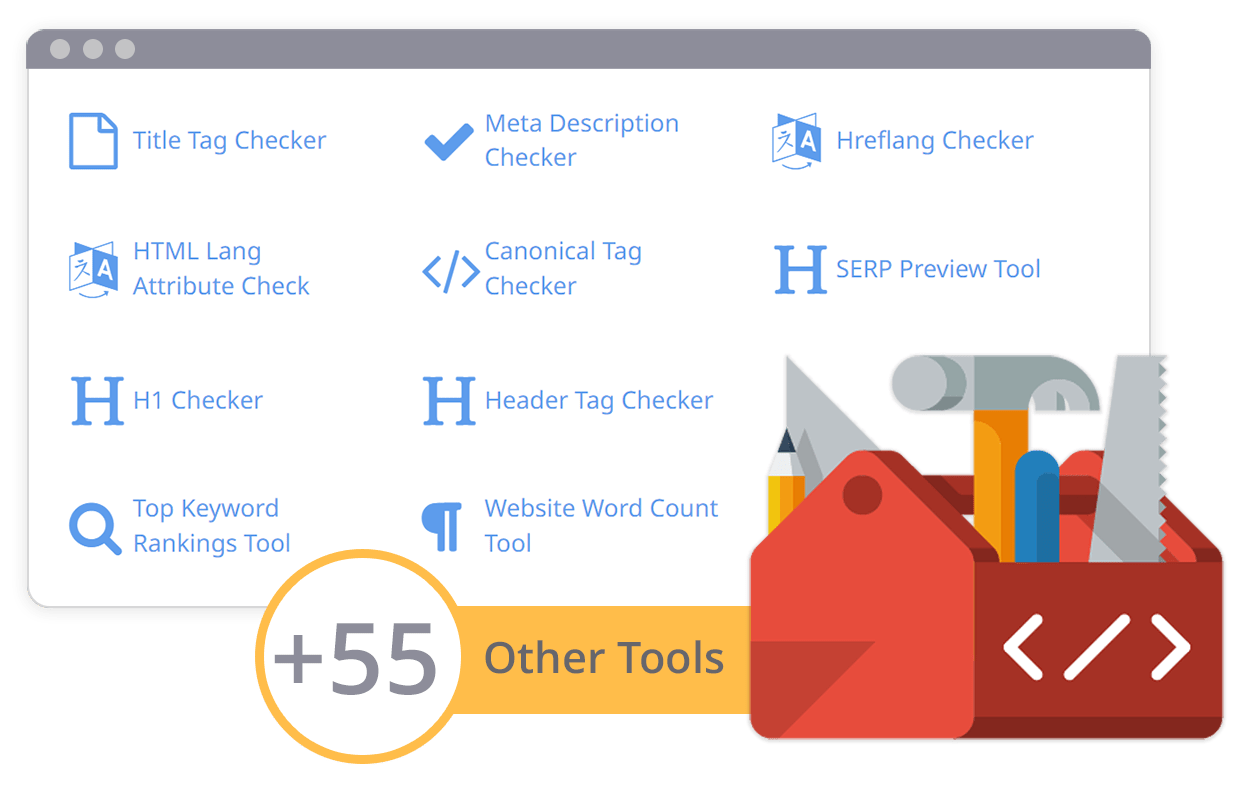
Comprehensive SEO Toolbox with over 55 Tools
Check Titles, Meta Descriptions, Headings, Schema, Core Web Vitals, SSL and Robots.txt. Generate Meta Tags, Sitemaps and .htaccess Rules, minify CSS, JS and HTML, and draft copy with our AI Writing Tools - instantly and for free.
Further Reading
See More
On-Page SEO: Complete Guide + Checklist for 2026
What is On-Page SEO?
On-page SEO is the process of optimizing the content and elements on a webpage so that search engines can bette...