Header Tag Checker
SEOptimer's Free Header Tag Checker Tool. Check that you are using Header Tags.
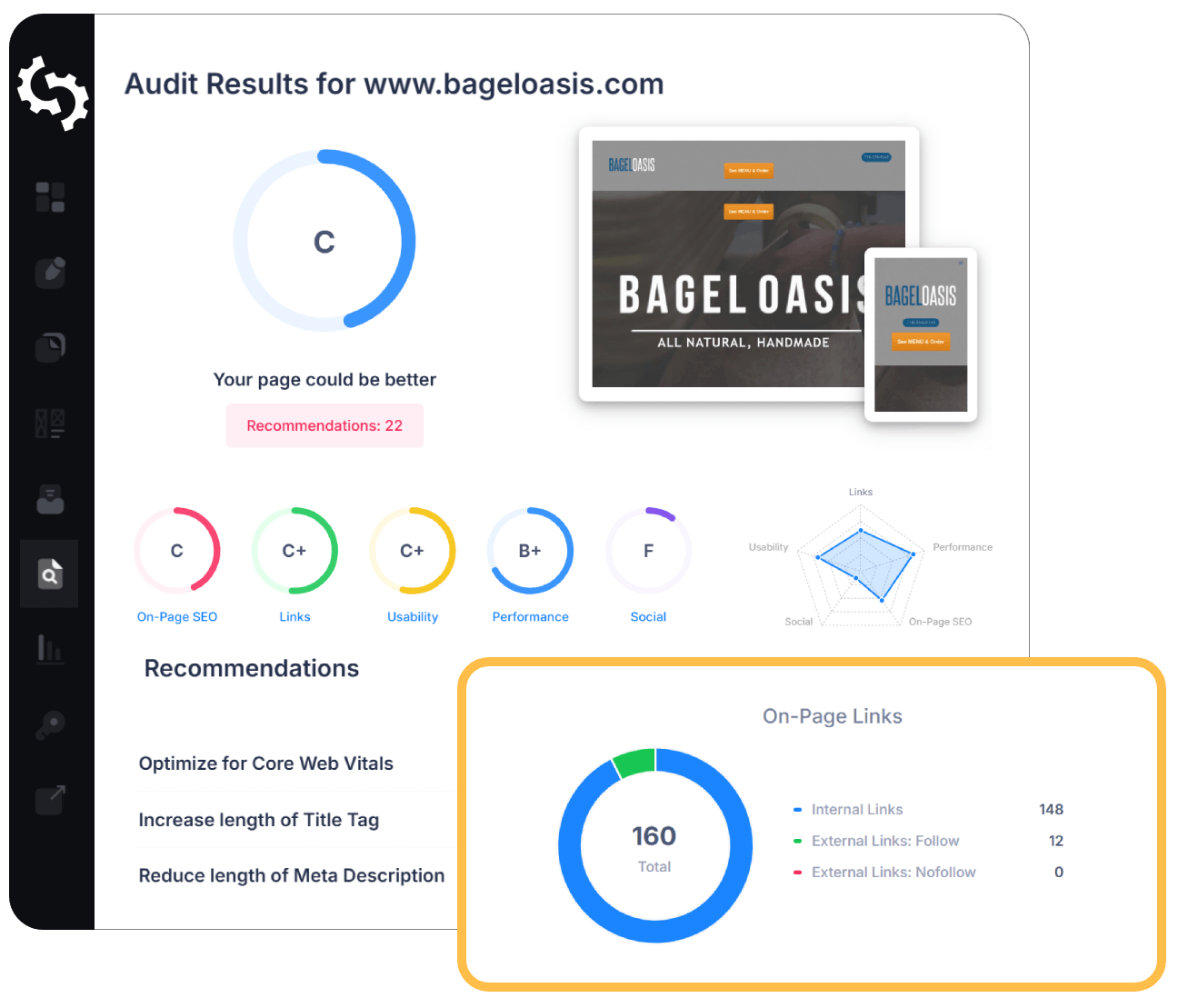
SEO Audit Any Site in Seconds
+ Comprehensive SEO / GEO Tools for Every Function
Run over 100 checks on your website across On-Page SEO, Usability, Performance, Social and Links. Now with GEO in every report. SEOptimer also offers keyword research, rank tracking, backlinks and a full site crawler.

About Header Tags
What are header tags?
Header tags, written H1 through H6, are the HTML elements that mark the headings on a page. They are not a styling choice: they describe the structure of a document, telling anything that reads the markup where each section begins, what it covers, and how it nests inside the section above it.
Together they form an outline. H1 names the page, H2 marks its main sections, H3 marks subsections within those, and so on down. Read on their own, the headings of a well-built page should summarise it.
A heading that is only a heading because it is bold and large exists for sighted readers and nobody else. That is what an H tag checker is really testing for: whether the visual structure you can see is backed by actual structure in the HTML.
H1 and everything below it
The six levels are not equally important, and it is worth being clear about why. The H1 is a claim about the whole page, and there should be exactly one of them. Get it wrong, or omit it, and the page has no stated subject in its own content.
H2 to H6 are a different kind of problem. There is no correct number of them, no single one that matters more than the others, and no rule about where they appear. What matters is that they exist where the content changes subject, and that the levels descend in order rather than being chosen for how big the text looks.
Because those are genuinely separate questions, they are worth checking separately. This tool covers H2 to H6; the H1 checker handles the H1 on its own, since counting to one is a different test from assessing whether a page is structured.
Do header tags still matter in 2026?
More than ever, because almost nobody reads a page linearly. People scan for the part that answers their question, and headings are what make scanning possible at all. A page that answers a question in paragraph nine, with nothing to signpost it, has lost the reader long before nine.
Search features that jump a visitor directly to a relevant part of a page depend on the same structure. Without headings there is nothing to jump to, and the visitor lands at the top to start hunting.
As pages get longer, structure becomes the difference between depth and sprawl. A 3,000 word page with six clear sections is a resource; the same words with no headings is a wall of text.
How header tags relate to AI search
AI answers are assembled from passages, and a heading is the clearest available marker of where a passage starts, what it covers and where it ends. A well-structured page is easier to quote accurately, because the boundaries of an idea are explicit rather than inferred from paragraph breaks.
Phrasing headings as the question a section answers is a small change that helps considerably, because it matches the shape of the prompts people actually type. A section headed "How long should a title tag be?" is a far better match for that question than one headed "Length".
It also makes a page more likely to be quoted correctly. A passage lifted from under a clear heading arrives with its context attached, and the H1 above it establishes what the whole document is about.
Header tag best practices
- Use exactly one H1, then descend in order without skipping levels to get a particular size.
- Describe the section rather than teasing it, so the outline reads well on its own.
- Phrase headings as questions where the section answers one.
- Break long sections up. If a block of text runs for several screens without a heading, it probably contains more than one idea.
- Keep them short enough to scan and specific enough to be worth scanning.
- Never use a heading tag purely for emphasis on text that is not a section.
What this tool checks
The H tag checker looks for heading tags below H1 on the page and reports whether any are present. It deliberately excludes the H1, which is assessed on its own because the question there is different: one is correct, none or several are not.
It does not grade the outline, check the nesting order, or read the wording, so a page with a single H2 passes exactly as a carefully structured one does. Use the H tag checker as a first pass: a failure means there is no structure at all, which is worth fixing immediately, while a pass means structure exists and your own judgement takes over.
Where to go next
Headings work as a system, and this tool covers only part of it. Check the H1 checker that sits above them, compare both against the title tag checker so the page subject is stated consistently from the results page down, and use the keyword consistency check to confirm your headings and body text agree on the topic.
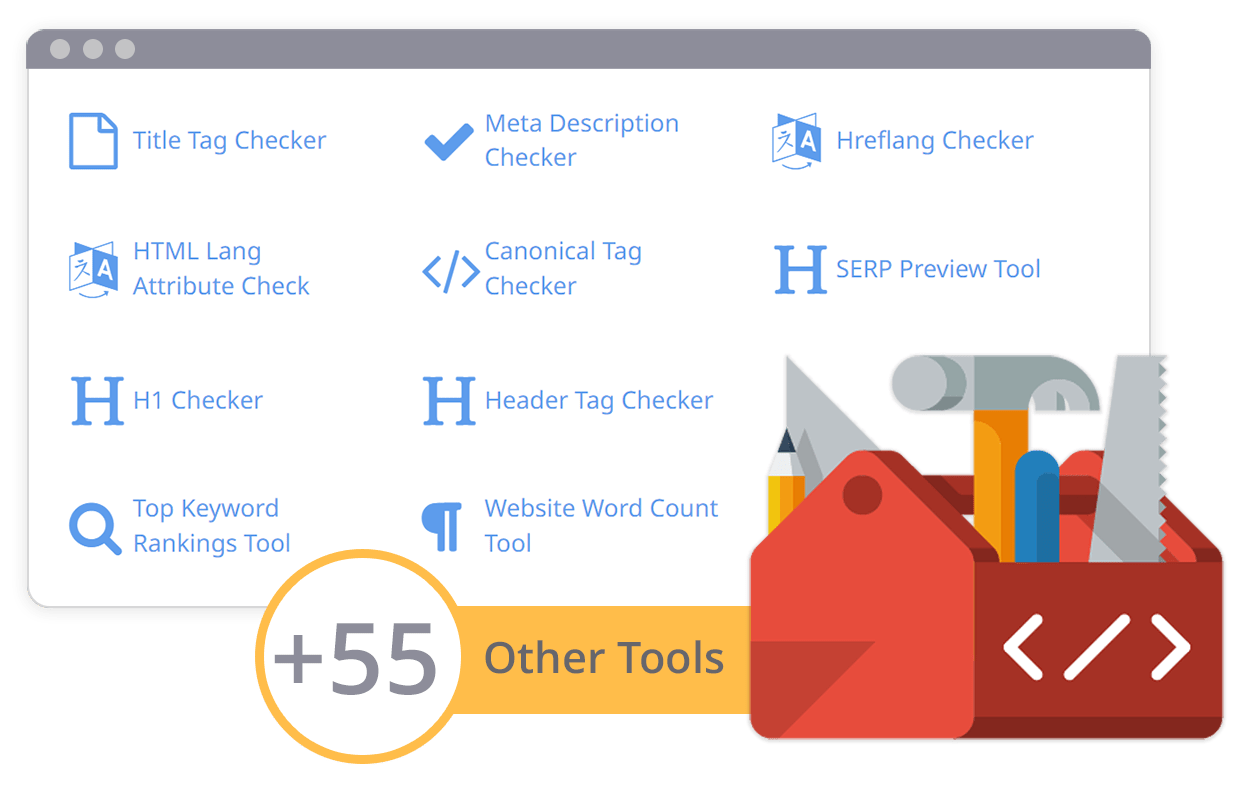
Comprehensive SEO Toolbox with over 55 Tools
Check Titles, Meta Descriptions, Headings, Schema, Core Web Vitals, SSL and Robots.txt. Generate Meta Tags, Sitemaps and .htaccess Rules, minify CSS, JS and HTML, and draft copy with our AI Writing Tools - instantly and for free.
Further Reading
See More
SEOptimer's Guide to Header Tags
What are Header Tags?
HTML header tags are used to differentiate different levels of headings and sub-headings within a page.
...
H1 HTML Tag: What Is It? How to Create One and Best Practices
H1 tags are a critical part of your website. Search engines use H1 tags to learn the primary content of a web page.
H1 was always...

Heading vs Title Tags: What are the Differences & How to Create Them?
Wondering what are the differences between heading and title tags?
Since both heading and title tags are used to tell the readers...

On-Page SEO: Complete Guide + Checklist for 2026
What is On-Page SEO?
On-page SEO is the process of optimizing the content and elements on a webpage so that search engines can bette...