Internal Link Checker
SEOptimer’s Internal Link Checker tool analyzes your webpage to count both internal and external links, and identifies whether they are set to "Follow" or "Nofollow."
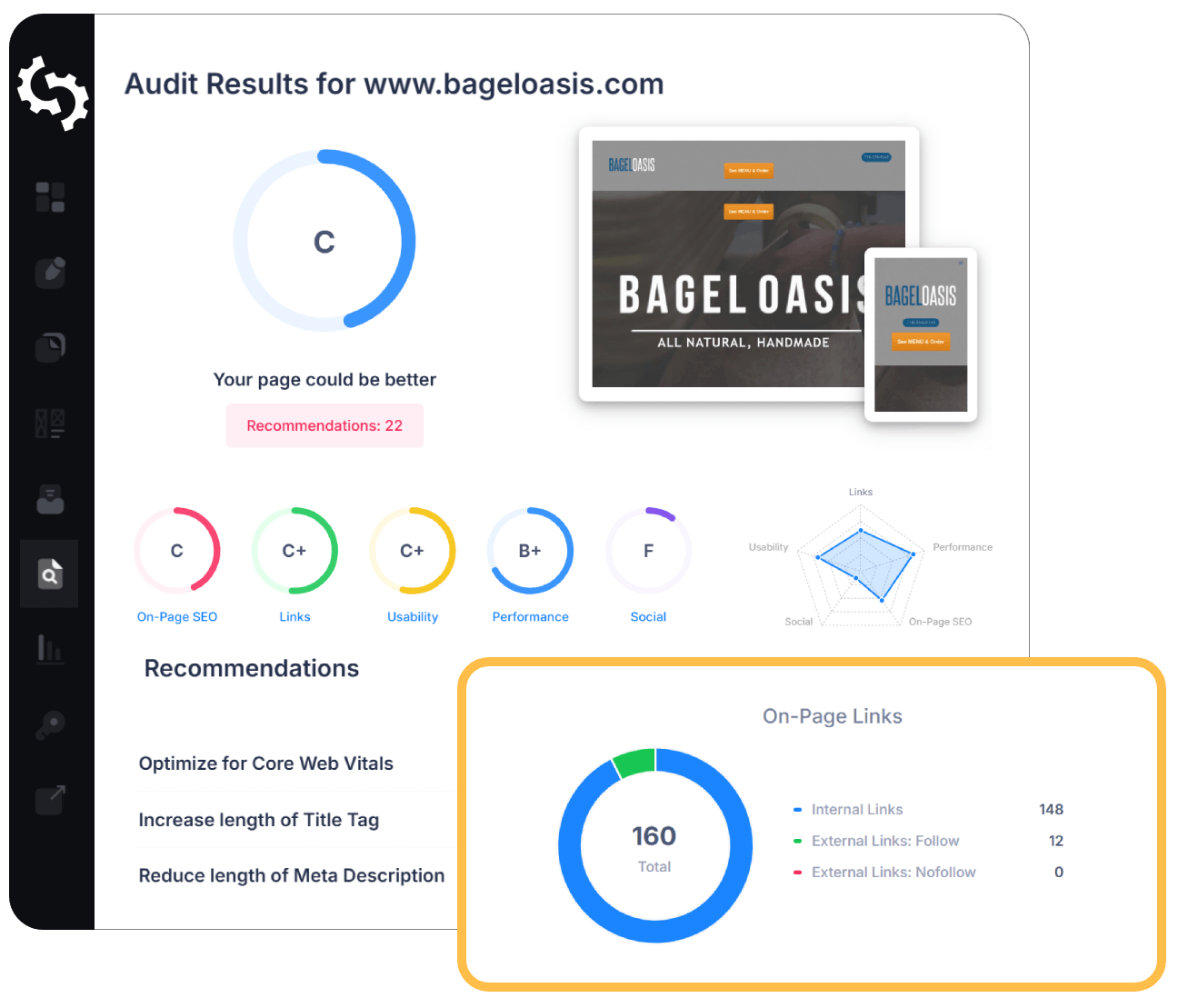
SEO Audit Any Site in Seconds
+ Comprehensive SEO / GEO Tools for Every Function
Run over 100 checks on your website across On-Page SEO, Usability, Performance, Social and Links. Now with GEO in every report. SEOptimer also offers keyword research, rank tracking, backlinks and a full site crawler.

About Internal Links
What are internal links?
Internal links connect one page of a site to another. They are how visitors move around, how crawlers discover pages, and how importance is distributed through a site.
Unlike backlinks, they are entirely under your control. Nobody has to agree to give you one, which makes them the most neglected easy win in most site audits: all the benefit of a link, none of the negotiation.
An internal link checker gives you the picture from a single page outward, which is usually where the problems show. A page linking to nothing is a dead end; a page nothing links to is invisible.
Do internal links still matter in 2026?
They matter enormously and are consistently underused. A page nothing links to is a page that is difficult to find and appears unimportant, however good the content on it happens to be.
They also communicate structure. Which pages you link to, from where, and with what wording tells a search engine how your site is organised and which pages you consider central, and that is a signal you write yourself.
For large sites the effect compounds. Crawl budget is finite, and a well-linked site directs it toward the pages that matter instead of spending it on the ones nothing points at.
How internal links relate to AI search
They are how a crawler finds its way around, and orphaned pages may simply never be read. For a large site that is the difference between some of your content being known and all of it.
Descriptive link text also provides context about a destination before it is fetched, which helps a system understand how the pieces of a site relate to one another rather than treating each page as isolated.
Linking related pages together is one of the clearer ways to signal that you cover a subject in depth rather than in a single article, and depth is what gets cited.
Internal linking best practices
- Link to related pages from within body content, not only from navigation.
- Use descriptive anchor text rather than "click here" or a bare URL.
- Make sure every page is reachable in a few clicks from the homepage.
- Find and fix orphan pages, which nothing links to at all.
- Link from your strongest pages to the ones you want to lift.
- Repair broken internal links promptly; they waste crawl effort and frustrate readers.
Common mistakes
- Relying entirely on navigation, so every page links to the same twenty destinations.
- Using the same anchor text for every link to a page, which reads as manufactured.
- Burying important pages several clicks deep with nothing pointing at them directly.
- Leaving links to pages that were removed or renamed during a redesign.
- Adding links for their own sake, until the body text is harder to read than it is useful.
What this tool checks
The internal link checker collects the links on the page and reports them for review, separating internal from external destinations.
It is a listing rather than a judgement, because whether a linking structure is sensible depends on the site around it. What it gives you is the raw picture: what this page points at, and how much of that is your own site.
Where to go next
Internal links are one half of how pages get discovered. Make sure the pages you link to are listed in your XML sitemap, confirm those destinations return a healthy status code, and check that nothing you want found is blocked by a noindex tag directive.
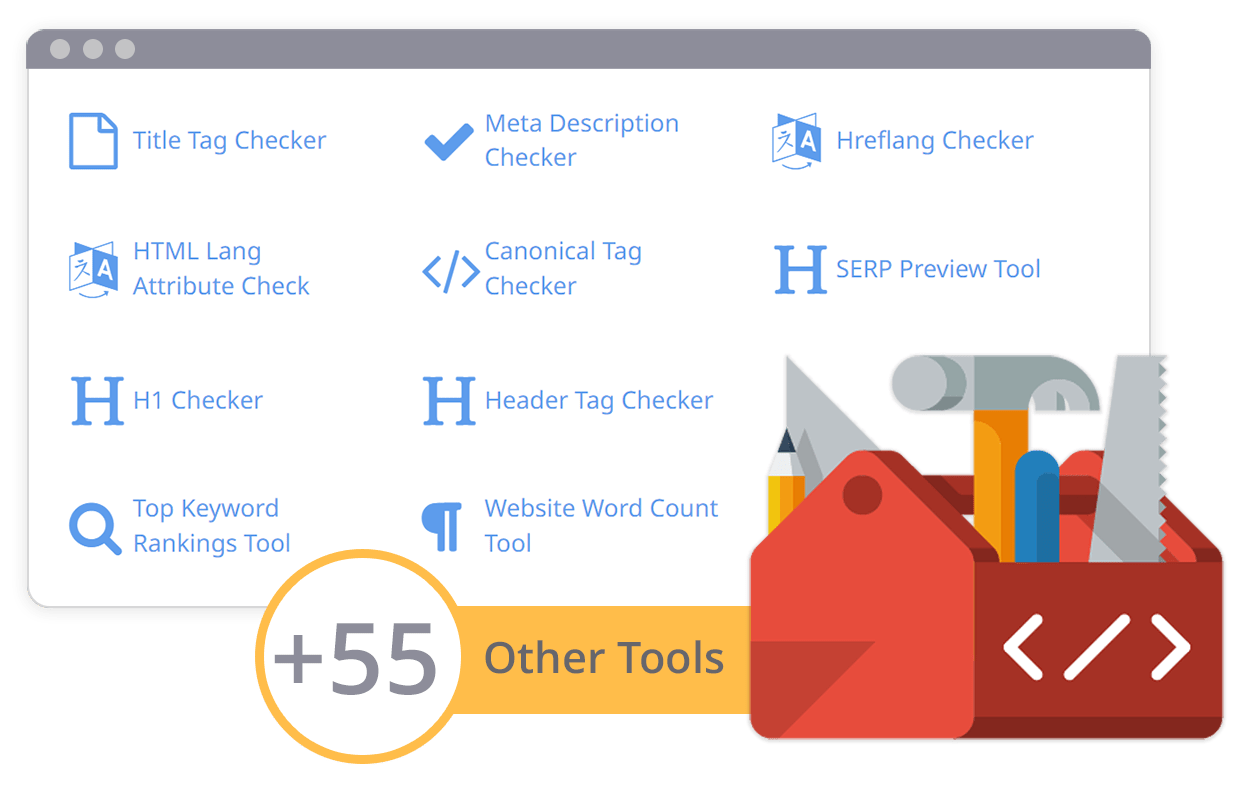
Comprehensive SEO Toolbox with over 55 Tools
Check Titles, Meta Descriptions, Headings, Schema, Core Web Vitals, SSL and Robots.txt. Generate Meta Tags, Sitemaps and .htaccess Rules, minify CSS, JS and HTML, and draft copy with our AI Writing Tools - instantly and for free.
Further Reading
See More
How to Find All the Internal Links to a Page
A well designed internal link structure increases crawl efficiency and builds link equity.
By linking the important pages on your si...
Deep Linking for SEO: Why It's Powerful for Boosting Rankings
Improving a website’s ranking ability involves standard practices such as on-page SEO, technical SEO, link-building, etc. A vital aspect o...
What are Broken Links? And How Do You Find and Fix Them?
What are Broken Links?
A broken link is a web-page that can't be found or accessed by a user, for various reasons. Web servers wil...
What are Inbound Links and How Do They Help You?
If you have been around people doing Search Engine Optimization (SEO), you may have heard them passionately talk about why you need to hav...
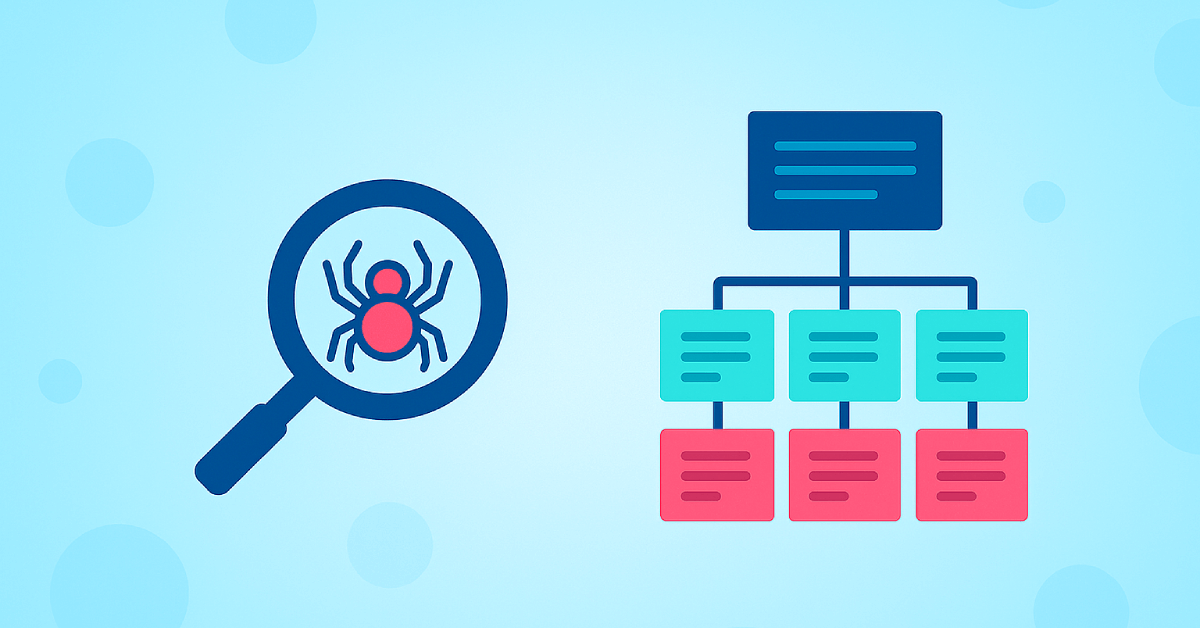
Crawl Depth in SEO: What is It & How to Improve It?
Crawl depth influences how efficiently Google can index your content.
Googlebot has limited time and server resources. Therefore, th...