


SEO MCP Key Takeaways
- SEO MCP servers connect AI assistants to SEO tools and datasets.
- They use the Model Context Protocol (MCP), an open standard developed by Anthropic.
- This allows AI to pull real data from tools like Google Search Console, GA4, and SEO platforms.
- SEO teams can automate tasks like keyword research, competitor analysis, and performance monitoring.
Every SEO or marketer knows the struggle of juggling too many tools and too much data, and this is exactly where SEO MCP servers come in.
Most SEO professionals still export CSVs, switch between dashboards from different tools, and manually piece together insights from several sources.
Imagine having a tool that connects all your SEO and website data into one place and makes it easy to extract insights from it. That’s exactly what SEO MCP servers are built for.
By connecting your AI assistant directly to your SEO data, you can skip the manual work and simply ask for the insights you need.
No exports or pivot tables. And far less guesswork in the analysis process.
In this guide, we explain what an SEO MCP server is, how it works, their drawdowns, and the top solutions worth using.
What is SEO MCP?
SEO MCP refers to the use of MCP servers that allow large language models (LLMs) like Claude and ChatGPT to connect to SEO tools and external data sources.
These servers act as the bridge between your AI assistant and the platforms you already use, such as Google Search Console, analytics tools, or keyword databases.
Instead of exporting CSVs or manually combining data from multiple dashboards, you can simply ask your AI assistant a question and it retrieves the relevant information directly from your connected tools.
The normal 15 to 20 minute cycle of exporting CSVs and reformatting spreadsheets is replaced with a single sentence typed into a chat window.
You inquire about your site and the AI goes and gets the answer from your real data. No middleman and no outdated reports.
- Burkan Bur, Managing Director, Head of SEO at The Ad Firm
What does MCP Stand for in SEO?
MCP stands for Model Context Protocol, an open standard introduced by Anthropic in November 2024.
It was designed to replace the web of custom integrations between AI systems and external tools with a single standardized protocol.
Using MCP, AI assistants can securely connect to tools, databases, and APIs through MCP servers, allowing them to retrieve real data and perform actions across multiple platforms.
How Model Context Protocols (MCP) Work
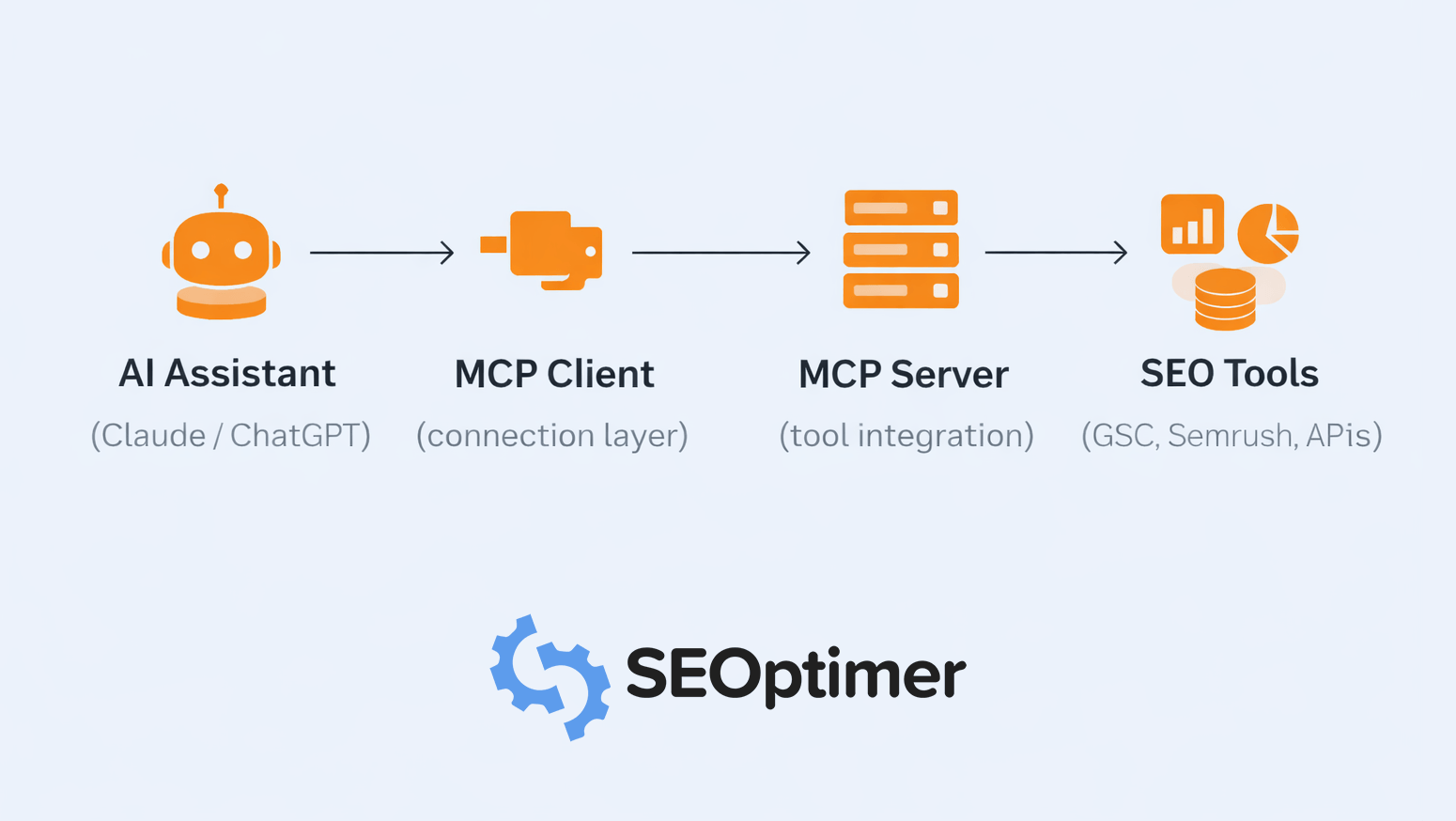
MCP follows a client-server architecture, with three main components:
- MCP Hosts: Applications like Claude Desktop or ChatGPT that initiate the connection.
- MCP Clients: Connectors within the host that maintain a connection to each MCP server.
- MCP Servers: Services that expose tools, data, and actions from external platforms such as Google Search Console, analytics platforms, or keyword databases.
These servers allow the AI to retrieve information and interact with real datasets instead of relying only on its training data. Because the data comes directly from connected tools, the AI can work with real, up-to-date information rather than relying only on general knowledge.
Here’s how it plays out in practice.
You ask Claude a question like: "Which of my pages has the most impressions but the lowest click-through rate?"
Claude identifies the relevant tool, calls your connected MCP server (for example, Google Search Console), retrieves the data, and then delivers the answer in plain English along with context and recommendations.
Why Use MCP Servers for SEO?
Traditional SEO analysis can be slow and fragmented compared to working with SEO MCP servers.
Before SEO MCP tools, you typically log into your favorite SEO tool for keyword data, check Google Search Console for indexing issues, open Google Analytics to review traffic trends, and then spend time stitching everything together manually.
SEO MCP servers eliminate that friction.
Here’s why:
- Real-time data access: No more waiting for scheduled reports or manual exports.
- Cross-platform analysis: Combine data from multiple tools in a single conversation.
- Unified data context: AI can analyze multiple datasets together, revealing insights that would normally require combining several reports.
- Natural language queries: Ask complex questions in plain English and get instant answers.
- Scalability: Analyze thousands of URLs or keywords without spreadsheet limitations.
- Automation: Set up agents to handle routine tasks like rank monitoring or weekly reporting.
The result is less time spent gathering data and more time focusing on strategy.
Top SEO MCP Solutions in 2026
1. Google Search Console MCP Server (mcp-gsc)
Built by developer AminForou, this open-source SEO MCP server connects Google Search Console directly to Claude AI.
This SEO MCP has become one of the most popular options, with over 500 GitHub stars.
What it can do:
- Pull search analytics data: impressions, clicks, CTR, and ranking positions
- Inspect individual URLs for indexing issues
- Submit and monitor sitemaps
- Compare performance across different time periods
- Visualize GSC data using charts and graphs created by Claude
Sample prompts you can run:
- "Show me my top 20 queries from the last 30 days and highlight any with a CTR below 2%."
- "Check these 5 product pages for indexing issues and tell me which needs immediate attention."
- "Compare my site's performance between January and March."
This tool is particularly valuable for technical SEO audits and diagnosing indexing problems without ever leaving your AI chat window.
MCP servers are proving really useful for reducing SEO analysis time for me.
There is setup and testing involved, but work that would normally take a couple of hours across GSC exports, PageSpeed checks, and spreadsheets can now be done in minutes. That makes technical SEO auditing far more scalable.
- Paul Pennington, Founder at Frankenstein Digital
2. Google Analytics MCP Server
Google officially launched its own MCP server for Google Analytics 4, letting you connect GA4 data directly to an LLM like Gemini or Claude.
It's built and maintained by Google's developer team.
What it can do:
- Pull session data, user counts, and engagement metrics
- Identify top-performing pages and products
- Build data-driven marketing plans using live analytics data
- Answer questions like: "How many users did I have yesterday?" or "What were my top-selling products last week?"
This is a great option for SEOs who want to connect their organic traffic data to actionable marketing decisions without manually exporting reports.
3. DataForSEO MCP Server
DataForSEO serves hundreds of SEO software companies and agencies, and their official SEO MCP server brings that data directly into your AI conversations.
It's one of the top SEO MCPs available.
What it can do:
- Pull real-time SERP data from Google, Bing, Yahoo, and Baidu
- Access keyword difficulty scores, search volume, and CPC data
- Analyze backlink profiles and referring domains
- Run on-page SEO audits and technical checks
- Pull competitive domain analytics and traffic estimates
If you're doing serious keyword research or competitive analysis, DataForSEO's MCP server is one of the most data-rich options available.
4. Semrush MCP Server
Semrush offers an official remote MCP server that connects directly to its massive SEO database.
It's available within Claude and also as a built-in connector in ChatGPT (for Plus, Pro, and Business users).
What it can do:
- Find low-competition keywords with search volume and difficulty scores
- Run competitor domain comparisons with side-by-side data tables
- Identify keyword clusters for your existing content
- Analyze which queries are trending up or down on your site
- Spot keywords where you're ranking on page 2 (prime targets for content updates)
The Semrush MCP server uses API credits, so it's worth tracking your usage.
But for high-volume keyword research and competitive intelligence, it's a great addition to any SEO workflow.
5. Nightwatch SEO MCP
Nightwatch's SEO AI Agent is built on MCP and designed to automate the most time-consuming parts of SEO monitoring.
It's aimed at teams that want to scale their SEO operations.
What it can do:
- Track thousands of keywords across 200+ countries with daily updates
- Monitor AI search visibility across ChatGPT, Claude, Perplexity, and Google AI Overviews
- Detect technical SEO issues and generate prioritized fix recommendations
- Automate competitor rank tracking
- Generate stakeholder-ready reports with natural language summaries
For enterprise SEO teams or agencies managing multiple clients, Nightwatch's MCP integration can reduce manual reporting time significantly.
6. Coupler.io MCP Server
Coupler.io is a no-code data integration platform that connects over 400 business apps, including Google Search Console, Google Business Profile, and Google Analytics into one centralized database.
Its MCP server exposes these datasets directly to AI assistants.
What it can do:
- Query your GSC and GA4 data using plain English
- Cross-reference traffic data with PPC metrics
- Identify pages with high clicks but zero backlinks
- Generate visual dashboards from SEO data using Claude
- Combine multiple data sources in a single conversation
SEO MCP Use Cases
1. Competitive Analysis
Connect Claude to your preferred SEO MCP server and ask it to identify your top competitors based on overlapping keywords or search rankings.
It can then generate a comparison table across all four domains (yours and the competitors), including metrics like keyword rankings, estimated traffic, or backlink counts.
You can follow up with a prompt like: "What areas should I prioritize to close the gap?"
Claude analyzes the data from your connected SEO tools and delivers actionable recommendations in seconds.
This makes it much easier to identify competitors that are outranking you for valuable keywords or earning stronger backlink profiles.
2. Keyword Research
Use an SEO MCP server to find keyword opportunities related to your topic, filtered by metrics like search volume, keyword difficulty, or search intent.
Instead of manually exporting keyword lists from different tools, you can ask your AI assistant to surface opportunities directly from your connected SEO data sources.
For me the use case of an SEO MCP is being able to lean on the AI to do a lot of the grunt work analysis such as intent grouping, topic grouping, identifying keywords with growth trends, pulling out keywords with AI overviews etc.
- Ben Poulton, SEO Consultant & Founder at Intellar
A prompt like, "Find 10 keywords related to indoor gardening with a difficulty score under 30 and a volume over 100." will return a ready-to-use keyword list with all the key metrics attached.
Related Reading: How to Use SEOptimer's Keyword Research Tool
3. Comparing Performance Over Time
By connecting an LLM to Google Search Console using the mcp-gsc server, you can compare a specific page's performance across two time periods.
Ask the AI to analyze changes in rankings, impressions, clicks, and SERP features.
This is a fast way to catch content that is starting to slip before it has a larger negative impact on your traffic.
One of the most practical uses is identifying “almost ranking” opportunities. The MCP scans keywords sitting around positions 8–15, then compares them with the structure of the top results. From there it suggests concrete adjustments such as adding concise answer sections, restructuring headings, or expanding specific subtopics.
- Nassira Sennoune, SEO Consultant at Rhillane Marketing Digital
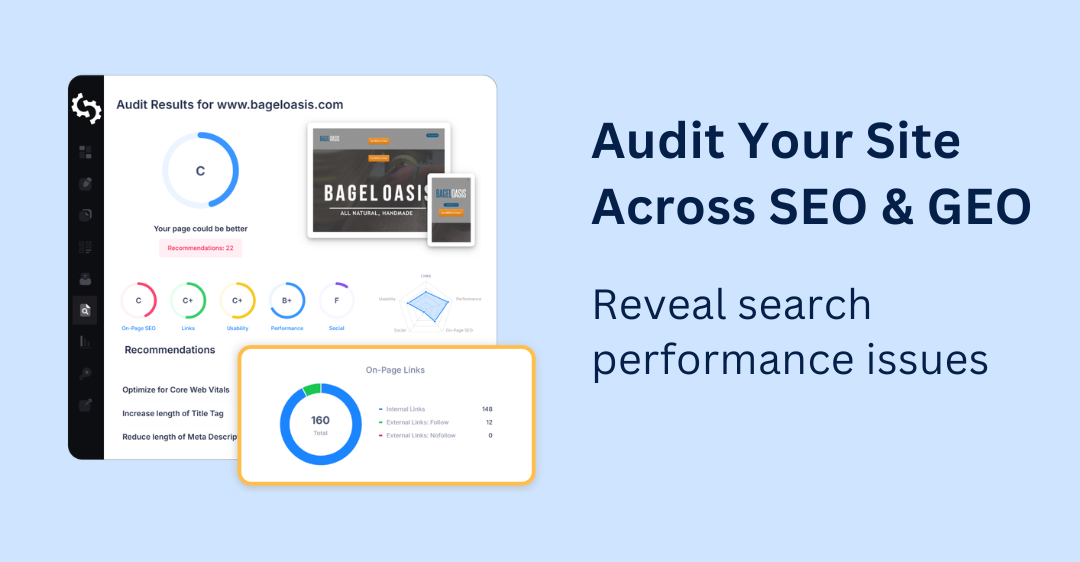
4. Technical SEO Audits
Technical SEO audits often require checking multiple reports across tools like Google Search Console, site crawlers, and analytics platforms.
With an SEO MCP server, you can ask your AI assistant to surface technical issues across your site without manually reviewing each report.
For example, you could prompt: "Find pages on my site with indexing issues but still receiving impressions in Google Search Console."
The AI can pull data from your connected SEO tools, identify problematic URLs, and explain the potential impact on search performance.
This makes it easier to detect issues such as indexing errors, crawl problems, slow-loading pages, or technical factors that could be affecting rankings.
Google Search Console limits the inspection of batches of URLs using its web interface. Doing it manually on 500 or 1,000 pages takes hours of analyst time every week. With MCP integrated with Search Console API, you send a whole list of URLs, and in minutes you receive indexing status, date of last crawl and covering errors.
- Burkan Bur, Managing Director, Head of SEO at The Ad Firm
Instead of manually investigating each report, the AI highlights the most important issues and suggests what to fix first.
You can also ask the AI to prioritize technical issues based on traffic impact, helping you focus on fixes that will deliver the biggest SEO gains.
Related Reading: SEO Auditing Quick Guide
5. Content Optimization
SEO MCP servers can also help identify opportunities to improve existing content.
By connecting your AI assistant to keyword research tools and Google Search Console data, you can ask it to analyze how a page is currently performing in search.
For example, you might prompt: "Which queries is this page ranking for that are not clearly addressed in the content?"
The AI can analyze keyword data, search intent, and the structure of the top-ranking pages to highlight gaps in your content.
From there, it can recommend practical improvements such as adding new sections, expanding on missing subtopics, improving headings, or including concise answer blocks that better match what users are searching for.
This makes it easier to refine existing pages and strengthen their relevance for the keywords they are already ranking for.
6. Rank Monitoring
SEO MCP servers can also simplify rank monitoring by allowing your AI assistant to analyze keyword position changes across your tracked queries.
Instead of manually reviewing rank tracking dashboards, you can ask the AI to highlight meaningful movements in your keyword rankings.
For example, you could prompt: "Which of my tracked keywords dropped more than 5 positions this week?"
The AI can pull ranking data from your connected rank tracking tools, identify significant changes, and explain what might be driving the movement.
This makes it easier to quickly spot declining keywords, identify pages that are gaining traction, and detect potential ranking opportunities before they have a larger impact on your organic traffic.
You can also ask the AI to summarize ranking trends over time or highlight keywords that are close to breaking into the top results.
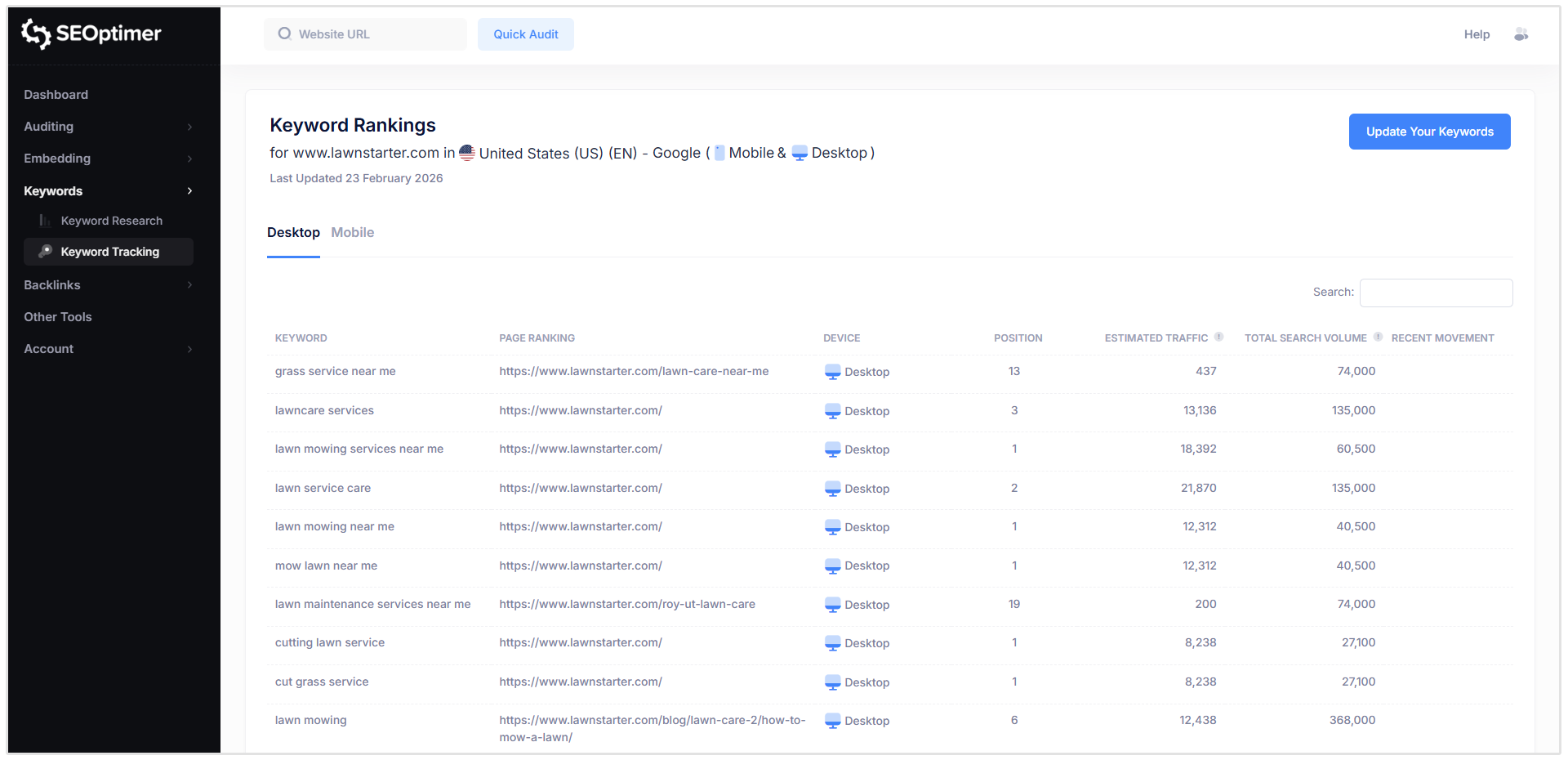
Don't want to use SEO MCP for rank tracking?
Check out SEOptimer's Keyword Tracking tool for monitoring and tracking ranking changes on Google and Bing, as well as Desktop and Mobile devices.
7. AI Search Visibility
Some SEO tools are beginning to track how websites appear in AI-powered search experiences such as ChatGPT, Perplexity, and Google AI Overviews.
If your SEO tool supports this feature and exposes the data through an SEO MCP server, you can ask your AI assistant to analyze your visibility across these AI-driven search platforms.
Related Reading: LLM SEO: How to Get Cited by ChatGPT, Gemini, and Claude
Limitations of SEO MCP Servers
1. Setup Complexity
Most MCP servers still require technical setup, such as configuring API keys, installing connectors, or running local servers. This can be challenging for users without a technical background.
2. Limited Tool Support
Not all SEO tools currently offer MCP integrations. While platforms like Google Search Console, Semrush, and DataForSEO have MCP-compatible solutions, many tools have not yet adopted the protocol.
3. API Costs and Usage Limits
Many MCP servers rely on APIs from SEO platforms. These APIs often have usage limits or costs associated with them, which means heavy data queries can quickly consume API credits.
4. Data Access Permissions
MCP servers can only access data that your connected tools allow. If a dataset isn’t exposed through the API, the AI assistant won’t be able to analyze it.
5. AI Interpretation Limitations
Although AI can analyze large datasets quickly, the insights it generates should still be reviewed by an SEO professional. AI models may occasionally misinterpret data or provide overly simplified recommendations.
AI Agents and the Future of SEO MCP
One of the most interesting developments around MCP is the rise of AI agents.
Instead of only answering individual questions, AI agents can continuously monitor data, perform tasks, and generate insights automatically.
Because MCP servers give AI assistants direct access to SEO tools and datasets, they create the foundation for more autonomous SEO workflows.
In the future, AI agents could monitor ranking changes, detect technical issues, analyze competitor activity, and surface optimization opportunities without needing a manual prompt each time.
Rather than replacing SEO professionals, these systems are likely to handle repetitive analysis tasks, allowing teams to focus more on strategy and decision-making.
As more SEO platforms adopt MCP integrations, agent-driven workflows could become a standard part of modern SEO operations.
Start Using SEO MCP Today
MCP servers won't replace SEO strategy, but they will change how fast and effective you execute it.
The tools above remove the repetitive, time-consuming parts of data analysis so you can focus on decisions that actually move the needle and your business forward.
Start by picking one MCP server that connects to a tool you already use every day and run your first natural language query.
Once you see how much faster the answers come, you'll see why these tools are so helpful.
SEO MCP Frequent Asked Questions (FAQ)
What does MCP stand for?
MCP stands for Model Context Protocol, an open standard introduced by Anthropic that allows AI assistants to communicate with external software through standardized connectors called MCP servers.
How is MCP different from traditional SEO APIs?
Traditional SEO APIs require developers to manually write code to request and process data from SEO tools. MCP servers provide a standardized interface that allows AI assistants to access and analyze this data automatically through natural language queries.
How do MCP servers work?
MCP servers act as intermediaries between AI assistants and external tools. When you ask a question, the AI identifies the appropriate tool, retrieves the relevant data through the MCP server, and returns the results in a structured response.
Are SEO MPC tools free?
Some SEO MCP servers are open source or free to use, but many rely on data from SEO platforms that require paid subscriptions or API usage credits. The cost will depend on the tool you connect and the amount of data you query.